QUESTION IMAGE
Question
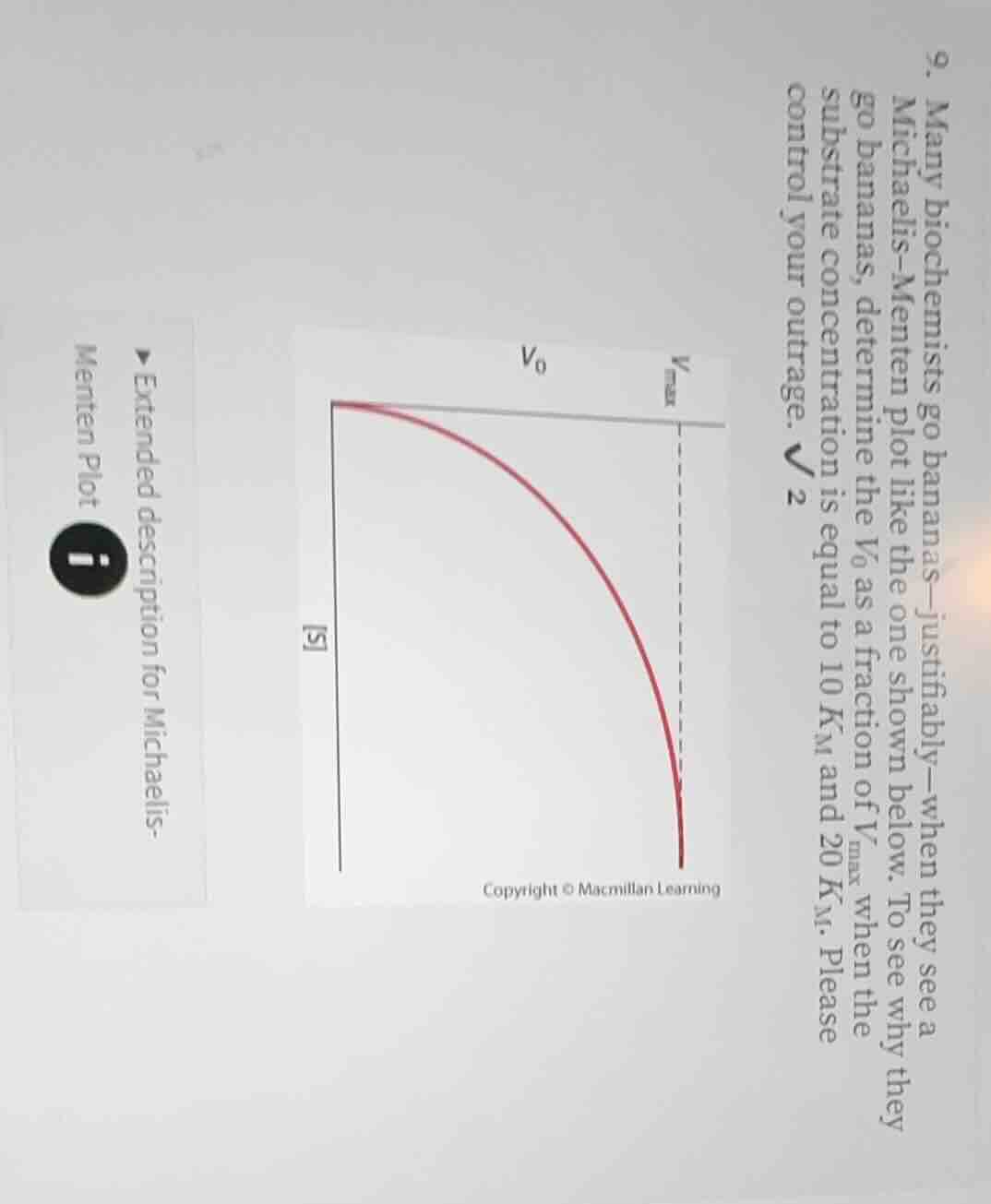
- many biochemists go bananas—justifiably—when they see a michaelis–menten plot like the one shown below. to see why they go bananas, determine the ( v_0 ) as a fraction of ( v_{\text{max}} ) when the substrate concentration is equal to ( 10 k_m ) and ( 20 k_m ). please control your outrage. (\boldsymbol{sqrt{2}}) extended description for michaelis-menten plot
Step1: Recall Michaelis-Menten equation
The Michaelis-Menten equation is:
$$V_0 = \frac{V_{max} [S]}{K_M + [S]}$$
To find $V_0$ as a fraction of $V_{max}$, rearrange to get $\frac{V_0}{V_{max}} = \frac{[S]}{K_M + [S]}$
Step2: Calculate for $[S] = 10K_M$
Substitute $[S] = 10K_M$ into the fraction:
$$\frac{V_0}{V_{max}} = \frac{10K_M}{K_M + 10K_M} = \frac{10K_M}{11K_M} = \frac{10}{11}$$
Step3: Calculate for $[S] = 20K_M$
Substitute $[S] = 20K_M$ into the fraction:
$$\frac{V_0}{V_{max}} = \frac{20K_M}{K_M + 20K_M} = \frac{20K_M}{21K_M} = \frac{20}{21}$$

Snap & solve any problem in the app
Get step-by-step solutions on Sovi AI
Photo-based solutions with guided steps
Explore more problems and detailed explanations
When $[S] = 10K_M$, $V_0 = \frac{10}{11}V_{max}$; when $[S] = 20K_M$, $V_0 = \frac{20}{21}V_{max}$