QUESTION IMAGE
Question
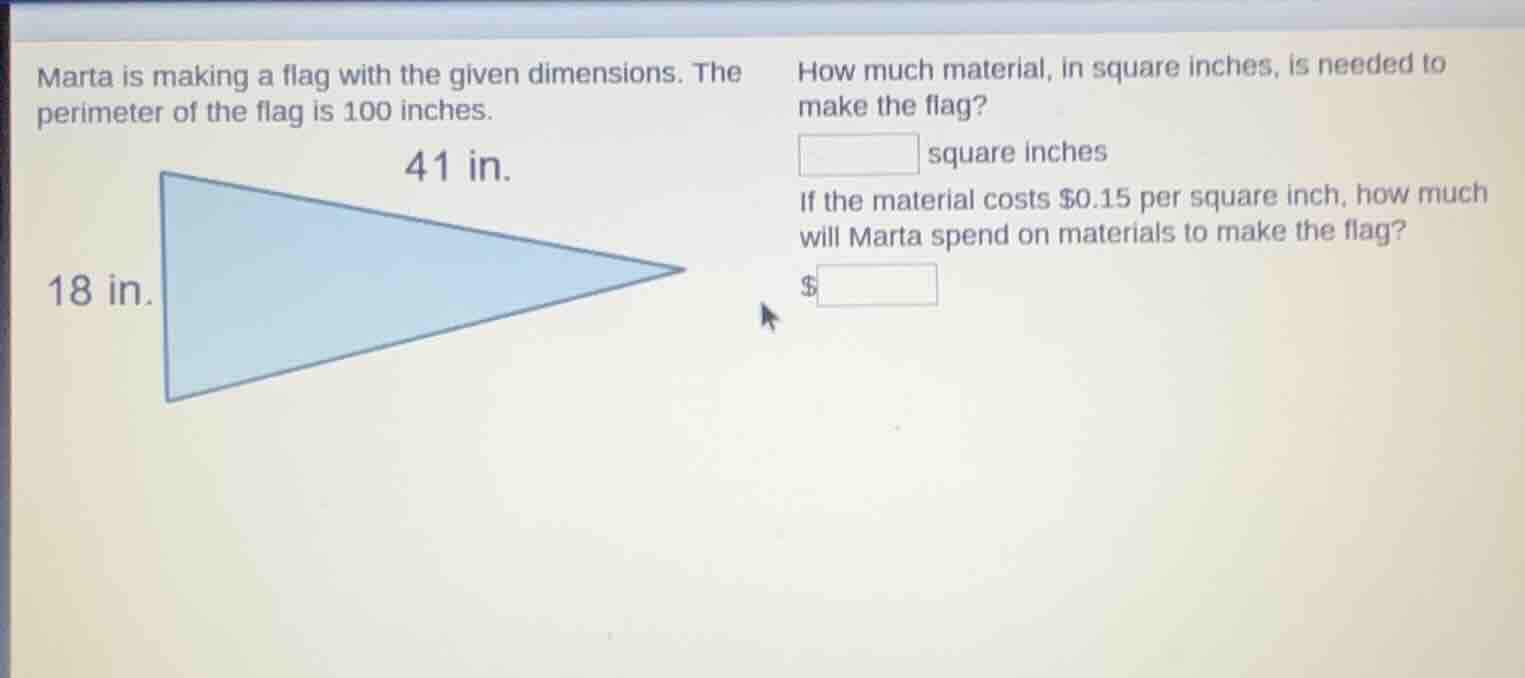
marta is making a flag with the given dimensions. the perimeter of the flag is 100 inches.
41 in.
18 in.
how much material, in square inches, is needed to make the flag?
square inches
if the material costs $0.15 per square inch, how much will marta spend on materials to make the flag?
$
Part 1: Find the area of the triangular flag
Step 1: Find the third side of the triangle
The perimeter of a triangle is the sum of its three sides. Let the third side be \( x \). We know the perimeter is 100 inches, one side is 41 inches, and another is 18 inches. So, \( 18 + 41 + x = 100 \). Solving for \( x \): \( x = 100 - 18 - 41 = 41 \) inches. Wait, no, wait. Wait, the triangle: wait, maybe it's a triangle with two sides? Wait, no, the flag is a triangle. Wait, maybe the 18 in is the height? Wait, no, the perimeter is 100. Wait, the given sides are 18 in, 41 in, and we need to find the third side. Wait, perimeter \( P = a + b + c \). So \( 100 = 18 + 41 + c \), so \( c = 100 - 18 - 41 = 41 \). Wait, but then if two sides are 41, it's an isoceles triangle? Wait, no, maybe the 18 is the height? Wait, no, the problem says "the flag" is a triangle. Wait, maybe the 18 is the height, and the base? Wait, no, the perimeter is 100. Wait, perhaps I made a mistake. Wait, no, let's re-examine. The flag is a triangle. The perimeter is 100 inches. Two sides are 18 in and 41 in. So the third side is \( 100 - 18 - 41 = 41 \) inches. Wait, so the triangle has sides 18, 41, 41. Wait, but then, to find the area of a triangle, we can use \( \text{Area} = \frac{1}{2} \times \text{base} \times \text{height} \). Wait, maybe the 18 is the height, and the base is the third side? Wait, no, maybe the 18 is one of the legs, and the triangle is a triangle where we can find the base. Wait, no, perhaps the triangle is a triangle with base equal to the third side we found, and height 18? Wait, no, let's think again. Wait, maybe the 18 is the height, and the base is the side we found. Wait, no, let's calculate the third side first. Perimeter is 100, so third side \( c = 100 - 18 - 41 = 41 \). So the triangle has sides 18, 41, 41. Wait, but then, if we take 18 as the height, and the base as the side opposite? Wait, no, maybe the 18 is the height, and the base is the side that's not 41? Wait, no, this is confusing. Wait, maybe the triangle is a triangle where the two equal sides are 41, and the base is 18? No, that can't be, because 18 + 41 + 41 = 100. Yes! So the triangle has two sides of 41 inches (the equal sides) and a base of 18 inches. Wait, no, 18 + 41 + 41 = 100. Yes, that adds up. So the base is 18 inches, and the height? Wait, no, to find the area, we need the base and the height. Wait, maybe the 18 is the height, and the base is the third side? Wait, no, I think I messed up. Wait, maybe the triangle is a right triangle? No, the problem doesn't say it's a right triangle. Wait, wait, maybe the 18 is the height, and the base is the side we found (41)? No, that doesn't make sense. Wait, no, let's start over.
Wait, the flag is a triangle. Perimeter is 100 inches. Two sides are 18 in and 41 in. So the third side is \( 100 - 18 - 41 = 41 \) inches. So the triangle has sides 18, 41, 41. So it's an isoceles triangle with two sides 41 and base 18. To find the area, we can use the formula for the area of a triangle: \( \text{Area} = \frac{1}{2} \times \text{base} \times \text{height} \). We need to find the height. Let's split the isoceles triangle into two right triangles by drawing the height from the apex to the base. This height will bisect the base (since it's isoceles). So the base of each right triangle is \( \frac{18}{2} = 9 \) inches, the hypotenuse is 41 inches, and the height \( h \) can be found using the Pythagorean theorem: \( h^2 + 9^2 = 41^2 \). So \( h^2 = 41^2 - 9^2 = 1681 - 81 = 1600 \), so \( h = \sqrt{1600} = 40 \) inches. Ah, there we go. So the height is 40 inches, and the base i…
Step 1: Calculate the total cost
The material costs $0.15 per square inch. The area is 360 square inches. So the total cost is \( \text{Cost} = \text{Area} \times \text{Cost per square inch} \). Plugging in the values: \( \text{Cost} = 360 \times 0.15 \).
Step 2: Compute the cost
\( 360 \times 0.15 = 54 \) dollars.

Snap & solve any problem in the app
Get step-by-step solutions on Sovi AI
Photo-based solutions with guided steps
Explore more problems and detailed explanations
(Part 1): 360