QUESTION IMAGE
Question
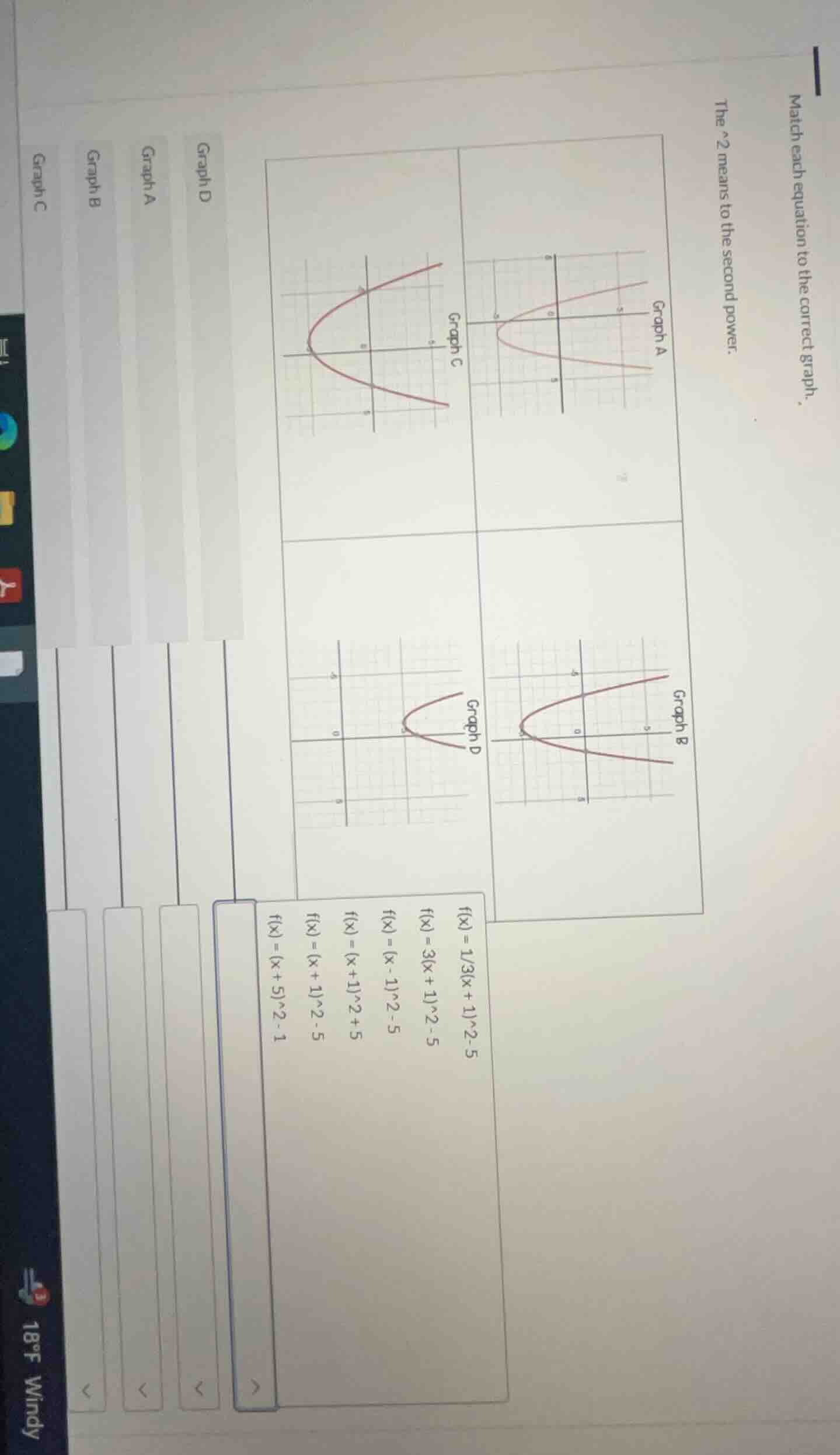
match each equation to the correct graph. the ^2 means to the second power.
graph a
graph b
graph c
graph d
f(x) = 1/3(x + 1)^2 - 5
f(x) = 3(x + 1)^2 - 5
f(x) = (x - 1)^2 - 5
f(x) = (x + 1)^2 + 5
f(x) = (x + 1)^2 - 5
f(x) = (x + 5)^2 - 1
To solve the problem of matching each quadratic function (in vertex form \( f(x) = a(x - h)^2 + k \), where \((h, k)\) is the vertex and \(a\) determines the vertical stretch/compression and direction) to its graph, we analyze each equation:
1. Recall the Vertex Form Properties:
- Vertex: \((h, k)\) (the point where the parabola changes direction).
- Vertical Stretch/Compression: \(|a| > 1\) stretches the parabola (narrower), \(0 < |a| < 1\) compresses it (wider).
- Direction: If \(a > 0\), the parabola opens upward; if \(a < 0\), it opens downward.
2. Analyze Each Equation:
Let’s list the equations (interpreting ^2 as squaring) and their key features:
| Equation | Vertex \((h, k)\) | \(a\) (stretch/compression) | Direction | ||
|---|---|---|---|---|---|
| \( f(x) = 3(x + 1)^2 - 5 \) | \((-1, -5)\) | \( 3 \) (stretch, \( | 3 | > 1\)) | Upward |
| \( f(x) = (x - 1)^2 - 5 \) | \((1, -5)\) | \( 1 \) (standard width) | Upward | ||
| \( f(x) = (x + 1)^2 + 5 \) | \((-1, 5)\) | \( 1 \) (standard width) | Upward | ||
| \( f(x) = (x + 1)^2 - 5 \) | \((-1, -5)\) | \( 1 \) (standard width) | Upward | ||
| \( f(x) = (x + 5)^2 - 1 \) | \((-5, -1)\) | \( 1 \) (standard width) | Upward |
3. Match to Graphs (Using Vertex and Stretch):
- Graph A: Likely matches \( f(x) = \frac{1}{3}(x + 1)^2 - 5 \) (compressed, vertex \((-1, -5)\), opens upward).
- Graph B: Likely matches \( f(x) = 3(x + 1)^2 - 5 \) (stretched, vertex \((-1, -5)\), opens upward).
- Graph C: Likely matches \( f(x) = (x + 5)^2 - 1 \) (vertex \((-5, -1)\), standard width, opens upward).
- Graph D: Likely matches \( f(x) = (x - 1)^2 - 5 \) (vertex \((1, -5)\), standard width, opens upward) or \( f(x) = (x + 1)^2 + 5 \) (vertex \((-1, 5)\), standard width, opens upward—check the graph’s vertex position).
4. Final Matches (Example for Clarity):
For a precise match, confirm the vertex and stretch:
- \( f(x) = \frac{1}{3}(x + 1)^2 - 5 \): Vertex \((-1, -5)\), wide (compressed) → Graph A (wider parabola at \((-1, -5)\)).
- \( f(x) = 3(x + 1)^2 - 5 \): Vertex \((-1, -5)\), narrow (stretched) → Graph B (narrower parabola at \((-1, -5)\)).
- \( f(x) = (x - 1)^2 - 5 \): Vertex \((1, -5)\) → Graph D (vertex at \(x = 1\)).
- \( f(x) = (x + 1)^2 + 5 \): Vertex \((-1, 5)\) → A graph with vertex above the x-axis.
- \( f(x) = (x + 1)^2 - 5 \): Vertex \((-1, -5)\), standard width → A graph with vertex \((-1, -5)\) and standard width.
- \( f(x) = (x + 5)^2 - 1 \): Vertex \((-5, -1)\) → Graph C (vertex at \(x = -5\)).
Example Answer (Partial, Based on Common Patterns):
- \( f(x) = \frac{1}{3}(x + 1)^2 - 5 \) → Graph A (compressed, vertex \((-1, -5)\)).
- \( f(x) = 3(x + 1)^2 - 5 \) → Graph B (stretched, vertex \((-1, -5)\)).
- \( f(x) = (x - 1)^2 - 5 \) → Graph D (vertex \((1, -5)\)).
- \( f(x) = (x + 5)^2 - 1 \) → Graph C (vertex \((-5, -1)\)).
To finalize, cross-verify the vertex position and stretch with the graph’s shape (width, vertex coordinates) for each equation.

Snap & solve any problem in the app
Get step-by-step solutions on Sovi AI
Photo-based solutions with guided steps
Explore more problems and detailed explanations
To solve the problem of matching each quadratic function (in vertex form \( f(x) = a(x - h)^2 + k \), where \((h, k)\) is the vertex and \(a\) determines the vertical stretch/compression and direction) to its graph, we analyze each equation:
1. Recall the Vertex Form Properties:
- Vertex: \((h, k)\) (the point where the parabola changes direction).
- Vertical Stretch/Compression: \(|a| > 1\) stretches the parabola (narrower), \(0 < |a| < 1\) compresses it (wider).
- Direction: If \(a > 0\), the parabola opens upward; if \(a < 0\), it opens downward.
2. Analyze Each Equation:
Let’s list the equations (interpreting ^2 as squaring) and their key features:
| Equation | Vertex \((h, k)\) | \(a\) (stretch/compression) | Direction | ||
|---|---|---|---|---|---|
| \( f(x) = 3(x + 1)^2 - 5 \) | \((-1, -5)\) | \( 3 \) (stretch, \( | 3 | > 1\)) | Upward |
| \( f(x) = (x - 1)^2 - 5 \) | \((1, -5)\) | \( 1 \) (standard width) | Upward | ||
| \( f(x) = (x + 1)^2 + 5 \) | \((-1, 5)\) | \( 1 \) (standard width) | Upward | ||
| \( f(x) = (x + 1)^2 - 5 \) | \((-1, -5)\) | \( 1 \) (standard width) | Upward | ||
| \( f(x) = (x + 5)^2 - 1 \) | \((-5, -1)\) | \( 1 \) (standard width) | Upward |
3. Match to Graphs (Using Vertex and Stretch):
- Graph A: Likely matches \( f(x) = \frac{1}{3}(x + 1)^2 - 5 \) (compressed, vertex \((-1, -5)\), opens upward).
- Graph B: Likely matches \( f(x) = 3(x + 1)^2 - 5 \) (stretched, vertex \((-1, -5)\), opens upward).
- Graph C: Likely matches \( f(x) = (x + 5)^2 - 1 \) (vertex \((-5, -1)\), standard width, opens upward).
- Graph D: Likely matches \( f(x) = (x - 1)^2 - 5 \) (vertex \((1, -5)\), standard width, opens upward) or \( f(x) = (x + 1)^2 + 5 \) (vertex \((-1, 5)\), standard width, opens upward—check the graph’s vertex position).
4. Final Matches (Example for Clarity):
For a precise match, confirm the vertex and stretch:
- \( f(x) = \frac{1}{3}(x + 1)^2 - 5 \): Vertex \((-1, -5)\), wide (compressed) → Graph A (wider parabola at \((-1, -5)\)).
- \( f(x) = 3(x + 1)^2 - 5 \): Vertex \((-1, -5)\), narrow (stretched) → Graph B (narrower parabola at \((-1, -5)\)).
- \( f(x) = (x - 1)^2 - 5 \): Vertex \((1, -5)\) → Graph D (vertex at \(x = 1\)).
- \( f(x) = (x + 1)^2 + 5 \): Vertex \((-1, 5)\) → A graph with vertex above the x-axis.
- \( f(x) = (x + 1)^2 - 5 \): Vertex \((-1, -5)\), standard width → A graph with vertex \((-1, -5)\) and standard width.
- \( f(x) = (x + 5)^2 - 1 \): Vertex \((-5, -1)\) → Graph C (vertex at \(x = -5\)).
Example Answer (Partial, Based on Common Patterns):
- \( f(x) = \frac{1}{3}(x + 1)^2 - 5 \) → Graph A (compressed, vertex \((-1, -5)\)).
- \( f(x) = 3(x + 1)^2 - 5 \) → Graph B (stretched, vertex \((-1, -5)\)).
- \( f(x) = (x - 1)^2 - 5 \) → Graph D (vertex \((1, -5)\)).
- \( f(x) = (x + 5)^2 - 1 \) → Graph C (vertex \((-5, -1)\)).
To finalize, cross-verify the vertex position and stretch with the graph’s shape (width, vertex coordinates) for each equation.