QUESTION IMAGE
Question
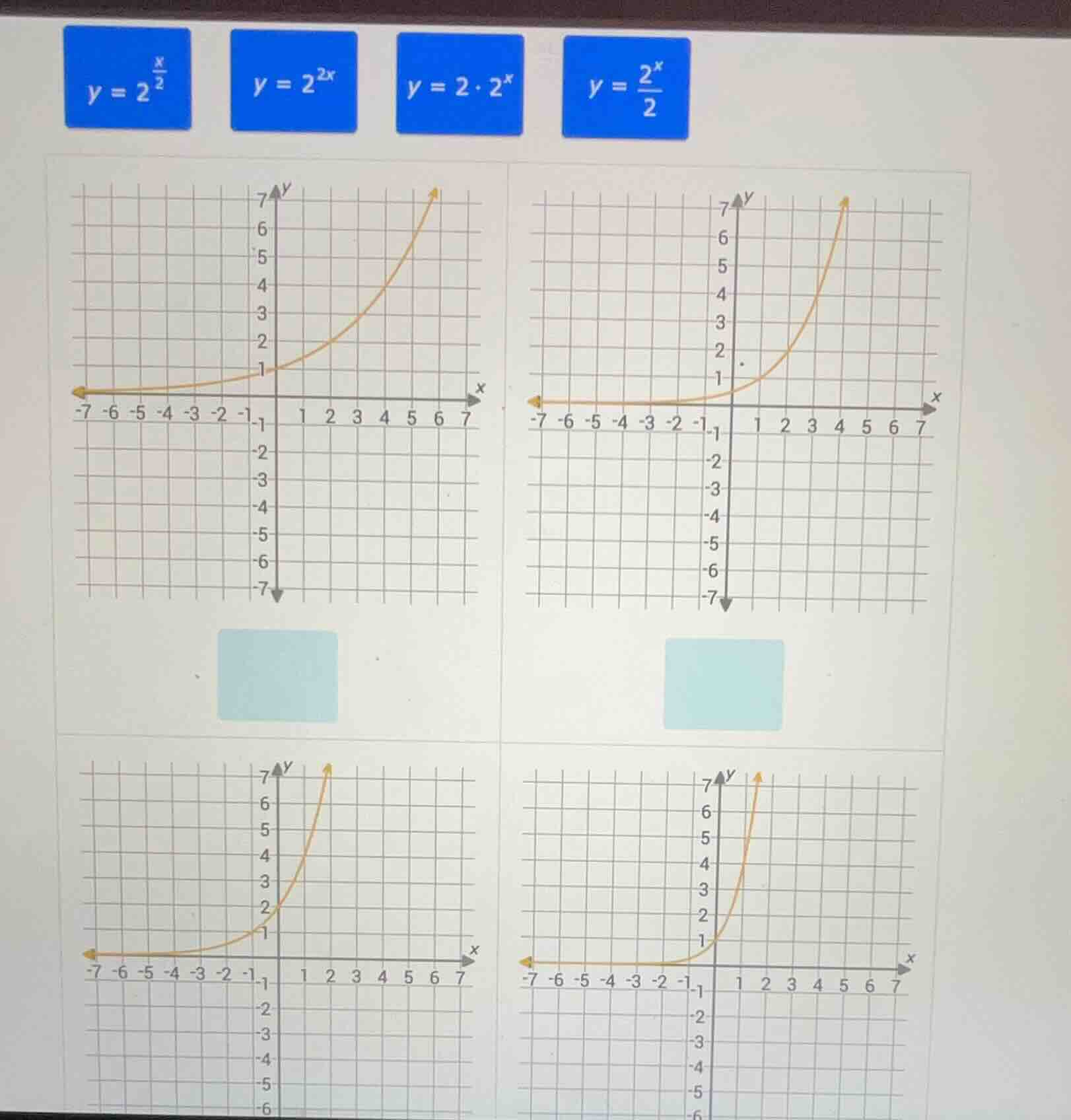
match the exponential functions ( y = 2^{\frac{x}{2}} ), ( y = 2^{2x} ), ( y = 2cdot 2^{x} ), ( y = \frac{2^{x}}{2} ) with their corresponding graphs (four graphs are provided on a coordinate grid).
Response
To solve the problem of matching the exponential functions to their graphs, we analyze each function's key features (y - intercept, growth rate) and compare them with the graphs:
1. Analyze \( y = 2^{\frac{x}{2}} \)
- Simplify the function: Using the exponent rule \( a^{mn}=(a^m)^n \), we can rewrite \( y = 2^{\frac{x}{2}}=(2^{\frac{1}{2}})^x=\sqrt{2}^x\approx1.414^x \).
- Find the y - intercept: Substitute \( x = 0 \) into the function. When \( x = 0 \), \( y=2^{\frac{0}{2}}=2^0 = 1 \).
- Growth rate: The base \( \sqrt{2}\approx1.414 \) is greater than 1, so the function is an exponential growth function. The growth rate is relatively slow compared to functions with larger bases.
- Match with the graph: The first graph (top - left) has a y - intercept of 1 and a relatively slow growth rate, so \( y = 2^{\frac{x}{2}} \) matches the top - left graph.
2. Analyze \( y = 2^{2x} \)
- Simplify the function: Using the exponent rule \( a^{mn}=(a^m)^n \), we can rewrite \( y = 2^{2x}=(2^{2})^x = 4^x \).
- Find the y - intercept: Substitute \( x = 0 \) into the function. When \( x = 0 \), \( y = 2^{2\times0}=2^0=1 \).
- Growth rate: The base \( 4>1 \), so the function is an exponential growth function. The growth rate is relatively fast because the base 4 is larger than the bases of the other exponential growth functions (except maybe when compared to functions with vertical stretches).
- Match with the graph: The bottom - right graph has a relatively fast growth rate and a y - intercept of 1, so \( y = 2^{2x} \) matches the bottom - right graph.
3. Analyze \( y = 2\cdot2^{x} \)
- Simplify the function: Using the exponent rule \( a^m\times a^n=a^{m + n} \), we can rewrite \( y = 2\cdot2^{x}=2^{x + 1} \).
- Find the y - intercept: Substitute \( x = 0 \) into the function. When \( x = 0 \), \( y=2\times2^{0}=2\times1 = 2 \).
- Growth rate: The base \( 2>1 \), so the function is an exponential growth function. The y - intercept of 2 is a key feature.
- Match with the graph: The bottom - left graph has a y - intercept of 2 and is an exponential growth function, so \( y = 2\cdot2^{x} \) matches the bottom - left graph.
4. Analyze \( y=\frac{2^{x}}{2} \)
- Simplify the function: Using the exponent rule \( \frac{a^m}{a^n}=a^{m - n} \), we can rewrite \( y=\frac{2^{x}}{2}=2^{x-1} \).
- Find the y - intercept: Substitute \( x = 0 \) into the function. When \( x = 0 \), \( y=\frac{2^{0}}{2}=\frac{1}{2}=0.5 \).
- Growth rate: The base \( 2>1 \), so the function is an exponential growth function. The y - intercept of 0.5 (or \( \frac{1}{2} \)) is a key feature.
- Match with the graph: The top - right graph has a y - intercept of approximately 0.5 (it crosses the y - axis between 0 and 1) and is an exponential growth function, so \( y=\frac{2^{x}}{2} \) matches the top - right graph.
Final Matches:
- \( y = 2^{\frac{x}{2}} \): Top - left graph
- \( y = 2^{2x} \): Bottom - right graph
- \( y = 2\cdot2^{x} \): Bottom - left graph
- \( y=\frac{2^{x}}{2} \): Top - right graph

Snap & solve any problem in the app
Get step-by-step solutions on Sovi AI
Photo-based solutions with guided steps
Explore more problems and detailed explanations
To solve the problem of matching the exponential functions to their graphs, we analyze each function's key features (y - intercept, growth rate) and compare them with the graphs:
1. Analyze \( y = 2^{\frac{x}{2}} \)
- Simplify the function: Using the exponent rule \( a^{mn}=(a^m)^n \), we can rewrite \( y = 2^{\frac{x}{2}}=(2^{\frac{1}{2}})^x=\sqrt{2}^x\approx1.414^x \).
- Find the y - intercept: Substitute \( x = 0 \) into the function. When \( x = 0 \), \( y=2^{\frac{0}{2}}=2^0 = 1 \).
- Growth rate: The base \( \sqrt{2}\approx1.414 \) is greater than 1, so the function is an exponential growth function. The growth rate is relatively slow compared to functions with larger bases.
- Match with the graph: The first graph (top - left) has a y - intercept of 1 and a relatively slow growth rate, so \( y = 2^{\frac{x}{2}} \) matches the top - left graph.
2. Analyze \( y = 2^{2x} \)
- Simplify the function: Using the exponent rule \( a^{mn}=(a^m)^n \), we can rewrite \( y = 2^{2x}=(2^{2})^x = 4^x \).
- Find the y - intercept: Substitute \( x = 0 \) into the function. When \( x = 0 \), \( y = 2^{2\times0}=2^0=1 \).
- Growth rate: The base \( 4>1 \), so the function is an exponential growth function. The growth rate is relatively fast because the base 4 is larger than the bases of the other exponential growth functions (except maybe when compared to functions with vertical stretches).
- Match with the graph: The bottom - right graph has a relatively fast growth rate and a y - intercept of 1, so \( y = 2^{2x} \) matches the bottom - right graph.
3. Analyze \( y = 2\cdot2^{x} \)
- Simplify the function: Using the exponent rule \( a^m\times a^n=a^{m + n} \), we can rewrite \( y = 2\cdot2^{x}=2^{x + 1} \).
- Find the y - intercept: Substitute \( x = 0 \) into the function. When \( x = 0 \), \( y=2\times2^{0}=2\times1 = 2 \).
- Growth rate: The base \( 2>1 \), so the function is an exponential growth function. The y - intercept of 2 is a key feature.
- Match with the graph: The bottom - left graph has a y - intercept of 2 and is an exponential growth function, so \( y = 2\cdot2^{x} \) matches the bottom - left graph.
4. Analyze \( y=\frac{2^{x}}{2} \)
- Simplify the function: Using the exponent rule \( \frac{a^m}{a^n}=a^{m - n} \), we can rewrite \( y=\frac{2^{x}}{2}=2^{x-1} \).
- Find the y - intercept: Substitute \( x = 0 \) into the function. When \( x = 0 \), \( y=\frac{2^{0}}{2}=\frac{1}{2}=0.5 \).
- Growth rate: The base \( 2>1 \), so the function is an exponential growth function. The y - intercept of 0.5 (or \( \frac{1}{2} \)) is a key feature.
- Match with the graph: The top - right graph has a y - intercept of approximately 0.5 (it crosses the y - axis between 0 and 1) and is an exponential growth function, so \( y=\frac{2^{x}}{2} \) matches the top - right graph.
Final Matches:
- \( y = 2^{\frac{x}{2}} \): Top - left graph
- \( y = 2^{2x} \): Bottom - right graph
- \( y = 2\cdot2^{x} \): Bottom - left graph
- \( y=\frac{2^{x}}{2} \): Top - right graph