QUESTION IMAGE
Question
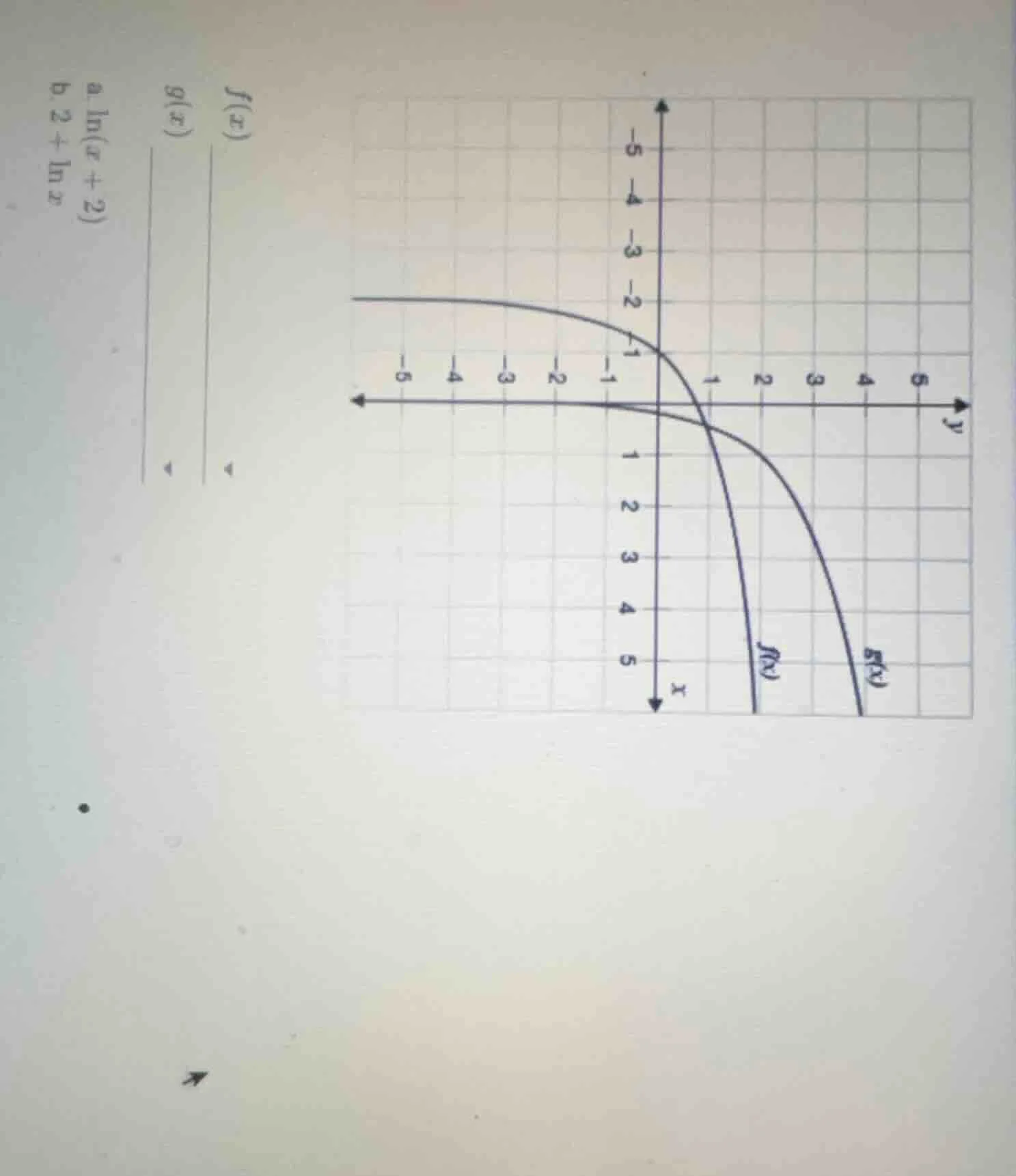
match the functions to the graph:
a. $ln(x + 2)$
b. $2 + ln x$
$f(x)$ ________
$g(x)$ ________
Step1: Identify parent function
The parent function is $y=\ln x$, which has a vertical asymptote at $x=0$ and passes through $(1,0)$.
Step2: Analyze $f(x)$ transformation
$f(x)$ is shifted left 2 units. For a horizontal shift left by $h$ units, the function becomes $\ln(x+h)$. Here $h=2$, so $f(x)=\ln(x+2)$.
Step3: Analyze $g(x)$ transformation
$g(x)$ is shifted down 2 units. For a vertical shift down by $k$ units, the function becomes $\ln x - k$, which is equivalent to $-2+\ln x=2+\ln x$? No, correction: $g(x)$ is $\ln x$ shifted down 2 units? No, wait, the parent $\ln x$ at $x=1$ is 0, $g(x)$ at $x=1$ is -1? No, wait, the graph of $g(x)$ passes through $(1,0)$? No, wait, $f(x)$ passes through $(-1,0)$: $\ln(-1+2)=\ln1=0$, correct. $g(x)$ passes through $(1,0)$? No, $g(x)$ at $x=e^2$ would be 2? No, wait, $g(x)$ is $\ln x$ shifted down? No, $g(x)=\ln x - 2$? No, at $x=1$, $\ln1-2=-2$, but the graph at $x=1$ is -1? Wait no, the axes are swapped: x-axis is vertical, y-axis is horizontal. Oh right! The x-axis is vertical (upwards), y-axis is horizontal (rightwards). So the parent function is $x=\ln y$ (equivalent to $y=e^x$), no, wait, the curve crosses the vertical axis (x-axis) at x=0, y=0? No, the curve crosses the horizontal axis (y-axis) at y=0, x=0? Wait, no, let's reorient:
The horizontal axis is y (right is positive y), vertical axis is x (up is positive x). So the parent function is $x=\ln y$ (so $y=e^x$). Then $f(x)$ (wait no, the functions are $f(x)$ and $g(x)$, so x is the vertical variable, y is the input. So $x=f(y)$, $x=g(y)$.
Wait, the function $a. \ln(x+2)$: if x is the vertical variable, then $x=\ln(y+2)$ (shift left 2 in y, which is horizontal shift left). This matches $f(x)$ (the steeper curve) which has a vertical asymptote at y=-2 (since $y+2>0 \implies y>-2$).
Function $b. 2+\ln x$: $x=2+\ln y$ (shift up 2 in x, vertical shift up). This matches $g(x)$ which is the upper curve, shifted up from the parent $x=\ln y$.
Wait, correcting:
Step1: Reorient axis interpretation
Horizontal axis = $y$ (input), vertical axis = $x$ (output, $x=f(y), x=g(y)$). Parent function: $x=\ln y$ (passes through $(y=1, x=0)$).
Step2: Match $f(x)$ to option
$f(x)$ has asymptote at $y=-2$: $y+2>0$, so $x=\ln(y+2)$, which is $\ln(x+2)$ if we swap variable labels (the problem uses x as input, y as output, so the graph is $y=f(x)$, x is horizontal, y is vertical. I misread axes: horizontal is x, vertical is y. Oh right! The arrow on horizontal is y? No, no, the labels: horizontal axis has arrow to right labeled y, vertical axis up labeled x. So the graph is $x$ as a function of $y$, i.e., $x=f(y)$, $x=g(y)$.
But the options are in terms of x as input: $a. \ln(x+2)$ (y as output: $y=\ln(x+2)$), $b. 2+\ln x$ ($y=2+\ln x$).
For $y=\ln(x+2)$: domain $x>-2$, vertical asymptote $x=-2$, passes through $x=-1, y=0$ (matches the left curve $f(x)$ which crosses (x=-1, y=0)).
For $y=2+\ln x$: domain $x>0$, vertical asymptote $x=0$, passes through $x=1, y=2$? No, wait the graph $g(x)$ crosses (x=1, y=0)? No, $2+\ln1=2$, so that's not matching. Wait no, $y=\ln x - 2$ would pass through (x=1, y=-2), but the option is $2+\ln x$. Wait, the graph's vertical axis is x, horizontal is y, so $x=2+\ln y$ (so $y=e^{x-2}$), which is a shift right of $y=e^x$. The upper curve $g(x)$ is $x=2+\ln y$, which is equivalent to $y=e^{x-2}$, but the option is $2+\ln x$, which is $y=2+\ln x$ (x is input, y output), which is a shift up of $\ln x$.
Wait, the problem says: match $f(x)$ and $g(x)$ to the options a and b.
- Option a: $\ln(x+2)$: this is $\ln x$…

Snap & solve any problem in the app
Get step-by-step solutions on Sovi AI
Photo-based solutions with guided steps
Explore more problems and detailed explanations
$f(x) = \ln(x+2)$
$g(x) = 2+\ln x$