QUESTION IMAGE
Question
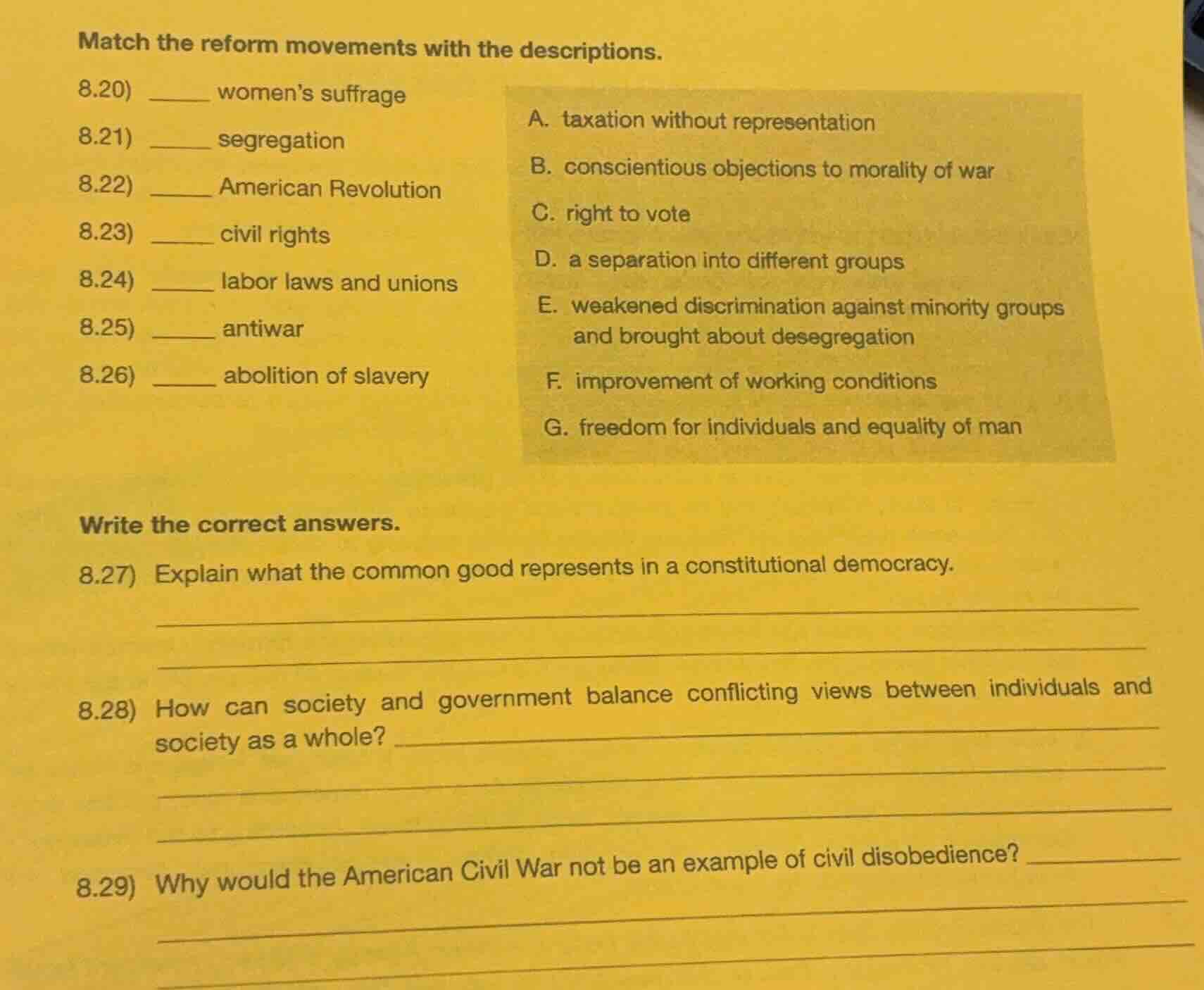
match the reform movements with the descriptions.
8.20) ______ womens suffrage
8.21) ______ segregation
8.22) ______ american revolution
8.23) ______ civil rights
8.24) ______ labor laws and unions
8.25) ______ antiwar
8.26) ______ abolition of slavery
a. taxation without representation
b. conscientious objections to morality of war
c. right to vote
d. a separation into different groups
e. weakened discrimination against minority groups and brought about desegregation
f. improvement of working conditions
g. freedom for individuals and equality of man
write the correct answers.
8.27) explain what the common good represents in a constitutional democracy.
_____________________________________________________________________
_____________________________________________________________________
8.28) how can society and government balance conflicting views between individuals and society as a whole? _____________________________________
_____________________________________________________________________
_____________________________________________________________________
8.29) why would the american civil war not be an example of civil disobedience? _____________________________________________________
_____________________________________________________________________
Matching Section:
- Women's suffrage focused on securing voting rights for women.
- Segregation refers to separating people into distinct groups.
- A core grievance of the American Revolution was being taxed without political representation.
- The civil rights movement fought to reduce discrimination and end segregation.
- Labor laws and unions aimed to make working conditions better.
- Antiwar movements are rooted in moral opposition to war.
- The abolition of slavery centered on securing freedom and equality for enslaved people.
Short Answer Section:
8.27: In a constitutional democracy, the common good is the collective well-being of all members of society, prioritized through policies that protect shared rights, public safety, and equitable access to resources, balancing individual freedoms with community needs.
8.28: This balance can be achieved through democratic processes like open debate, compromise, inclusive policy-making, protecting individual rights via the constitution, and using institutions like courts to mediate conflicts.
8.29: Civil disobedience is nonviolent, individual/group defiance of unjust laws by citizens within an existing government framework. The American Civil War was an armed conflict between two opposing political entities (the Union and Confederacy), not nonviolent citizen resistance to a single governing body's laws.

Snap & solve any problem in the app
Get step-by-step solutions on Sovi AI
Photo-based solutions with guided steps
Explore more problems and detailed explanations
Matching Answers:
8.20) C. right to vote
8.21) D. a separation into different groups
8.22) A. taxation without representation
8.23) E. weakened discrimination against minority groups and brought about desegregation
8.24) F. improvement of working conditions
8.25) B. conscientious objections to morality of war
8.26) G. freedom for individuals and equality of man
Short Answer Answers:
8.27) It is the collective well-being of all society members, achieved by balancing individual freedoms with policies that protect shared rights, public safety, and equitable access to resources for the community as a whole.
8.28) Through democratic processes: open public debate, political compromise, inclusive policy-making, upholding constitutional protections for individual rights, and using impartial judicial systems to mediate conflicts.
8.29) Civil disobedience is nonviolent, citizen-led resistance to specific unjust laws within a single governing system. The American Civil War was an armed, large-scale conflict between two competing political entities (Union and Confederacy), not nonviolent individual/group resistance to an established government's laws.