QUESTION IMAGE
Question
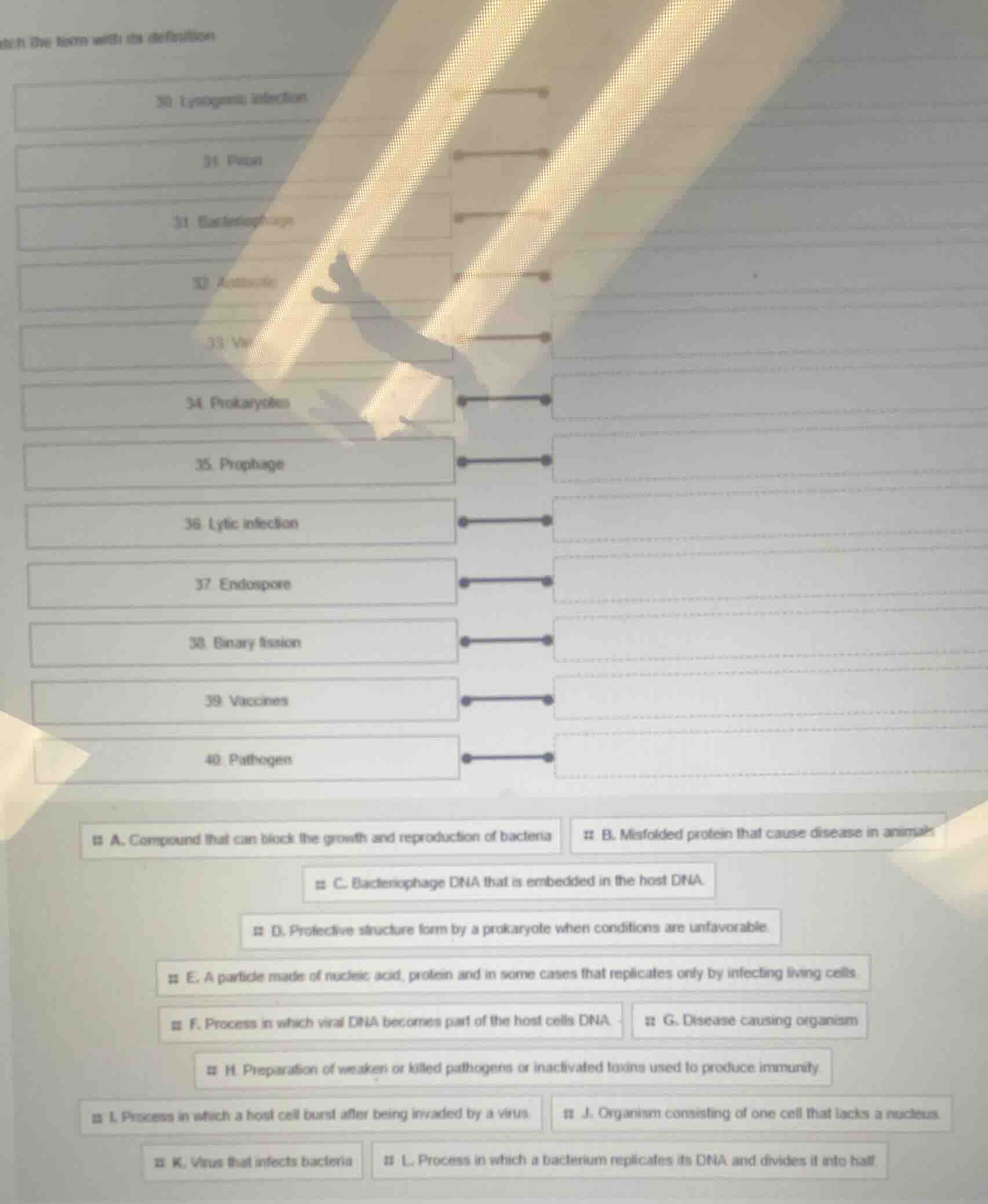
match the terms with its definition
- lysogenic infection
- prion
- bacteriophage
- antibiotic
- virus
- prokaryotes
- prophage
- lytic infection
- endospore
- binary fission
- vaccines
- pathogen
a. compound that can block the growth and reproduction of bacteria
b. misfolded protein that cause disease in animals
c. bacteriophage dna that is embedded in the host dna.
d. protective structure form by a prokaryote when conditions are unfavorable.
e. a particle made of nucleic acid, protein and in some cases that replicates only by infecting living cells.
f. process in which viral dna becomes part of the host cells dna.
g. disease causing organism
h. preparation of weaken or killed pathogens or inactivated toxins used to produce immunity
i. process in which a host cell burst after being invaded by a virus
j. organism consisting of one cell that lacks a nucleus.
k. virus that infects bacteria
l. process in which a bacterium replicates its dna and divides it into half
Each term is matched to its standard biological definition:
- Lysogenic infection is the process where viral DNA integrates into host DNA.
- Prion is a misfolded protein that causes animal disease.
- Bacteriophage is a virus that infects bacteria.
- Antibiotic blocks bacterial growth/reproduction.
- Virus is a particle that replicates only in living cells.
- Prokaryotes are single-celled organisms without a nucleus.
- Prophage is bacteriophage DNA embedded in host DNA.
- Lytic infection causes host cell lysis (bursting).
- Endospore is a protective prokaryotic survival structure.
- Binary fission is bacterial DNA replication and division.
- Vaccines use weakened pathogens to induce immunity.
- Pathogen is a disease-causing organism.

Snap & solve any problem in the app
Get step-by-step solutions on Sovi AI
Photo-based solutions with guided steps
Explore more problems and detailed explanations
- Lysogenic infection - F. Process in which viral DNA becomes part of the host cells DNA.
- Prion - B. Misfolded protein that cause disease in animals
- Bacteriophage - K. Virus that infects bacteria
- Antibiotic - A. Compound that can block the growth and reproduction of bacteria
- Virus - E. A particle made of nucleic acid, protein and in some cases that replicates only by infecting living cells
- Prokaryotes - J. Organism consisting of one cell that lacks a nucleus
- Prophage - C. Bacteriophage DNA that is embedded in the host DNA.
- Lytic infection - I. Process in which a host cell burst after being invaded by a virus
- Endospore - D. Protective structure form by a prokaryote when conditions are unfavorable
- Binary fission - L. Process in which a bacterium replicates its DNA and divides it into half
- Vaccines - H. Preparation of weaken or killed pathogens or inactivated toxins used to produce immunity
- Pathogen - G. Disease causing organism