QUESTION IMAGE
Question
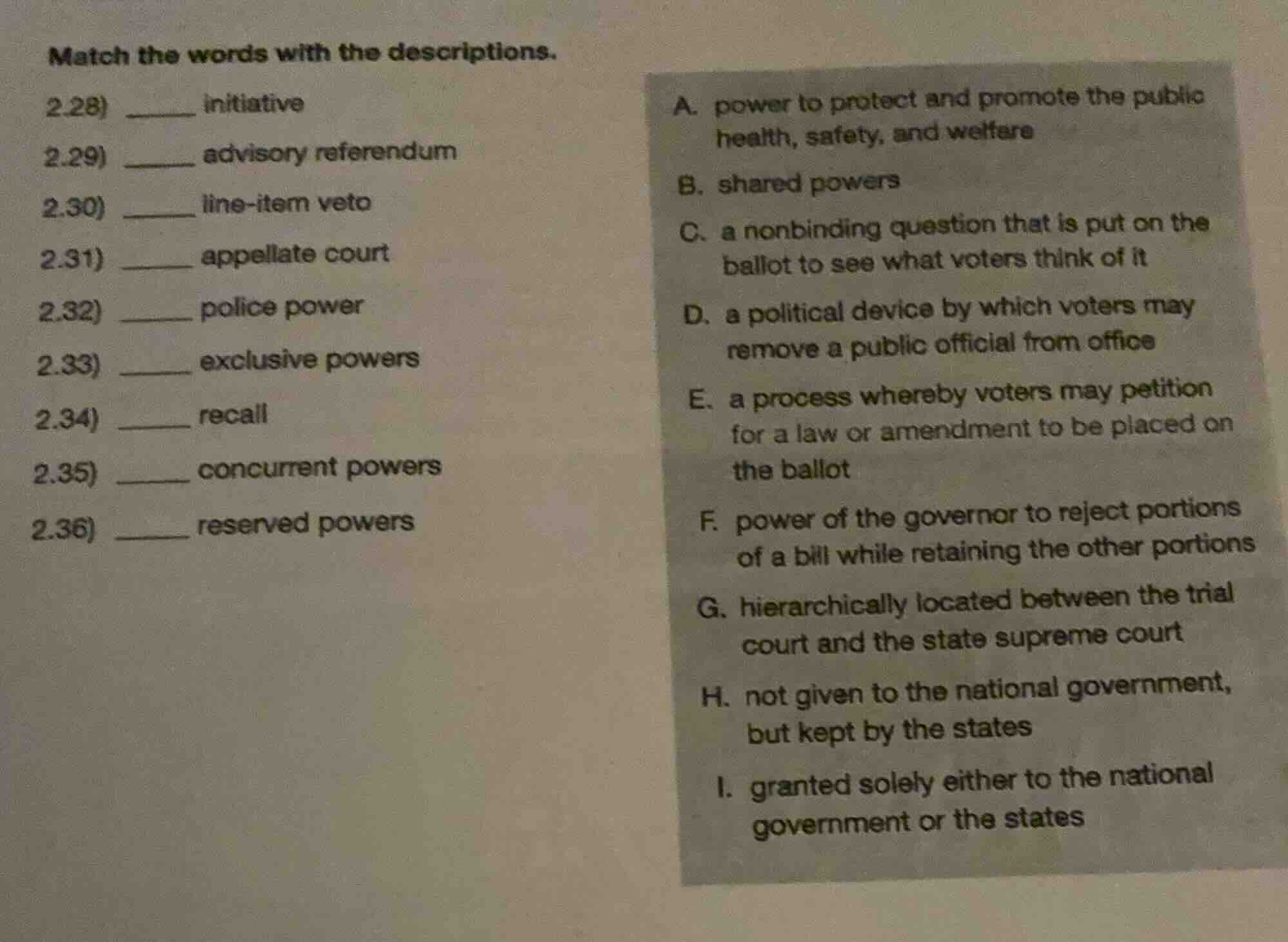
match the words with the descriptions.
2.28) ______ initiative
2.29) ______ advisory referendum
2.30) ______ line - item veto
2.31) ______ appellate court
2.32) ______ police power
2.33) ______ exclusive powers
2.34) ______ recall
2.35) ______ concurrent powers
2.36) ______ reserved powers
a. power to protect and promote the public health, safety, and welfare
b. shared powers
c. a nonbinding question that is put on the ballot to see what voters think of it
d. a political device by which voters may remove a public official from office
e. a process whereby voters may petition for a law or amendment to be placed on the ballot
f. power of the governor to reject portions of a bill while retaining the other portions
g. hierarchically located between the trial court and the state supreme court
h. not given to the national government, but kept by the states
i. granted solely either to the national government or the states
Each term is matched to its standard definition in U.S. government and politics:
- Initiative allows voters to petition for ballot measures.
- Advisory referendums are nonbinding voter opinion questions.
- Line-item veto lets governors reject parts of a bill.
- Appellate courts sit between trial and supreme courts.
- Police power protects public health/safety/welfare.
- Exclusive powers belong solely to one level of government.
- Recall lets voters remove public officials.
- Concurrent powers are shared by levels of government.
- Reserved powers are kept by states, not the national government.

Snap & solve any problem in the app
Get step-by-step solutions on Sovi AI
Photo-based solutions with guided steps
Explore more problems and detailed explanations
2.28) E. a process whereby voters may petition for a law or amendment to be placed on the ballot
2.29) C. a nonbinding question that is put on the ballot to see what voters think of it
2.30) F. power of the governor to reject portions of a bill while retaining the other portions
2.31) G. hierarchically located between the trial court and the state supreme court
2.32) A. power to protect and promote the public health, safety, and welfare
2.33) I. granted solely either to the national government or the states
2.34) D. a political device by which voters may remove a public official from office
2.35) B. shared powers
2.36) H. not given to the national government, but kept by the states