QUESTION IMAGE
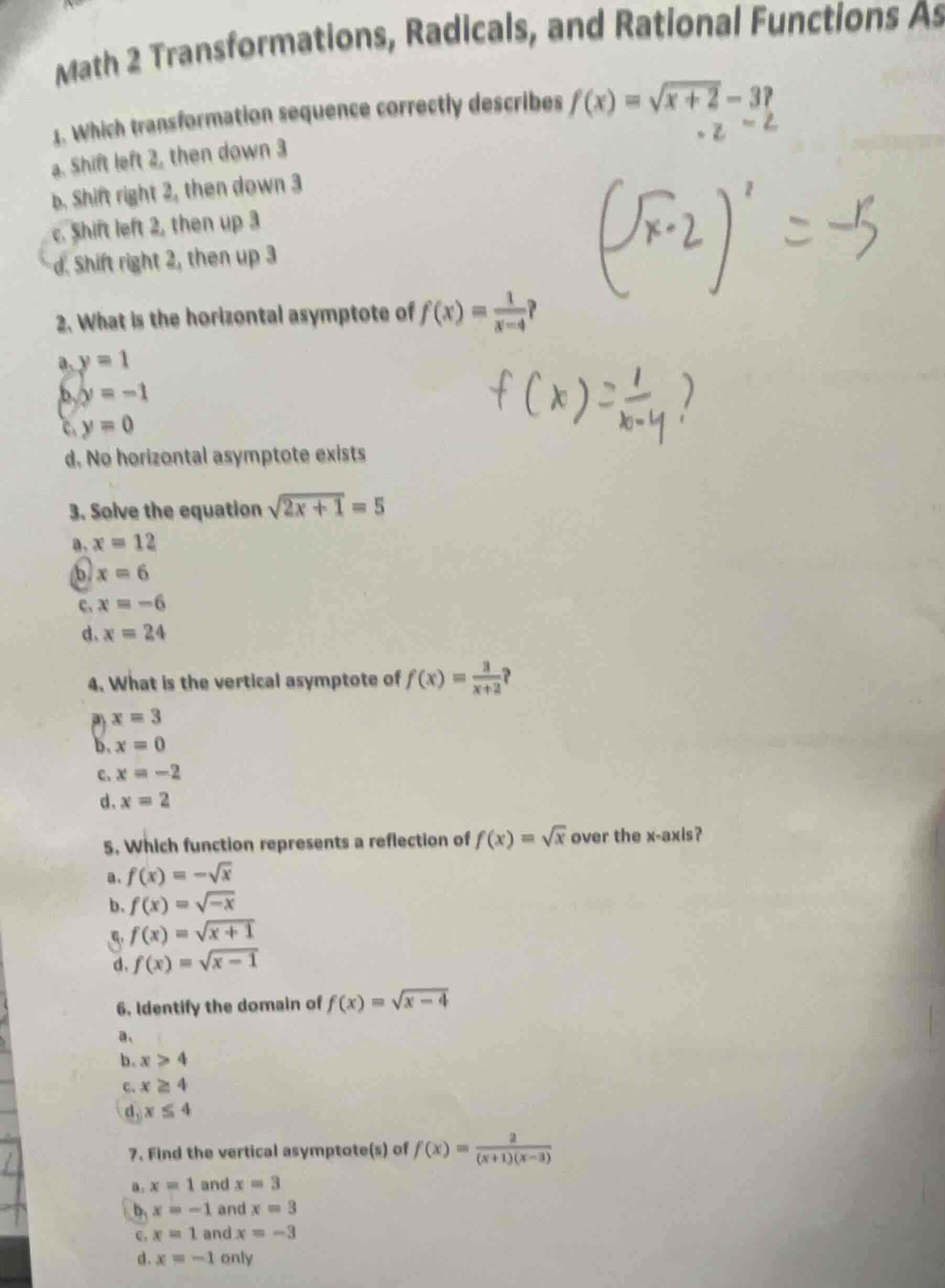
Question
math 2 transformations, radicals, and rational functions as
- which transformation sequence correctly describes $f(x) = \sqrt{x + 2} - 3$?
a. shift left 2, then down 3
b. shift right 2, then down 3
c. shift left 2, then up 3
d. shift right 2, then up 3
- what is the horizontal asymptote of $f(x) = \frac{1}{x - 4}$?
a. $y = 1$
b. $y = -1$
c. $y = 0$
d. no horizontal asymptote exists
- solve the equation $\sqrt{2x + 1} = 5$
a. $x = 12$
b. $x = 6$
c. $x = -6$
d. $x = 24$
- what is the vertical asymptote of $f(x) = \frac{3}{x + 2}$?
a. $x = 3$
b. $x = 0$
c. $x = -2$
d. $x = 2$
- which function represents a reflection of $f(x) = \sqrt{x}$ over the x - axis?
a. $f(x) = -\sqrt{x}$
b. $f(x) = \sqrt{-x}$
c. $f(x) = \sqrt{x + 1}$
d. $f(x) = \sqrt{x - 1}$
- identify the domain of $f(x) = \sqrt{x - 4}$
a.
b. $x > 4$
c. $x \geq 4$
d. $x \leq 4$
- find the vertical asymptote(s) of $f(x) = \frac{2}{(x + 1)(x - 3)}$
a. $x = 1$ and $x = 3$
b. $x = -1$ and $x = 3$
c. $x = 1$ and $x = -3$
d. $x = -1$ only
Question 1
Step1: Recall function transformation rules
For a function \( y = \sqrt{x + h}+k \), horizontal shift: if \( h>0 \), shift left \( h \) units; if \( h<0 \), shift right \( |h| \) units. Vertical shift: if \( k>0 \), shift up \( k \) units; if \( k<0 \), shift down \( |k| \) units.
For \( f(x)=\sqrt{x + 2}-3 \), compare with \( y=\sqrt{x} \). Here \( h = 2 \) (so shift left 2 units) and \( k=-3 \) (so shift down 3 units).
Step1: Recall horizontal asymptote rules for rational functions
For a rational function \( f(x)=\frac{N(x)}{D(x)} \), if the degree of \( N(x) \) is less than the degree of \( D(x) \), the horizontal asymptote is \( y = 0 \).
In \( f(x)=\frac{1}{x - 4} \), degree of numerator (1) is 0, degree of denominator ( \( x-4 \)) is 1. So horizontal asymptote is \( y = 0 \).
Step1: Square both sides to eliminate the square root
Given \( \sqrt{2x + 1}=5 \), square both sides: \( (\sqrt{2x + 1})^2=5^2 \)
Step2: Simplify and solve for x
\( 2x+1 = 25 \)
Subtract 1: \( 2x=25 - 1=24 \)
Divide by 2: \( x=\frac{24}{2}=12 \)? Wait, no, wait the options: Wait, maybe I miscalculated? Wait, no, wait the option a is \( x = 12 \), but the marked option is b. Wait, let's re - check. Wait, \( \sqrt{2x + 1}=5 \), square both sides: \( 2x + 1=25 \), \( 2x=24 \), \( x = 12 \). But the marked option is b (\( x = 6 \)) which is wrong. Wait, maybe a typo? Wait, if the equation was \( \sqrt{2x - 1}=5 \), then \( 2x-1 = 25 \), \( 2x=26 \), \( x = 13 \). No. Wait, maybe the original equation was \( \sqrt{2x+1}= \sqrt{13} \)? No, the given equation is \( \sqrt{2x + 1}=5 \). So correct answer should be a. \( x = 12 \). But the marked option is b. Maybe a mistake in the mark.

Snap & solve any problem in the app
Get step-by-step solutions on Sovi AI
Photo-based solutions with guided steps
Explore more problems and detailed explanations
A. Shift left 2, then down 3