QUESTION IMAGE
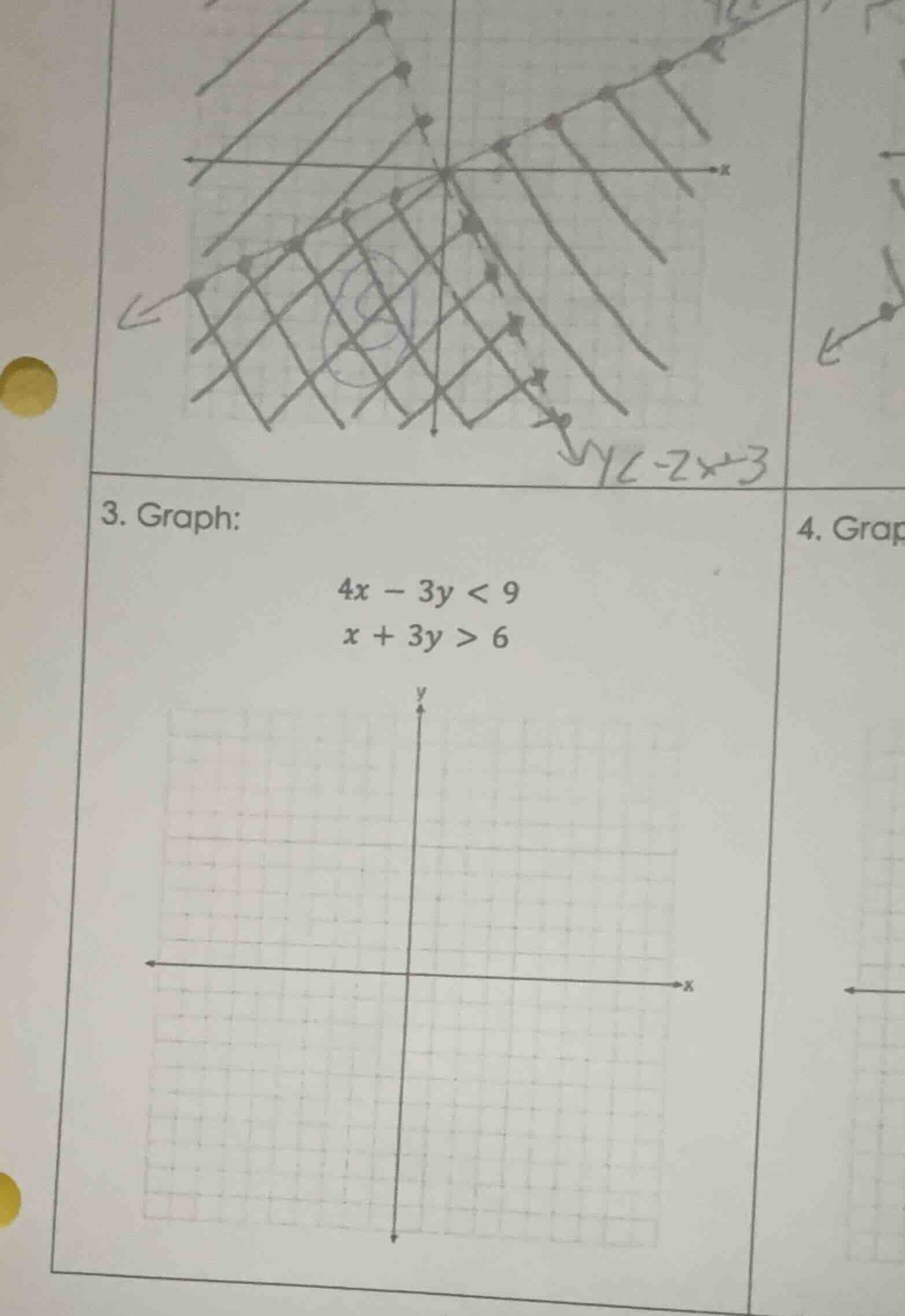
Question
- graph:
$4x - 3y < 9$
$x + 3y > 6$
Step1: Rewrite first inequality to slope-intercept
Rearrange $4x - 3y < 9$ to solve for $y$:
$$\begin{align*}
-3y &< -4x + 9 \\
y &> \frac{4}{3}x - 3
\end{align*}$$
(Reverse inequality when dividing by negative)
Step2: Rewrite second inequality to slope-intercept
Rearrange $x + 3y > 6$ to solve for $y$:
$$\begin{align*}
3y &> -x + 6 \\
y &> -\frac{1}{3}x + 2
\end{align*}$$
Step3: Identify boundary lines
- For $y > \frac{4}{3}x - 3$: Boundary is $y=\frac{4}{3}x - 3$ (dashed line, since inequality is strict). Plot points: when $x=0$, $y=-3$; when $y=0$, $x=\frac{9}{4}=2.25$.
- For $y > -\frac{1}{3}x + 2$: Boundary is $y=-\frac{1}{3}x + 2$ (dashed line, strict inequality). Plot points: when $x=0$, $y=2$; when $y=0$, $x=6$.
Step4: Shade solution regions
- For $y > \frac{4}{3}x - 3$: Shade above the dashed line.
- For $y > -\frac{1}{3}x + 2$: Shade above the dashed line.
- The final solution is the overlapping shaded area of both regions.

Snap & solve any problem in the app
Get step-by-step solutions on Sovi AI
Photo-based solutions with guided steps
Explore more problems and detailed explanations
The graph consists of two dashed lines:
- Dashed line $y=\frac{4}{3}x - 3$, with shading above the line
- Dashed line $y=-\frac{1}{3}x + 2$, with shading above the line
The overlapping shaded area (above both lines) is the solution set to the system of inequalities.