QUESTION IMAGE
Question
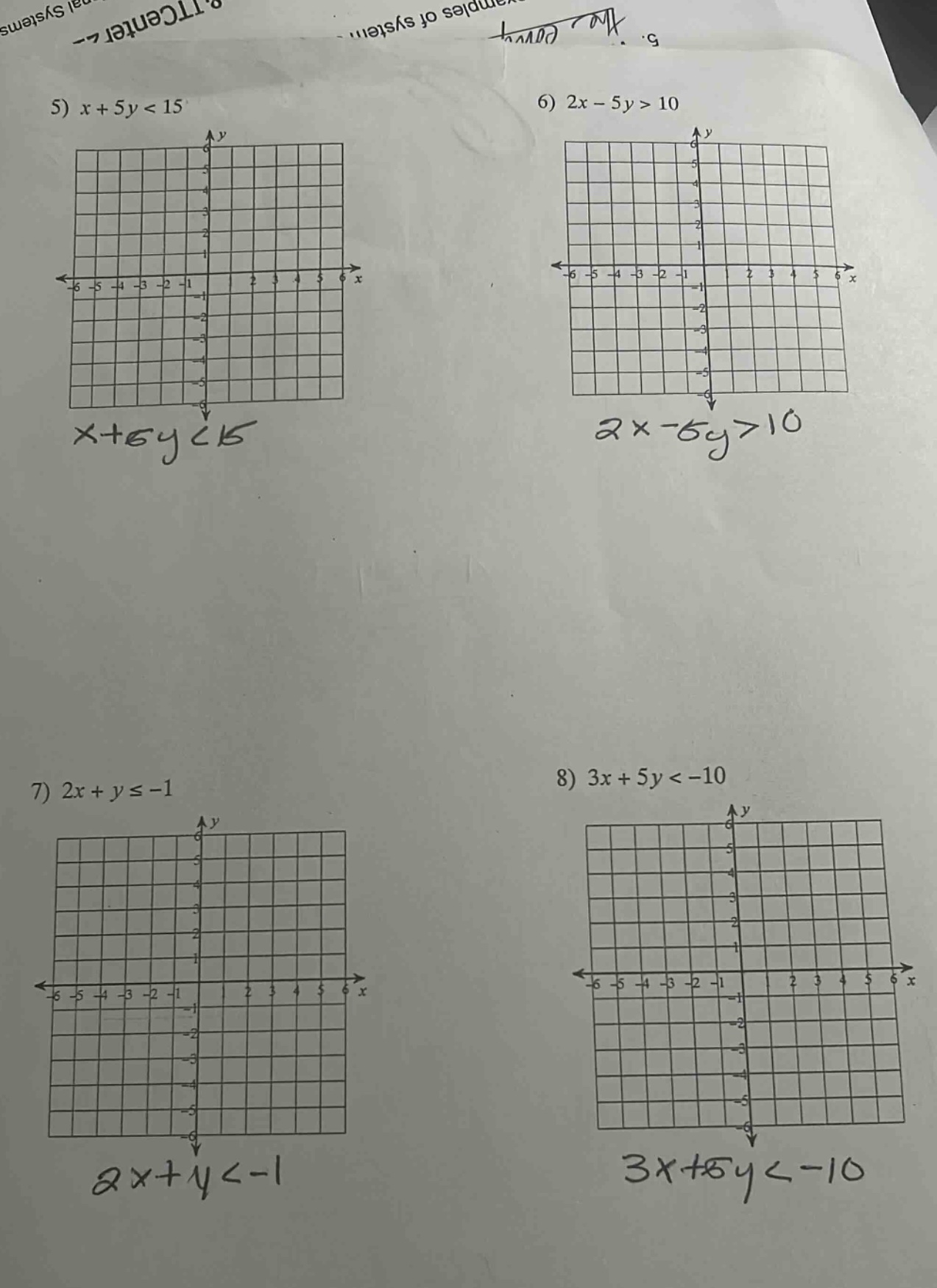
- $x + 5y < 15$
- $2x - 5y > 10$
- $2x + y \leq -1$
- $3x + 5y < -10$
To solve these linear inequality graphing problems, we'll go through each one step by step. Here, we'll solve problem 5: \( x + 5y < 15 \)
Step 1: Rewrite the inequality in slope - intercept form (\(y=mx + b\))
We start with the inequality \(x + 5y<15\).
Subtract \(x\) from both sides: \(5y<-x + 15\)
Divide each term by 5: \(y<-\frac{1}{5}x + 3\)
Step 2: Graph the boundary line
The boundary line for the inequality \(y =-\frac{1}{5}x + 3\) has a slope \(m =-\frac{1}{5}\) and a y - intercept \(b = 3\).
- Plot the y - intercept: The point \((0,3)\) is on the line.
- Use the slope to find another point. Since the slope is \(\frac{\text{rise}}{\text{run}}=-\frac{1}{5}\), from the point \((0,3)\), we can go down 1 unit (because the rise is - 1) and to the right 5 units (because the run is 5). This gives us the point \((5,2)\).
Since the inequality is \(y<-\frac{1}{5}x + 3\) (not \(y\leq-\frac{1}{5}x + 3\)), we draw a dashed line to represent the boundary line (a dashed line indicates that the points on the line are not included in the solution set).
Step 3: Shade the region
To determine which side of the line to shade, we can use a test point. A common test point is \((0,0)\) (as long as it is not on the boundary line).
Substitute \(x = 0\) and \(y = 0\) into the original inequality \(x+5y<15\):
\(0 + 5(0)=0<15\), which is true.
So we shade the region that contains the point \((0,0)\), which is the region below the dashed line \(y =-\frac{1}{5}x+3\)
Now, let's solve problem 6: \(2x - 5y>10\)
Step 1: Rewrite the inequality in slope - intercept form
Start with \(2x-5y > 10\)
Subtract \(2x\) from both sides: \(-5y>-2x + 10\)
Divide each term by - 5. When we divide an inequality by a negative number, we reverse the inequality sign. So we get \(y<\frac{2}{5}x-2\)
Step 2: Graph the boundary line
The boundary line is \(y=\frac{2}{5}x - 2\) with slope \(m=\frac{2}{5}\) and y - intercept \(b=-2\)
- Plot the y - intercept: The point \((0, - 2)\) is on the line.
- Use the slope to find another point. Since the slope is \(\frac{\text{rise}}{\text{run}}=\frac{2}{5}\), from the point \((0,-2)\), we can go up 2 units and to the right 5 units. This gives us the point \((5,0)\)
Since the inequality is \(y<\frac{2}{5}x - 2\) (not \(y\leq\frac{2}{5}x - 2\)), we draw a dashed line.
Step 3: Shade the region
Use the test point \((0,0)\). Substitute \(x = 0\) and \(y = 0\) into the original inequality \(2x-5y>10\):
\(2(0)-5(0)=0
ot>10\)
So we shade the region that does not contain the point \((0,0)\), which is the region below the dashed line \(y=\frac{2}{5}x - 2\)
For problem 7: \(2x + y\leq-1\)
Step 1: Rewrite the inequality in slope - intercept form
Start with \(2x + y\leq-1\)
Subtract \(2x\) from both sides: \(y\leq-2x-1\)
Step 2: Graph the boundary line
The boundary line is \(y=-2x - 1\) with slope \(m=-2\) and y - intercept \(b = - 1\)
- Plot the y - intercept: The point \((0,-1)\) is on the line.
- Use the slope to find another point. Since the slope is \(\frac{\text{rise}}{\text{run}}=-2=\frac{-2}{1}\), from the point \((0,-1)\), we can go down 2 units and to the right 1 unit, which gives us the point \((1,-3)\)
Since the inequality is \(y\leq-2x - 1\) (the "less than or equal to" symbol), we draw a solid line to represent the boundary line (a solid line indicates that the points on the line are included in the solution set).
Step 3: Shade the region
Use the test point \((0,0)\). Substitute \(x = 0\) and \(y = 0\) into the original inequality \(2x + y\leq-1\):
\(2(0)+0=0
ot\leq-1\)
So we shade the region tha…

Snap & solve any problem in the app
Get step-by-step solutions on Sovi AI
Photo-based solutions with guided steps
Explore more problems and detailed explanations
To solve these linear inequality graphing problems, we'll go through each one step by step. Here, we'll solve problem 5: \( x + 5y < 15 \)
Step 1: Rewrite the inequality in slope - intercept form (\(y=mx + b\))
We start with the inequality \(x + 5y<15\).
Subtract \(x\) from both sides: \(5y<-x + 15\)
Divide each term by 5: \(y<-\frac{1}{5}x + 3\)
Step 2: Graph the boundary line
The boundary line for the inequality \(y =-\frac{1}{5}x + 3\) has a slope \(m =-\frac{1}{5}\) and a y - intercept \(b = 3\).
- Plot the y - intercept: The point \((0,3)\) is on the line.
- Use the slope to find another point. Since the slope is \(\frac{\text{rise}}{\text{run}}=-\frac{1}{5}\), from the point \((0,3)\), we can go down 1 unit (because the rise is - 1) and to the right 5 units (because the run is 5). This gives us the point \((5,2)\).
Since the inequality is \(y<-\frac{1}{5}x + 3\) (not \(y\leq-\frac{1}{5}x + 3\)), we draw a dashed line to represent the boundary line (a dashed line indicates that the points on the line are not included in the solution set).
Step 3: Shade the region
To determine which side of the line to shade, we can use a test point. A common test point is \((0,0)\) (as long as it is not on the boundary line).
Substitute \(x = 0\) and \(y = 0\) into the original inequality \(x+5y<15\):
\(0 + 5(0)=0<15\), which is true.
So we shade the region that contains the point \((0,0)\), which is the region below the dashed line \(y =-\frac{1}{5}x+3\)
Now, let's solve problem 6: \(2x - 5y>10\)
Step 1: Rewrite the inequality in slope - intercept form
Start with \(2x-5y > 10\)
Subtract \(2x\) from both sides: \(-5y>-2x + 10\)
Divide each term by - 5. When we divide an inequality by a negative number, we reverse the inequality sign. So we get \(y<\frac{2}{5}x-2\)
Step 2: Graph the boundary line
The boundary line is \(y=\frac{2}{5}x - 2\) with slope \(m=\frac{2}{5}\) and y - intercept \(b=-2\)
- Plot the y - intercept: The point \((0, - 2)\) is on the line.
- Use the slope to find another point. Since the slope is \(\frac{\text{rise}}{\text{run}}=\frac{2}{5}\), from the point \((0,-2)\), we can go up 2 units and to the right 5 units. This gives us the point \((5,0)\)
Since the inequality is \(y<\frac{2}{5}x - 2\) (not \(y\leq\frac{2}{5}x - 2\)), we draw a dashed line.
Step 3: Shade the region
Use the test point \((0,0)\). Substitute \(x = 0\) and \(y = 0\) into the original inequality \(2x-5y>10\):
\(2(0)-5(0)=0
ot>10\)
So we shade the region that does not contain the point \((0,0)\), which is the region below the dashed line \(y=\frac{2}{5}x - 2\)
For problem 7: \(2x + y\leq-1\)
Step 1: Rewrite the inequality in slope - intercept form
Start with \(2x + y\leq-1\)
Subtract \(2x\) from both sides: \(y\leq-2x-1\)
Step 2: Graph the boundary line
The boundary line is \(y=-2x - 1\) with slope \(m=-2\) and y - intercept \(b = - 1\)
- Plot the y - intercept: The point \((0,-1)\) is on the line.
- Use the slope to find another point. Since the slope is \(\frac{\text{rise}}{\text{run}}=-2=\frac{-2}{1}\), from the point \((0,-1)\), we can go down 2 units and to the right 1 unit, which gives us the point \((1,-3)\)
Since the inequality is \(y\leq-2x - 1\) (the "less than or equal to" symbol), we draw a solid line to represent the boundary line (a solid line indicates that the points on the line are included in the solution set).
Step 3: Shade the region
Use the test point \((0,0)\). Substitute \(x = 0\) and \(y = 0\) into the original inequality \(2x + y\leq-1\):
\(2(0)+0=0
ot\leq-1\)
So we shade the region that does not contain the point \((0,0)\), which is the region below the solid line \(y=-2x - 1\)
For problem 8: \(3x + 5y<-10\)
Step 1: Rewrite the inequality in slope - intercept form
Start with \(3x + 5y<-10\)
Subtract \(3x\) from both sides: \(5y<-3x - 10\)
Divide each term by 5: \(y<-\frac{3}{5}x-2\)
Step 2: Graph the boundary line
The boundary line is \(y =-\frac{3}{5}x-2\) with slope \(m =-\frac{3}{5}\) and y - intercept \(b=-2\)
- Plot the y - intercept: The point \((0,-2)\) is on the line.
- Use the slope to find another point. Since the slope is \(\frac{\text{rise}}{\text{run}}=-\frac{3}{5}\), from the point \((0,-2)\), we can go down 3 units and to the right 5 units, which gives us the point \((5,-5)\)
Since the inequality is \(y<-\frac{3}{5}x - 2\) (not \(y\leq-\frac{3}{5}x - 2\)), we draw a dashed line.
Step 3: Shade the region
Use the test point \((0,0)\). Substitute \(x = 0\) and \(y = 0\) into the original inequality \(3x + 5y<-10\):
\(3(0)+5(0)=0
ot<-10\)
So we shade the region that does not contain the point \((0,0)\), which is the region below the dashed line \(y =-\frac{3}{5}x-2\)
(Note: Since the problem is about graphing linear inequalities, and we have provided the step - by - step process for each inequality. If you need a more detailed graphical representation, you can use the points and the slope - intercept form information to draw the lines and shade the regions on the given coordinate planes.)