QUESTION IMAGE
Question
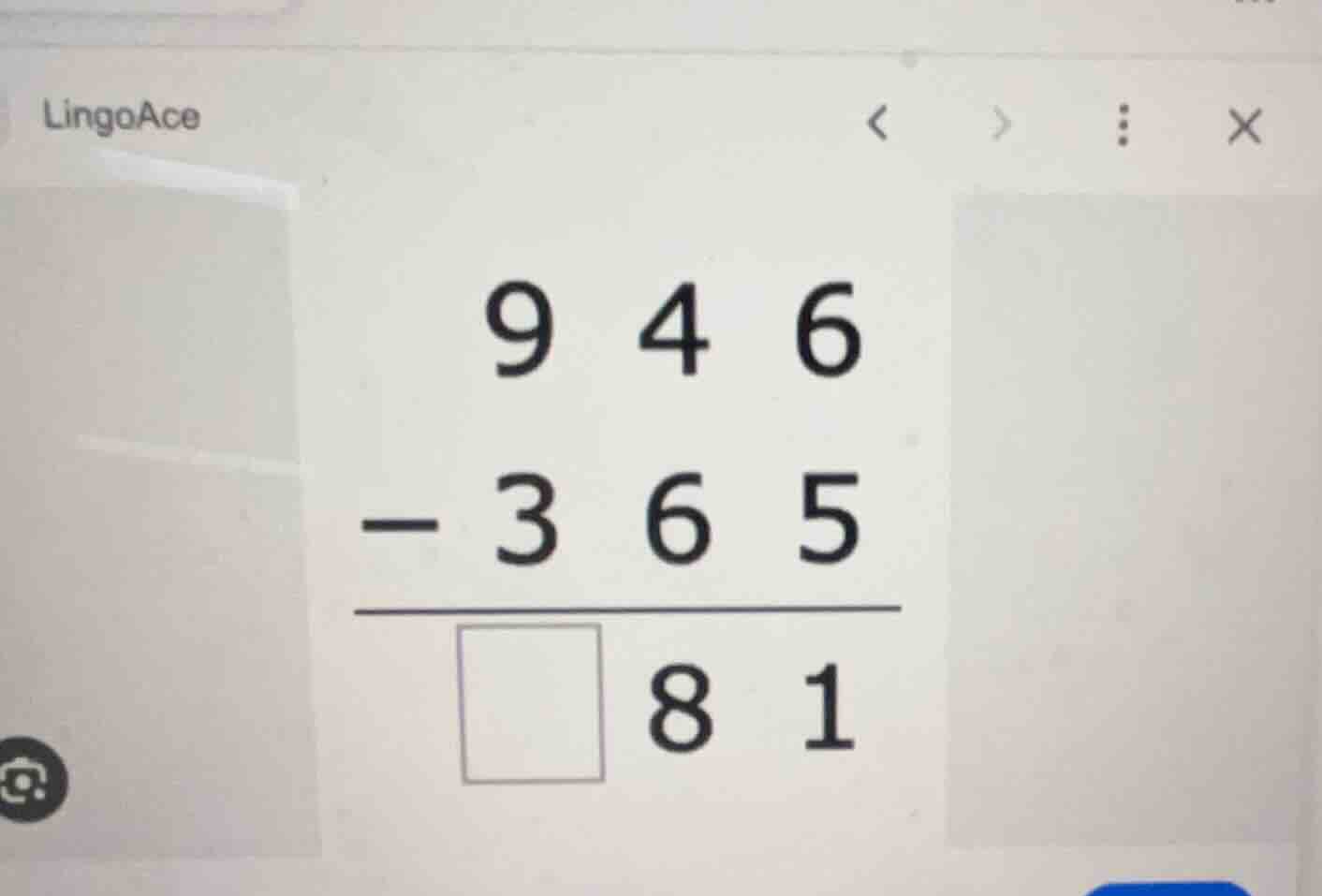
9 4 6
- 3 6 5
□ 8 1
Step1: Analyze the units and tens place
First, look at the units place: \(6 - 5 = 1\), which matches the result's units digit. Then the tens place: we have \(4 - 6\), but since \(4 < 6\), we need to borrow 1 from the hundreds place. So the hundreds place digit 9 becomes 8, and the tens place 4 becomes \(14\). Then \(14 - 6 = 8\), which matches the result's tens digit.
Step2: Calculate the hundreds place
Now, the hundreds place: originally 9, but we borrowed 1, so it's \(9 - 1 = 8\), and then we subtract 3 (from the subtrahend's hundreds place). So \(8 - 3 = 5\)? Wait, no, wait. Wait, the subtrahend's hundreds place is 3. Wait, let's re - do. The minuend's hundreds place is 9, but we borrowed 1 for the tens place, so it's \(9 - 1=8\). Then we do \(8 - 3 = 5\)? Wait, no, the result's hundreds place is the square we need to find. Wait, the minuend is 946, subtrahend is 365. Let's do the subtraction: \(946-365\). Let's compute step by step:
- Units: \(6 - 5 = 1\)
- Tens: \(4 - 6\), can't do, borrow from hundreds. So hundreds becomes \(9 - 1 = 8\), tens becomes \(14\). \(14 - 6 = 8\)
- Hundreds: \(8 - 3 = 5\)
Wait, so the hundreds place of the result is 5. Wait, but let's check \(946-365 = 581\). Yes, so the square (the hundreds place of the result) is 5.

Snap & solve any problem in the app
Get step-by-step solutions on Sovi AI
Photo-based solutions with guided steps
Explore more problems and detailed explanations
5