QUESTION IMAGE
Question
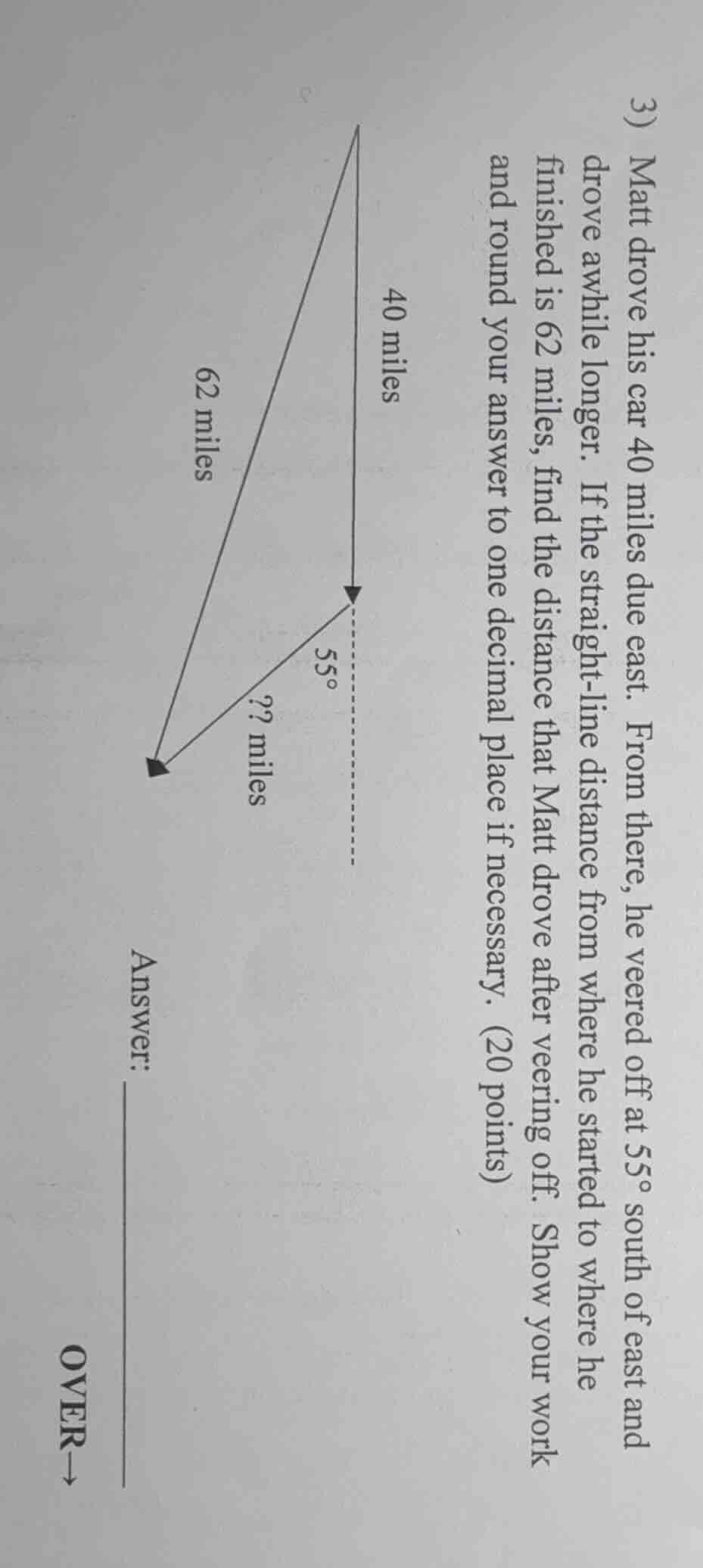
- matt drove his car 40 miles due east. from there, he veered off at 55° south of east and drove awhile longer. if the straight - line distance from where he started to where he finished is 62 miles, find the distance that matt drove after veering off. show your work and round your answer to one decimal place if necessary. (20 points)
answer:
over→
Step1: Identify the triangle type
We have a triangle with two sides (40 miles, 62 miles) and the included angle \(180^\circ - 55^\circ= 125^\circ\)? Wait, no, wait. Wait, Matt drove 40 miles east, then veered \(55^\circ\) south of east. Wait, the diagram: the first leg is 40 miles east (vertical? Wait, maybe the diagram has the first leg as north-south? Wait, no, the problem says "due east" first, then "veered off at \(55^\circ\) south of east". Wait, maybe the triangle is a triangle with sides \(a = 40\), \(c=62\), and the included angle \(B = 55^\circ\)? Wait, no, let's use the Law of Cosines. Wait, the straight-line distance is 62 miles, one leg is 40 miles, we need to find the other leg (let's call it \(x\)) with the angle between 40 and \(x\) being \(55^\circ\)? Wait, no, the Law of Cosines: \(c^2=a^2 + b^2-2ab\cos(C)\). Wait, let's define: let the first leg be \(a = 40\) (east), the second leg be \(b=x\) (after veering), and the hypotenuse (straight line) be \(c = 62\), and the angle between \(a\) and \(b\) is \(55^\circ\)? Wait, no, if he drove east, then veered \(55^\circ\) south of east, so the angle between the east direction (first leg) and the second leg is \(55^\circ\). So the triangle has sides \(a = 40\), \(b=x\), \(c = 62\), and angle \(C = 55^\circ\) between \(a\) and \(b\)? Wait, no, Law of Cosines: \(c^2=a^2 + b^2-2ab\cos(C)\). Wait, we need to solve for \(b\). So \(62^2=40^2 + x^2-2\times40\times x\times\cos(55^\circ)\)? Wait, no, that would be a quadratic. Wait, maybe I got the angle wrong. Wait, maybe the angle is \(180 - 55 = 125^\circ\)? Wait, no, let's look at the diagram: the first leg is 40 miles (vertical? Maybe the diagram has the first leg as north-south, then east? Wait, the diagram shows 40 miles vertical, then a dashed line, then a line with \(55^\circ\), and the hypotenuse 62. Wait, maybe the triangle is a triangle with sides 40, \(x\), 62, and the angle opposite to \(x\)? No, let's use Law of Cosines correctly. Let's assume that the two legs are 40 and \(x\), and the included angle is \(55^\circ\), and the third side (straight line) is 62. So Law of Cosines: \(62^2=40^2 + x^2-2\times40\times x\times\cos(55^\circ)\). Wait, that's a quadratic equation: \(x^2-(80\cos55^\circ)x + 40^2 - 62^2=0\). Let's compute:
First, \(\cos(55^\circ)\approx0.5736\)
So \(x^2-(80\times0.5736)x + 1600 - 3844 = 0\)
\(x^2 - 45.888x - 2244 = 0\)
Using quadratic formula: \(x=\frac{45.888\pm\sqrt{45.888^2 + 4\times2244}}{2}\)
Compute discriminant: \(45.888^2\approx2105.7\), \(4\times2244 = 8976\), so discriminant \(\approx2105.7 + 8976 = 11081.7\), square root \(\approx105.27\)
So \(x=\frac{45.888 + 105.27}{2}\approx\frac{151.158}{2}\approx75.6\)? Wait, that can't be. Wait, maybe I had the angle wrong. Maybe the angle is \(180 - 55 = 125^\circ\). Let's try that. Law of Cosines: \(62^2=40^2 + x^2-2\times40\times x\times\cos(125^\circ)\)
\(\cos(125^\circ)\approx-0.5736\)
So \(3844 = 1600 + x^2-2\times40\times x\times(-0.5736)\)
\(3844 = 1600 + x^2 + 45.888x\)
\(x^2 + 45.888x + 1600 - 3844 = 0\)
\(x^2 + 45.888x - 2244 = 0\)
Discriminant: \(45.888^2 + 4\times2244\approx2105.7 + 8976 = 11081.7\), square root \(\approx105.27\)
\(x=\frac{-45.888 + 105.27}{2}\approx\frac{59.382}{2}\approx29.7\)? Wait, no, that still doesn't seem right. Wait, maybe the triangle is a triangle where one side is 40, the hypotenuse is 62, and the angle is \(55^\circ\), so we can use Law of Sines. Let's try Law of Sines: \(\frac{40}{\sin(A)}=\frac{62}{\sin(180 - 55)}=\frac{62}{\sin(125^\circ)}\)
\(\sin(125^\circ)\approx0.8192\)
So \(\sin(A…

Snap & solve any problem in the app
Get step-by-step solutions on Sovi AI
Photo-based solutions with guided steps
Explore more problems and detailed explanations
\(75.6\)