QUESTION IMAGE
Question
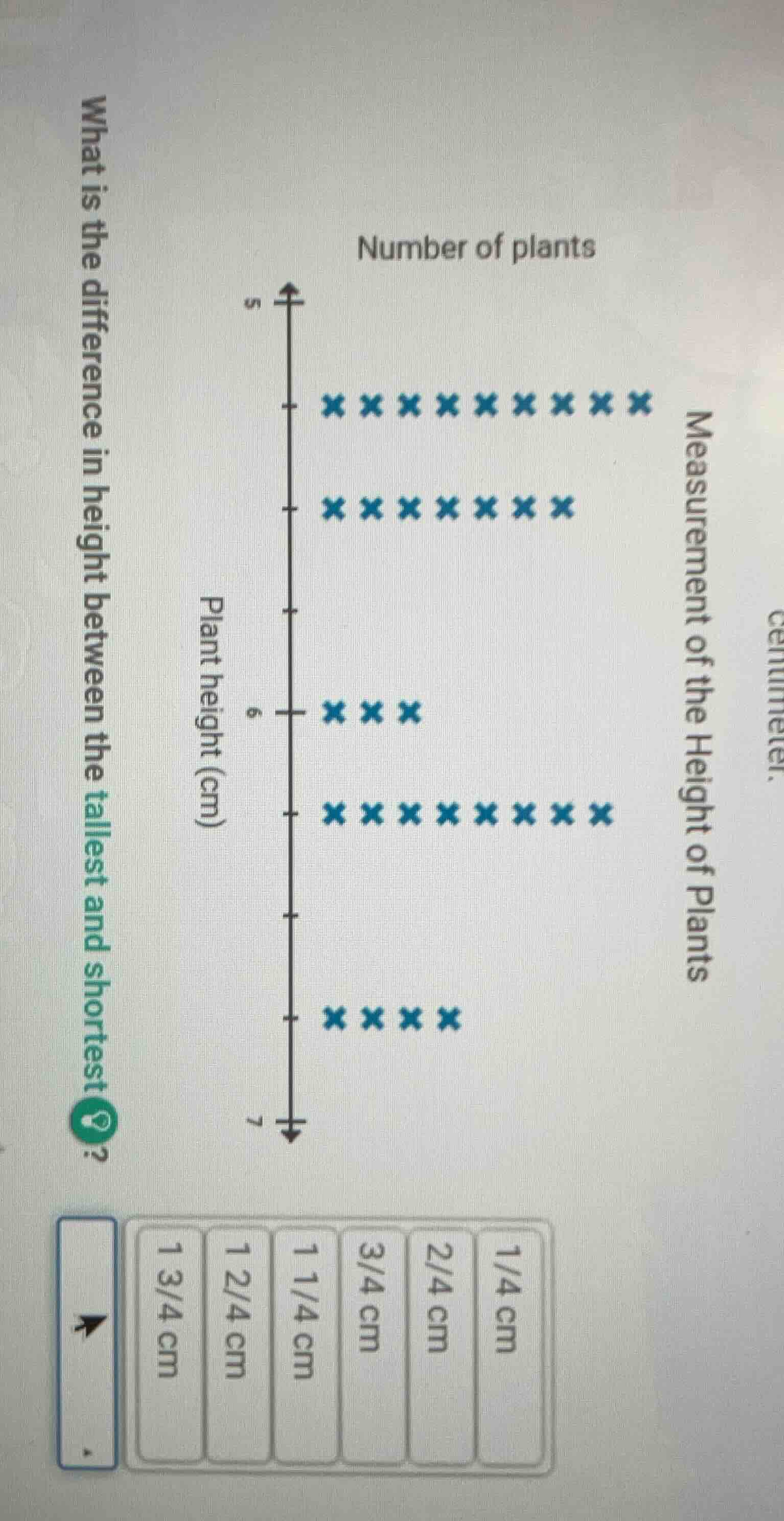
measurement of the height of plants
plant height (cm)
number of plants
what is the difference in height between the tallest and shortest?
options: 1/4 cm, 2/4 cm, 3/4 cm, 1 1/4 cm, 1 2/4 cm, 1 3/4 cm
Step1: Identify tallest and shortest heights
The shortest plant height is at the bottom of the vertical axis (5 cm? Wait, no, looking at the axis: the vertical axis is plant height (cm) with 5 at the top, 7 at the bottom? Wait, no, the axis is labeled with 5 at the top, then a mark, then 6, then a mark, then 7 at the bottom. Wait, actually, the vertical axis is reversed? Wait, the plant height (cm) has 5 at the top, then a division, then 6, then a division, then 7 at the bottom. So the topmost x's are at 5 cm (since 5 is at the top), then next at 5 + 1/4? Wait, no, the distance between 5 and 6: let's see the number of divisions. Wait, the options have fractions like 1/4, 2/4, 3/4, etc. So the vertical axis has 5, then 5 + 1/4, 5 + 2/4, 5 + 3/4, 6, 6 + 1/4, 6 + 2/4, 6 + 3/4, 7? Wait, no, looking at the x's:
- The top row (closest to 5) has x's: that's 5 cm?
- Then next row: 5 + 1/4 cm?
- Then 6 cm?
- Then 6 + 1/4 cm?
- Then 7 cm? Wait, no, the bottom row (closest to 7) has x's: that's 7 cm? Wait, no, the vertical axis is labeled with 5 at the top, 7 at the bottom, so it's a reversed axis (smaller numbers at top, larger at bottom). So the tallest plant is at the bottom (7 cm? No, wait, the bottom of the axis is 7, so the lowest x's (closest to 7) are the tallest. Wait, let's check the options. The options are 1/4, 2/4, 3/4, 1 1/4, 1 2/4, 1 3/4. So the difference should be a fraction or mixed number.
Wait, let's re-express the heights. Let's see the vertical axis:
- The topmost line (with 5) is 5 cm.
- Then a line below it (first division) is 5 + 1/4 cm? Wait, no, the distance between 5 and 6: how many divisions? Let's count the number of intervals between 5 and 7. From 5 to 7, there are 4 intervals? Wait, no, the axis has 5, then a mark, then 6, then a mark, then 7. So between 5 and 6: 1 interval, between 6 and 7: 1 interval? No, that can't be. Wait, the x's are in rows:
- Top row (near 5): 9 x's (tallest? No, wait, plant height: shorter plants are at top, taller at bottom. So top row (5 cm) is shortest, bottom row (7 cm) is tallest? Wait, no, 5 is less than 7, so 5 cm is shorter, 7 cm is taller? Wait, no, 5 cm is shorter than 7 cm. Wait, the vertical axis is labeled with 5 at the top, 7 at the bottom, so moving down the axis, height increases. So the topmost x's are at 5 cm (shortest), the bottommost x's are at 7 cm? No, the bottom row (closest to 7) has 4 x's. Wait, let's list the heights:
- Row 1 (top, near 5): height = 5 cm
- Row 2: height = 5 + 1/4 cm? Wait, no, the options have 1 3/4, etc. Wait, maybe the axis is 5, 5 1/4, 5 2/4, 5 3/4, 6, 6 1/4, 6 2/4, 6 3/4, 7. Wait, the distance between 5 and 7 is 2 cm, divided into 8 intervals? No, the options suggest that the difference is 1 3/4? Wait, no, let's look at the x's:
- Shortest plant: top row (5 cm)
- Tallest plant: bottom row (7 cm? No, 5 to 7 is 2 cm, but options don't have 2. Wait, maybe the axis is 5, 5 3/4, 6 2/4, 7 1/4? No, this is confusing. Wait, let's check the number of divisions between 5 and 7. From 5 to 7, there are 4 intervals (since 5, then a mark, 6, then a mark, 7: two intervals? No, 5 to 6 is one interval, 6 to 7 is another. So each interval is 1 cm? No, the options have fractions. Wait, maybe the vertical axis is 5, 5 1/4, 5 2/4, 5 3/4, 6, 6 1/4, 6 2/4, 6 3/4, 7. So between 5 and 6: 4 intervals (1/4 each), same for 6 to 7.
Wait, the top row (closest to 5) is 5 cm.
The next row: 5 + 1/4 cm? No, the second row (from top) has x's: that's 5 + 1/4? Wait, no, the first row (top) is 5, second is 5 + 1/4, third is 6, fourth is 6 + 1/4, fifth is 7? No, the bo…

Snap & solve any problem in the app
Get step-by-step solutions on Sovi AI
Photo-based solutions with guided steps
Explore more problems and detailed explanations
1 3/4 cm