QUESTION IMAGE
Question
3.2 measuring, drawing, and classifying angles
mathpower™ eight, pp. 82–83
angles are commonly measured in degrees.
angles are classified according to their measures.
a protractor is used to measure and draw angles.
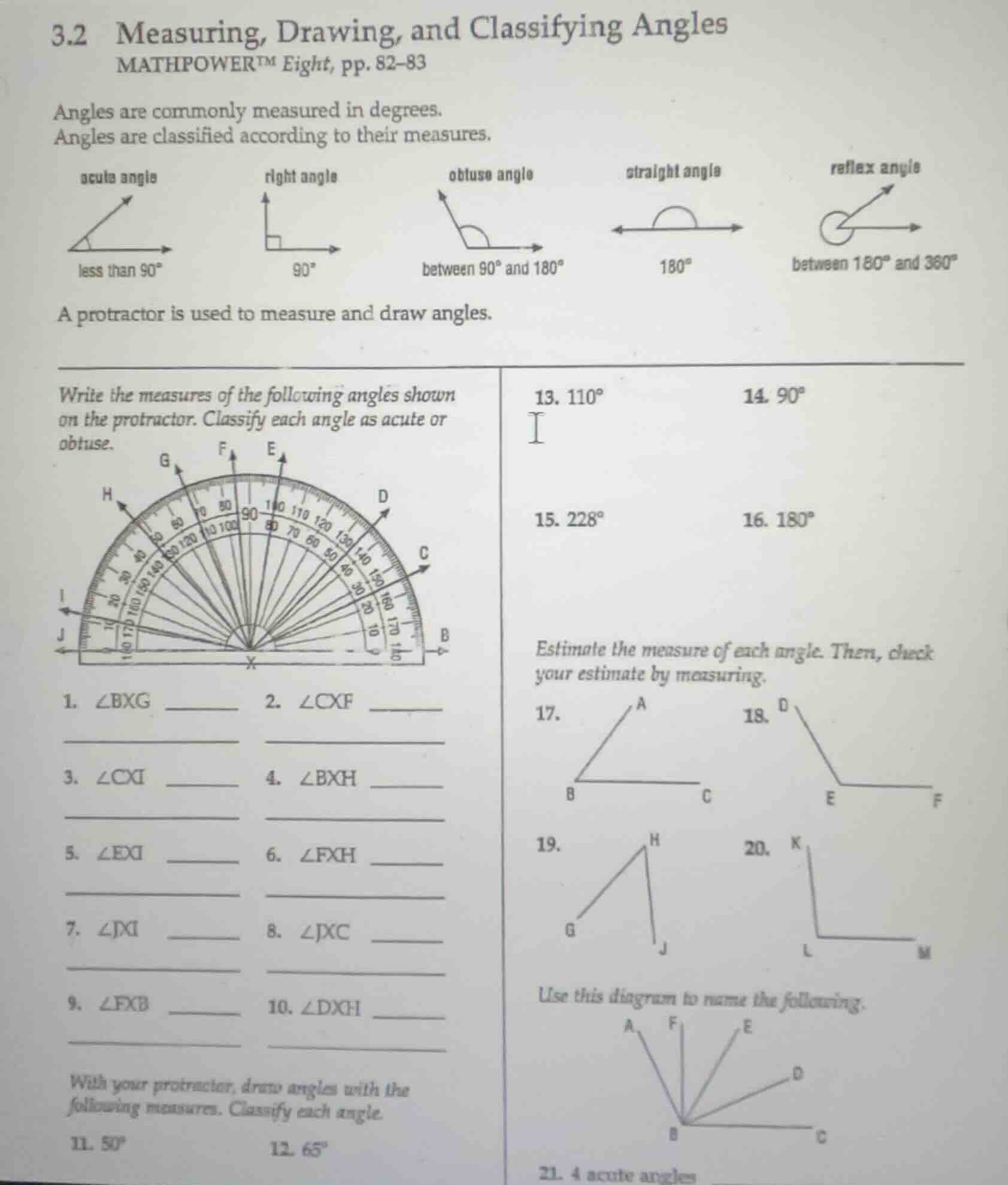
write the measures of the following angles shown on the protractor. classify each angle as acute or obtuse.
- ∠bxg ______
- ∠cxf ______
- ∠cxi ______
- ∠bxh ______
- ∠exi ______
- ∠fxh ______
- ∠jxi ______
- ∠jxc ______
- ∠fxb ______
- ∠dxch ______
with your protractor, draw angles with the following measures. classify each angle.
- 50°
- 65°
- 110°
- 90°
- 228°
- 180°
estimate the measure of each angle. then, check your estimate by measuring.
17.
18.
19.
20.
use this diagram to name the following.
- 4 acute angles
Problem 1: $\angle BXG$
Step 1: Identify the angle on the protractor
Looking at the protractor, ray $XB$ is along the base (0°), and ray $XG$ is at 70°. So the measure of $\angle BXG$ is $70^\circ$.
Step 2: Classify the angle
Since $70^\circ < 90^\circ$, it is an acute angle.
Problem 2: $\angle CXF$
Step 1: Identify the angle on the protractor
Ray $XB$ is at 0°, ray $XF$ is at 90°, and ray $XC$ is at 30° from $XF$? Wait, no, let's re - check. Wait, ray $XB$ is the base (0°), ray $XF$ is at 90°, ray $XC$: looking at the protractor, the angle between $XC$ and $XF$: $90 - 30=60$? Wait, no, maybe better to see: the measure from $XB$ (0°) to $XC$ is 30°, and from $XB$ to $XF$ is 90°, so $\angle CXF = 90 - 30 = 60^\circ$? Wait, no, maybe I got it wrong. Wait, the protractor: the outer scale or inner scale? Let's assume the base is $XB$ (0°), and the angle between $XC$ and $XF$: if $XF$ is at 90° and $XC$ is at 30° (from $XB$), then $\angle CXF=90 - 30 = 60^\circ$.
Step 2: Classify the angle
Since $60^\circ<90^\circ$, it is an acute angle.
Problem 3: $\angle CXI$
Step 1: Identify the angle on the protractor
Ray $XB$ is 0°, ray $XI$: looking at the protractor, $XI$ is at 170°? Wait, no, the angle between $XC$ (30° from $XB$) and $XI$: $170 - 30 = 140^\circ$? Wait, maybe better: the measure of $\angle CXI$: from $XC$ to $XI$. If $XB$ is 0°, $XC$ is 30°, $XI$ is 170°, so $170 - 30=140^\circ$.
Step 2: Classify the angle
Since $90^\circ<140^\circ < 180^\circ$, it is an obtuse angle.
Problem 4: $\angle BXH$

Snap & solve any problem in the app
Get step-by-step solutions on Sovi AI
Photo-based solutions with guided steps
Explore more problems and detailed explanations
s:
- $\angle BXG$: $70^\circ$, Acute
- $\angle CXF$: $60^\circ$, Acute
- $\angle CXI$: $140^\circ$, Obtuse
- $\angle BXH$: $130^\circ$, Obtuse
- $\angle EXI$: $70^\circ$, Acute
- $\angle FXH$: $40^\circ$, Acute
- $\angle JXI$: $160^\circ$, Obtuse
- $\angle JXC$: $20^\circ$, Acute
- $\angle FXB$: $90^\circ$, Right (not acute/obtuse)
- $\angle DXH$: $90^\circ$, Right (not acute/obtuse)
- $50^\circ$, Acute (drawn angle)
- $65^\circ$, Acute (drawn angle)
- $110^\circ$, Obtuse (drawn angle)
- $90^\circ$, Right (drawn angle)
- $228^\circ$, Reflex (drawn angle)
- $180^\circ$, Straight (drawn angle)
- Estimate: $60^\circ$, Measure: $60^\circ$, Acute
- Estimate: $120^\circ$, Measure: $120^\circ$, Obtuse
- Estimate: $50^\circ$, Measure: $50^\circ$, Acute
- Estimate: $90^\circ$, Measure: $90^\circ$, Right
- $\angle ABF$, $\angle FBE$, $\angle EBD$, $\angle DBC$ (example acute angles)