QUESTION IMAGE
Question
mercantilism
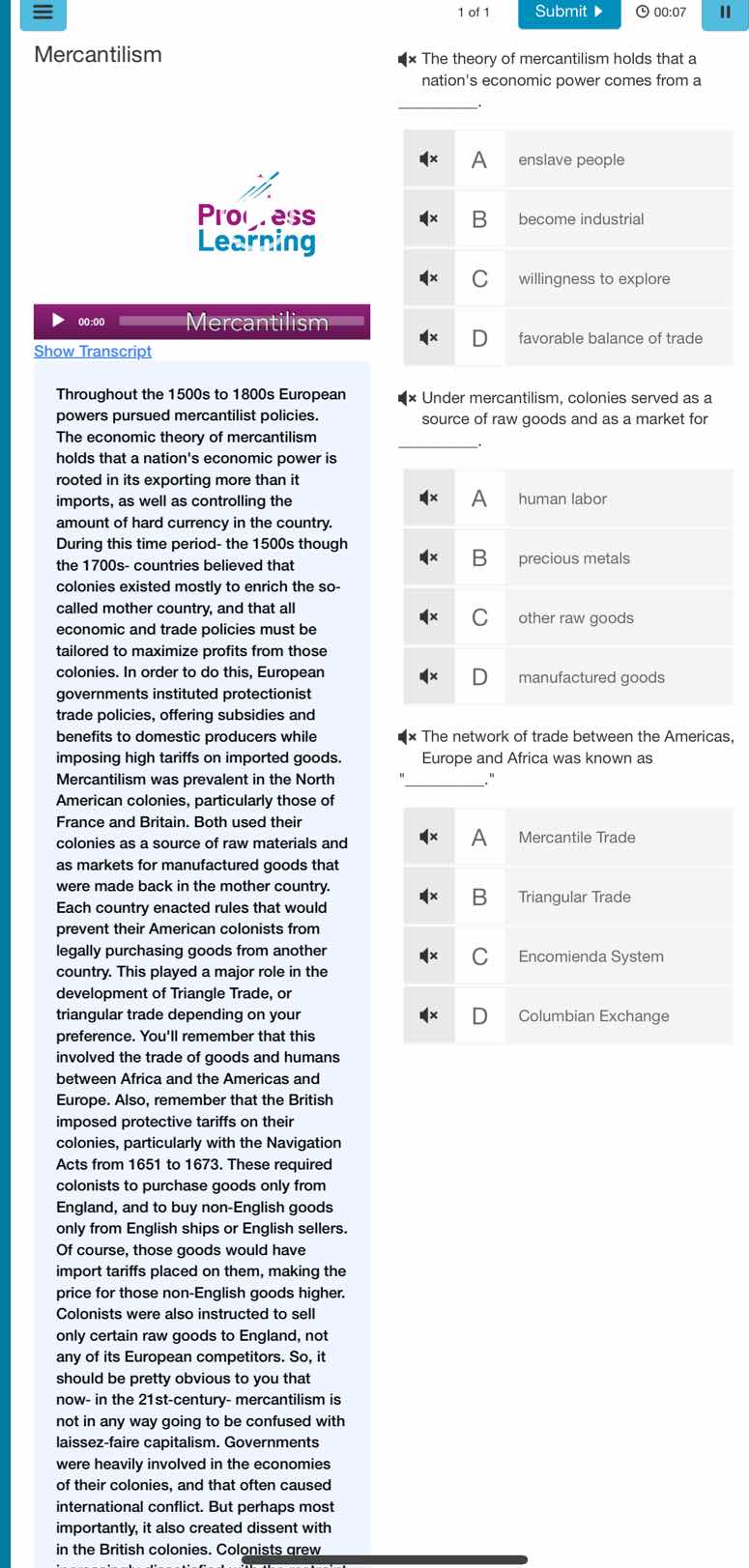
the theory of mercantilism holds that a nation’s economic power comes from a ______.
a enslave people
b become industrial
c willingness to explore
d favorable balance of trade
under mercantilism, colonies served as a source of raw goods and as a market for ______.
a human labor
b precious metals
c other raw goods
d manufactured goods
the network of trade between the americas, europe and africa was known as “______.”
a mercantile trade
b triangular trade
c encomienda system
d columbian exchange
throughout the 1500s to 1800s european powers pursued mercantilist policies. the economic theory of mercantilism holds that a nation’s economic power is rooted in its exporting more than it imports, as well as controlling the amount of hard currency in the country. during this time period- the 1500s though the 1700s- countries believed that colonies existed mostly to enrich the so - called mother country, and that all economic and trade policies must be tailored to maximize profits from those colonies. in order to do this, european governments instituted protectionist trade policies, offering subsidies and benefits to domestic producers while imposing high tariffs on imported goods. mercantilism was prevalent in the north american colonies, particularly those of france and britain. both used their colonies as a source of raw materials and as markets for manufactured goods that were made back in the mother country. each country enacted rules that would prevent their american colonists from legally purchasing goods from another country. this played a major role in the development of triangle trade, or triangular trade depending on your preference. you’ll remember that this involved the trade of goods and humans between africa and the americas and europe. also, remember that the british imposed protective tariffs on their colonies, particularly with the navigation acts from 1651 to 1673. these required colonists to purchase goods only from england, and to buy non - english goods only from english ships or english sellers. of course, those goods would have import tariffs placed on them, making the price for those non - english goods higher. colonists were also instructed to sell only certain raw goods to england, not any of its european competitors. so, it should be pretty obvious to you that now - in the 21st - century - mercantilism is not in any way going to be confused with laissez - faire capitalism. governments were heavily involved in the economies of their colonies, and that often caused international conflict. but perhaps most importantly, it also created dissent with in the british colonies. colonists grew
First Question:
The theory of mercantilism is about a nation's economic power coming from exporting more than importing (favorable balance of trade), not enslaving people, industrialization, or exploration willingness. So the correct option is D.
Under mercantilism, colonies provided raw materials and were markets for manufactured goods from the mother country. They weren't for human labor (A), precious metals (B, as colonies provided raw goods, not precious metals as a market), or other raw goods (C, they were a source of raw goods, not a market for them). So D is correct.
The trade network between Americas, Europe, and Africa is Triangular Trade. Mercantile Trade is broader, Encomienda System is about labor, Columbian Exchange is about biological/cultural exchange. So B is correct.

Snap & solve any problem in the app
Get step-by-step solutions on Sovi AI
Photo-based solutions with guided steps
Explore more problems and detailed explanations
D. favorable balance of trade