QUESTION IMAGE
Question
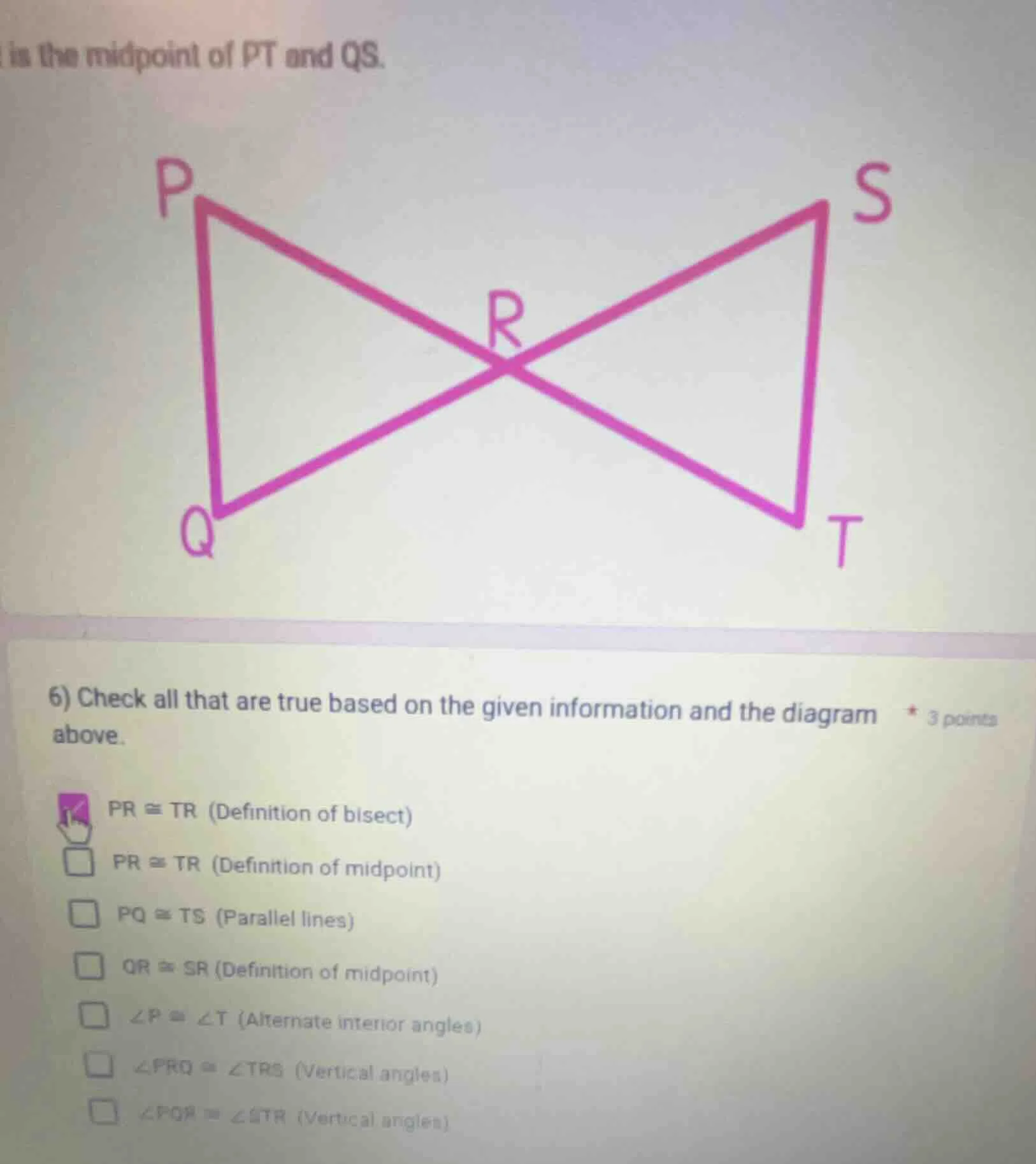
r is the midpoint of pt and qs.
- check all that are true based on the given information and the diagram above.
$\boldsymbol{pr cong tr}$ (definition of bisect)
$\boldsymbol{pr cong tr}$ (definition of midpoint)
$\boldsymbol{pq cong ts}$ (parallel lines)
$\boldsymbol{qr cong sr}$ (definition of midpoint)
$\boldsymbol{angle p cong angle t}$ (alternate interior angles)
$\boldsymbol{angle prq cong angle trs}$ (vertical angles)
$\boldsymbol{angle pqr cong angle str}$ (vertical angles)
Brief Explanations
- $PR \cong TR$: R is the midpoint of PT, so it splits PT into two congruent segments. This matches the definition of a midpoint (not bisect, which refers to splitting a segment/angle into two equal parts, but the specific term here for a segment's midpoint is the correct justification).
- $QR \cong SR$: R is the midpoint of QS, so it splits QS into two congruent segments, which fits the definition of a midpoint.
- $\angle PRQ \cong \angle TRS$: These are opposite angles formed by intersecting lines PT and QS, so they are vertical angles, which are congruent.
- The other options are incorrect:
- The first option uses "definition of bisect" which is not the precise term for a midpoint's effect on a segment here.
- There is no information stating PQ and TS are parallel, so we cannot conclude $PQ \cong TS$.
- We cannot confirm $\angle P \cong \angle T$ as alternate interior angles because we don't know if PQ and TS are parallel.
- $\angle PQR$ and $\angle STR$ are not vertical angles.

Snap & solve any problem in the app
Get step-by-step solutions on Sovi AI
Photo-based solutions with guided steps
Explore more problems and detailed explanations
- PR ≅ TR (Definition of midpoint)
- QR ≅ SR (Definition of midpoint)
- ∠PRQ ≅ ∠TRS (Vertical angles)