QUESTION IMAGE
Question
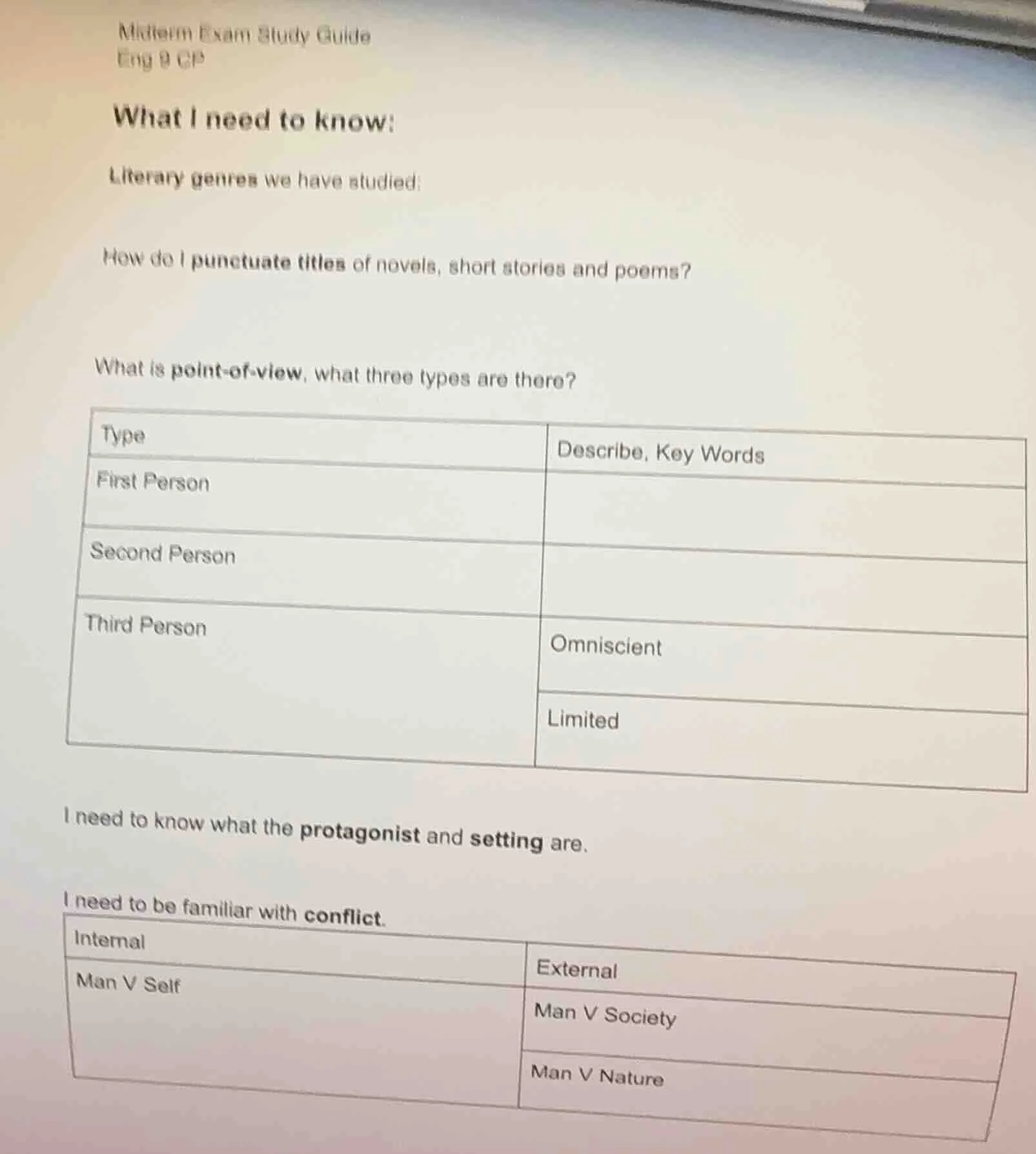
midterm exam study guide
eng 9 cp
what i need to know:
literary genres we have studied:
how do i punctuate titles of novels, short stories and poems?
what is point - of - view, what three types are there?
| type | describe, key words |
|---|---|
| second person | |
| third person | omniscient |
| third person | limited |
i need to know what the protagonist and setting are.
i need to be familiar with conflict.
| internal | external |
|---|---|
| man v self | man v nature |
Response
1. Punctuating Titles:
- Novels (and other long works like books, plays, movies): Italicize or underline. Example: To Kill a Mockingbird or Underline: To Kill a Mockingbird.
- Short stories, poems, articles (short works): Use quotation marks. Example: "The Tell - Tale Heart" (short story), "The Road Not Taken" (poem).
2. Point - of - View:
- First Person: The narrator is a character in the story, using "I" or "we". Key words: "I", personal perspective, narrator is involved. For example, in The Catcher in the Rye, Holden Caulfield tells the story from his own (first - person) perspective.
- Second Person: The narrator addresses the reader (or a character) as "you". It is less common in fiction but can be found in some choose - your - own - adventure stories or instructional texts. Key words: "you", direct address to the audience/character.
- Third Person: The narrator is not a character in the story, using "he", "she", "they".
- Third - Person Omniscient: The narrator knows everything about all characters, their thoughts, feelings, and actions. They can move freely between characters' minds. For example, in Pride and Prejudice, the narrator knows the thoughts and feelings of Elizabeth, Darcy, and other characters.
- Third - Person Limited: The narrator only knows the thoughts and feelings of one (or a few) characters. For example, in The Giver, the narrator mainly follows Jonas's thoughts and experiences.
3. Protagonist and Setting:
- Protagonist: The main character of a story, the one around whom the plot revolves. For example, in Harry Potter series, Harry Potter is the protagonist.
- Setting: The time and place in which a story occurs. It can include the historical period, geographical location, and the social environment. For example, the setting of The Great Gatsby is the 1920s in the United States, particularly in New York and Long Island.
4. Conflict:
- Internal (Man V Self): A conflict that occurs within a character's mind, usually involving a moral dilemma, a struggle with emotions, or a decision - making process. For example, in Hamlet, Hamlet struggles with whether to avenge his father's death or not, which is a conflict within himself.
- External:
- Man V Society: A character struggles against the norms, laws, or values of a society. For example, in The Adventures of Huckleberry Finn, Huck struggles against the racist and hypocritical society of the pre - Civil War South.
- Man V Nature: A character struggles against natural forces (like a storm, a wild animal, or a harsh environment). For example, in The Old Man and the Sea, Santiago struggles against the sea and the marlin (a part of nature in the context of the story).
- Man V Man: A character struggles against another character (a more specific form of external conflict, though not listed in the table but often included in conflict types). For example, in Romeo and Juliet, the Montagues and Capulets are in conflict with each other, and Romeo and Tybalt have a man - v - man conflict.

Snap & solve any problem in the app
Get step-by-step solutions on Sovi AI
Photo-based solutions with guided steps
Explore more problems and detailed explanations
1. Punctuating Titles:
- Novels (and other long works like books, plays, movies): Italicize or underline. Example: To Kill a Mockingbird or Underline: To Kill a Mockingbird.
- Short stories, poems, articles (short works): Use quotation marks. Example: "The Tell - Tale Heart" (short story), "The Road Not Taken" (poem).
2. Point - of - View:
- First Person: The narrator is a character in the story, using "I" or "we". Key words: "I", personal perspective, narrator is involved. For example, in The Catcher in the Rye, Holden Caulfield tells the story from his own (first - person) perspective.
- Second Person: The narrator addresses the reader (or a character) as "you". It is less common in fiction but can be found in some choose - your - own - adventure stories or instructional texts. Key words: "you", direct address to the audience/character.
- Third Person: The narrator is not a character in the story, using "he", "she", "they".
- Third - Person Omniscient: The narrator knows everything about all characters, their thoughts, feelings, and actions. They can move freely between characters' minds. For example, in Pride and Prejudice, the narrator knows the thoughts and feelings of Elizabeth, Darcy, and other characters.
- Third - Person Limited: The narrator only knows the thoughts and feelings of one (or a few) characters. For example, in The Giver, the narrator mainly follows Jonas's thoughts and experiences.
3. Protagonist and Setting:
- Protagonist: The main character of a story, the one around whom the plot revolves. For example, in Harry Potter series, Harry Potter is the protagonist.
- Setting: The time and place in which a story occurs. It can include the historical period, geographical location, and the social environment. For example, the setting of The Great Gatsby is the 1920s in the United States, particularly in New York and Long Island.
4. Conflict:
- Internal (Man V Self): A conflict that occurs within a character's mind, usually involving a moral dilemma, a struggle with emotions, or a decision - making process. For example, in Hamlet, Hamlet struggles with whether to avenge his father's death or not, which is a conflict within himself.
- External:
- Man V Society: A character struggles against the norms, laws, or values of a society. For example, in The Adventures of Huckleberry Finn, Huck struggles against the racist and hypocritical society of the pre - Civil War South.
- Man V Nature: A character struggles against natural forces (like a storm, a wild animal, or a harsh environment). For example, in The Old Man and the Sea, Santiago struggles against the sea and the marlin (a part of nature in the context of the story).
- Man V Man: A character struggles against another character (a more specific form of external conflict, though not listed in the table but often included in conflict types). For example, in Romeo and Juliet, the Montagues and Capulets are in conflict with each other, and Romeo and Tybalt have a man - v - man conflict.