QUESTION IMAGE
Question
mitosis reading questions
answer the following questions.for each answer, write the number of the paragraph where you found your answer.
egg + sperm
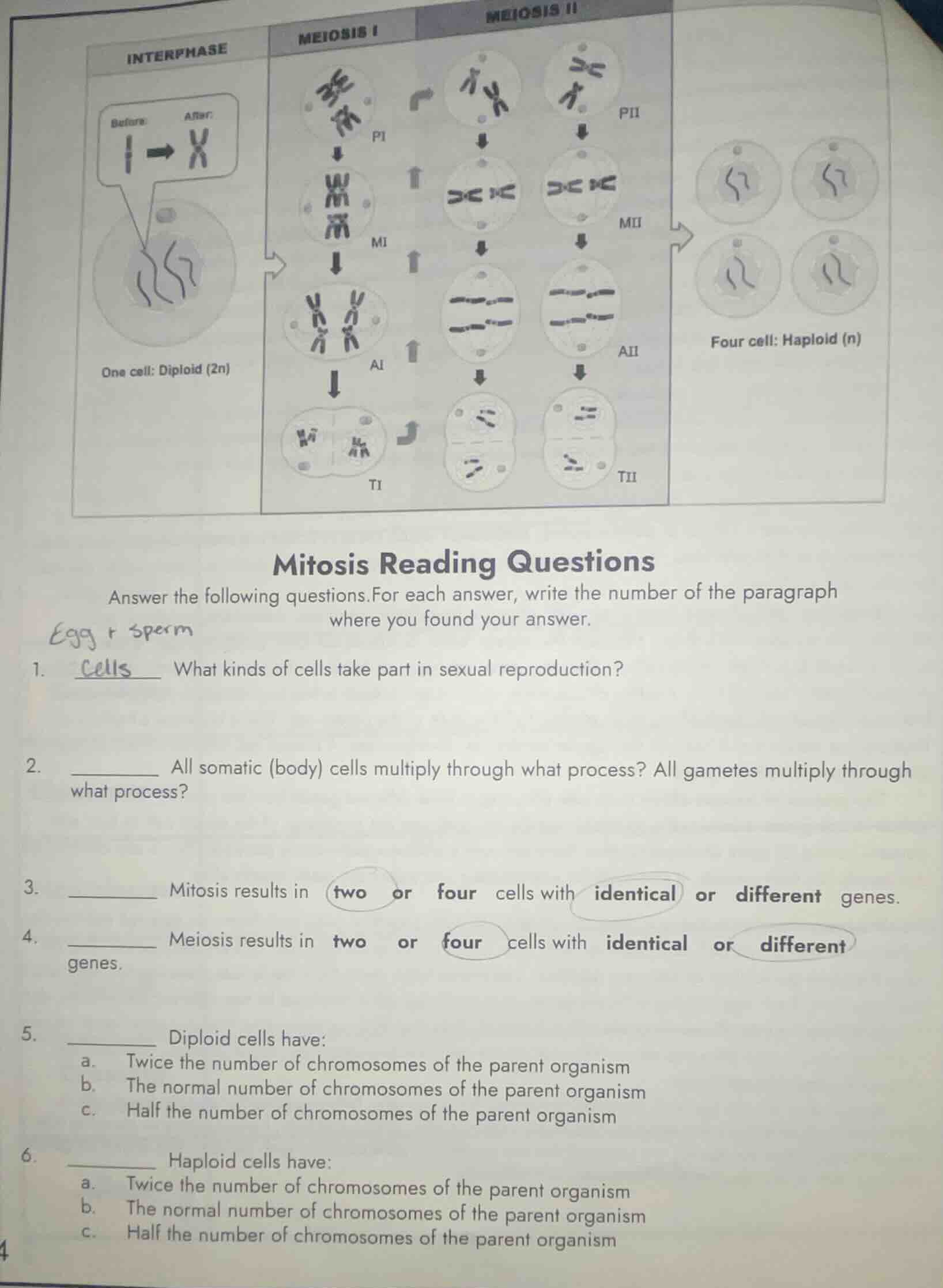
- cells what kinds of cells take part in sexual reproduction?
- all somatic (body) cells multiply through what process? all gametes multiply through what process?
- mitosis results in two or four cells with identical or different genes.
- meiosis results in two or four cells with identical or different genes.
- diploid cells have:
a. twice the number of chromosomes of the parent organism
b. the normal number of chromosomes of the parent organism
c. half the number of chromosomes of the parent organism
- haploid cells have:
a. twice the number of chromosomes of the parent organism
b. the normal number of chromosomes of the parent organism
c. half the number of chromosomes of the parent organism
Brief Explanations
- Gametes (sex cells like egg and sperm) are the cells that participate in sexual reproduction, fusing to form a zygote.
- Somatic cells use mitosis to produce identical diploid daughter cells for growth and repair. Gametes are formed via meiosis, which creates haploid, genetically unique cells.
- Mitosis is a conservative division that produces two genetically identical daughter cells with the same genes as the parent.
- Meiosis is a reduction division that creates four genetically distinct haploid cells, with genetic variation from crossing over and independent assortment.
- Diploid cells contain the full, normal set of chromosomes (two sets, one from each parent) for the organism, represented as 2n.
- Haploid cells contain half the normal number of chromosomes (one set), represented as n, typical of gametes.

Snap & solve any problem in the app
Get step-by-step solutions on Sovi AI
Photo-based solutions with guided steps
Explore more problems and detailed explanations
- Gametes (egg and sperm cells)
- Somatic cells: Mitosis; Gametes: Meiosis
- two, identical
- four, different
- b. The normal number of chromosomes of the parent organism
- c. Half the number of chromosomes of the parent organism