QUESTION IMAGE
Question
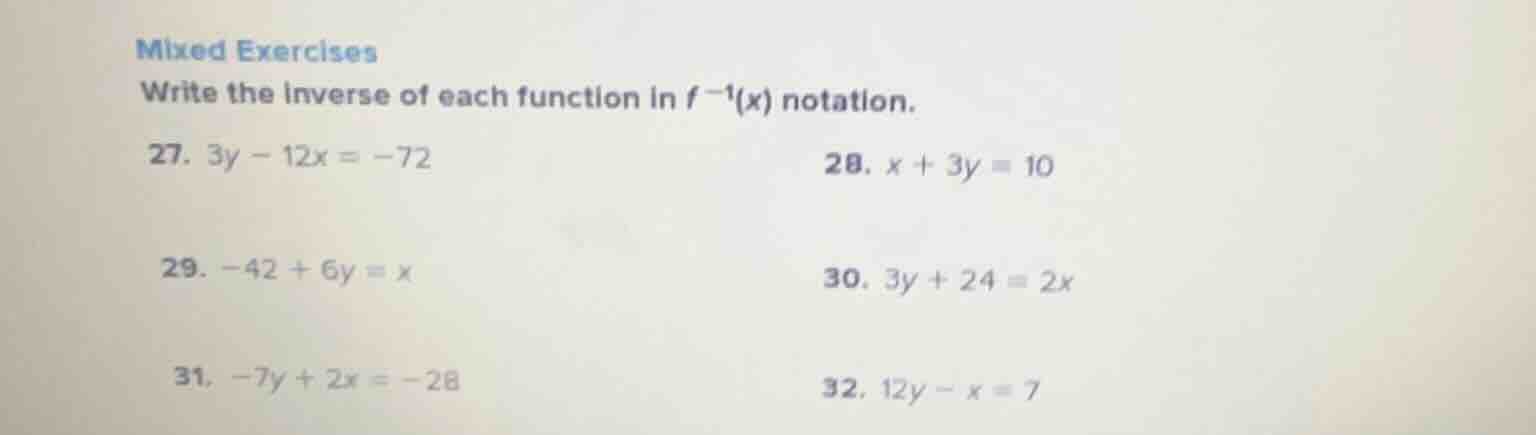
mixed exercises
write the inverse of each function in $f^{-1}(x)$ notation.
- $3y - 12x = -72$
- $x + 3y = 10$
- $-42 + 6y = x$
- $3y + 24 = 2x$
- $-7y + 2x = -28$
- $12y - x = 7$
Let's solve each problem step by step to find the inverse function \( f^{-1}(x) \). The general steps to find the inverse of a function (expressed as a linear equation) are: 1) Solve the original equation for \( y \) (treating \( x \) as the independent variable) to express \( y \) as a function of \( x \) (i.e., \( y = f(x) \)). 2) Swap \( x \) and \( y \) (this reflects the graph over the line \( y = x \), a key property of inverse functions). 3) Solve the new equation for \( y \) to get \( y = f^{-1}(x) \).
Problem 27: \( 3y - 12x = -72 \)
Step 1: Solve for \( y \)
Start with the original equation:
\( 3y - 12x = -72 \)
Add \( 12x \) to both sides:
\( 3y = 12x - 72 \)
Divide both sides by \( 3 \):
\( y = 4x - 24 \)
Step 2: Swap \( x \) and \( y \)
\( x = 4y - 24 \)
Step 3: Solve for \( y \)
Add \( 24 \) to both sides:
\( x + 24 = 4y \)
Divide both sides by \( 4 \):
\( y = \frac{1}{4}x + 6 \)
Thus, the inverse function is \( f^{-1}(x) = \frac{1}{4}x + 6 \).
Problem 28: \( x + 3y = 10 \)
Step 1: Solve for \( y \)
Start with the original equation:
\( x + 3y = 10 \)
Subtract \( x \) from both sides:
\( 3y = -x + 10 \)
Divide both sides by \( 3 \):
\( y = -\frac{1}{3}x + \frac{10}{3} \)
Step 2: Swap \( x \) and \( y \)
\( x = -\frac{1}{3}y + \frac{10}{3} \)
Step 3: Solve for \( y \)
Multiply both sides by \( 3 \) to eliminate denominators:
\( 3x = -y + 10 \)
Add \( y \) to both sides:
\( 3x + y = 10 \)
Subtract \( 3x \) from both sides:
\( y = -3x + 10 \)
Thus, the inverse function is \( f^{-1}(x) = -3x + 10 \).
Problem 29: \( -42 + 6y = x \)
Step 1: Solve for \( y \)
Start with the original equation:
\( -42 + 6y = x \)
Add \( 42 \) to both sides:
\( 6y = x + 42 \)
Divide both sides by \( 6 \):
\( y = \frac{1}{6}x + 7 \)
Step 2: Swap \( x \) and \( y \)
\( x = \frac{1}{6}y + 7 \)
Step 3: Solve for \( y \)
Subtract \( 7 \) from both sides:
\( x - 7 = \frac{1}{6}y \)
Multiply both sides by \( 6 \):
\( y = 6x - 42 \)
Thus, the inverse function is \( f^{-1}(x) = 6x - 42 \).
Problem 30: \( 3y + 24 = 2x \)
Step 1: Solve for \( y \)
Start with the original equation:
\( 3y + 24 = 2x \)
Subtract \( 24 \) from both sides:
\( 3y = 2x - 24 \)
Divide both sides by \( 3 \):
\( y = \frac{2}{3}x - 8 \)
Step 2: Swap \( x \) and \( y \)
\( x = \frac{2}{3}y - 8 \)
Step 3: Solve for \( y \)
Add \( 8 \) to both sides:
\( x + 8 = \frac{2}{3}y \)
Multiply both sides by \( \frac{3}{2} \):
\( y = \frac{3}{2}x + 12 \)
Thus, the inverse function is \( f^{-1}(x) = \frac{3}{2}x + 12 \).
Problem 31: \( -7y + 2x = -28 \)
Step 1: Solve for \( y \)
Start with the original equation:
\( -7y + 2x = -28 \)
Subtract \( 2x \) from both sides:
\( -7y = -2x - 28 \)
Divide both sides by \( -7 \):
\( y = \frac{2}{7}x + 4 \)
Step 2: Swap \( x \) and \( y \)
\( x = \frac{2}{7}y + 4 \)
Step 3: Solve for \( y \)
Subtract \( 4 \) from both sides:
\( x - 4 = \frac{2}{7}y \)
Multiply both sides by \( \frac{7}{2} \):
\( y = \frac{7}{2}x - 14 \)
Thus, the inverse function is \( f^{-1}(x) = \frac{7}{2}x - 14 \).
Problem 32: \( 12y - x = 7 \)
Step 1: Solve for \( y \)
Start with the original equation:
\( 12y - x = 7 \)
Add \( x \) to both sides:
\( 12y = x + 7 \)
Divide both sides by \( 12 \):
\( y = \frac{1}{12}x + \frac{7}{12} \)
Step 2: Swap \( x \) and \( y \)
\( x = \frac{1}{12}y + \frac{7}{12} \)
Step 3: Solve for \( y \)
Subtract \( \frac{7}{12} \) from both sides:
\( x - \frac{7}{12} = \frac{1}{12}y \)
Multiply both sides by \( 12 \):
\( y = 12x -…

Snap & solve any problem in the app
Get step-by-step solutions on Sovi AI
Photo-based solutions with guided steps
Explore more problems and detailed explanations
Let's solve each problem step by step to find the inverse function \( f^{-1}(x) \). The general steps to find the inverse of a function (expressed as a linear equation) are: 1) Solve the original equation for \( y \) (treating \( x \) as the independent variable) to express \( y \) as a function of \( x \) (i.e., \( y = f(x) \)). 2) Swap \( x \) and \( y \) (this reflects the graph over the line \( y = x \), a key property of inverse functions). 3) Solve the new equation for \( y \) to get \( y = f^{-1}(x) \).
Problem 27: \( 3y - 12x = -72 \)
Step 1: Solve for \( y \)
Start with the original equation:
\( 3y - 12x = -72 \)
Add \( 12x \) to both sides:
\( 3y = 12x - 72 \)
Divide both sides by \( 3 \):
\( y = 4x - 24 \)
Step 2: Swap \( x \) and \( y \)
\( x = 4y - 24 \)
Step 3: Solve for \( y \)
Add \( 24 \) to both sides:
\( x + 24 = 4y \)
Divide both sides by \( 4 \):
\( y = \frac{1}{4}x + 6 \)
Thus, the inverse function is \( f^{-1}(x) = \frac{1}{4}x + 6 \).
Problem 28: \( x + 3y = 10 \)
Step 1: Solve for \( y \)
Start with the original equation:
\( x + 3y = 10 \)
Subtract \( x \) from both sides:
\( 3y = -x + 10 \)
Divide both sides by \( 3 \):
\( y = -\frac{1}{3}x + \frac{10}{3} \)
Step 2: Swap \( x \) and \( y \)
\( x = -\frac{1}{3}y + \frac{10}{3} \)
Step 3: Solve for \( y \)
Multiply both sides by \( 3 \) to eliminate denominators:
\( 3x = -y + 10 \)
Add \( y \) to both sides:
\( 3x + y = 10 \)
Subtract \( 3x \) from both sides:
\( y = -3x + 10 \)
Thus, the inverse function is \( f^{-1}(x) = -3x + 10 \).
Problem 29: \( -42 + 6y = x \)
Step 1: Solve for \( y \)
Start with the original equation:
\( -42 + 6y = x \)
Add \( 42 \) to both sides:
\( 6y = x + 42 \)
Divide both sides by \( 6 \):
\( y = \frac{1}{6}x + 7 \)
Step 2: Swap \( x \) and \( y \)
\( x = \frac{1}{6}y + 7 \)
Step 3: Solve for \( y \)
Subtract \( 7 \) from both sides:
\( x - 7 = \frac{1}{6}y \)
Multiply both sides by \( 6 \):
\( y = 6x - 42 \)
Thus, the inverse function is \( f^{-1}(x) = 6x - 42 \).
Problem 30: \( 3y + 24 = 2x \)
Step 1: Solve for \( y \)
Start with the original equation:
\( 3y + 24 = 2x \)
Subtract \( 24 \) from both sides:
\( 3y = 2x - 24 \)
Divide both sides by \( 3 \):
\( y = \frac{2}{3}x - 8 \)
Step 2: Swap \( x \) and \( y \)
\( x = \frac{2}{3}y - 8 \)
Step 3: Solve for \( y \)
Add \( 8 \) to both sides:
\( x + 8 = \frac{2}{3}y \)
Multiply both sides by \( \frac{3}{2} \):
\( y = \frac{3}{2}x + 12 \)
Thus, the inverse function is \( f^{-1}(x) = \frac{3}{2}x + 12 \).
Problem 31: \( -7y + 2x = -28 \)
Step 1: Solve for \( y \)
Start with the original equation:
\( -7y + 2x = -28 \)
Subtract \( 2x \) from both sides:
\( -7y = -2x - 28 \)
Divide both sides by \( -7 \):
\( y = \frac{2}{7}x + 4 \)
Step 2: Swap \( x \) and \( y \)
\( x = \frac{2}{7}y + 4 \)
Step 3: Solve for \( y \)
Subtract \( 4 \) from both sides:
\( x - 4 = \frac{2}{7}y \)
Multiply both sides by \( \frac{7}{2} \):
\( y = \frac{7}{2}x - 14 \)
Thus, the inverse function is \( f^{-1}(x) = \frac{7}{2}x - 14 \).
Problem 32: \( 12y - x = 7 \)
Step 1: Solve for \( y \)
Start with the original equation:
\( 12y - x = 7 \)
Add \( x \) to both sides:
\( 12y = x + 7 \)
Divide both sides by \( 12 \):
\( y = \frac{1}{12}x + \frac{7}{12} \)
Step 2: Swap \( x \) and \( y \)
\( x = \frac{1}{12}y + \frac{7}{12} \)
Step 3: Solve for \( y \)
Subtract \( \frac{7}{12} \) from both sides:
\( x - \frac{7}{12} = \frac{1}{12}y \)
Multiply both sides by \( 12 \):
\( y = 12x - 7 \)
Thus, the inverse function is \( f^{-1}(x) = 12x - 7 \).
Final Answers:
- \( \boldsymbol{f^{-1}(x) = \frac{1}{4}x + 6} \)
- \( \boldsymbol{f^{-1}(x) = -3x + 10} \)
- \( \boldsymbol{f^{-1}(x) = 6x - 42} \)
- \( \boldsymbol{f^{-1}(x) = \frac{3}{2}x + 12} \)
- \( \boldsymbol{f^{-1}(x) = \frac{7}{2}x - 14} \)
- \( \boldsymbol{f^{-1}(x) = 12x - 7} \)