QUESTION IMAGE
Question
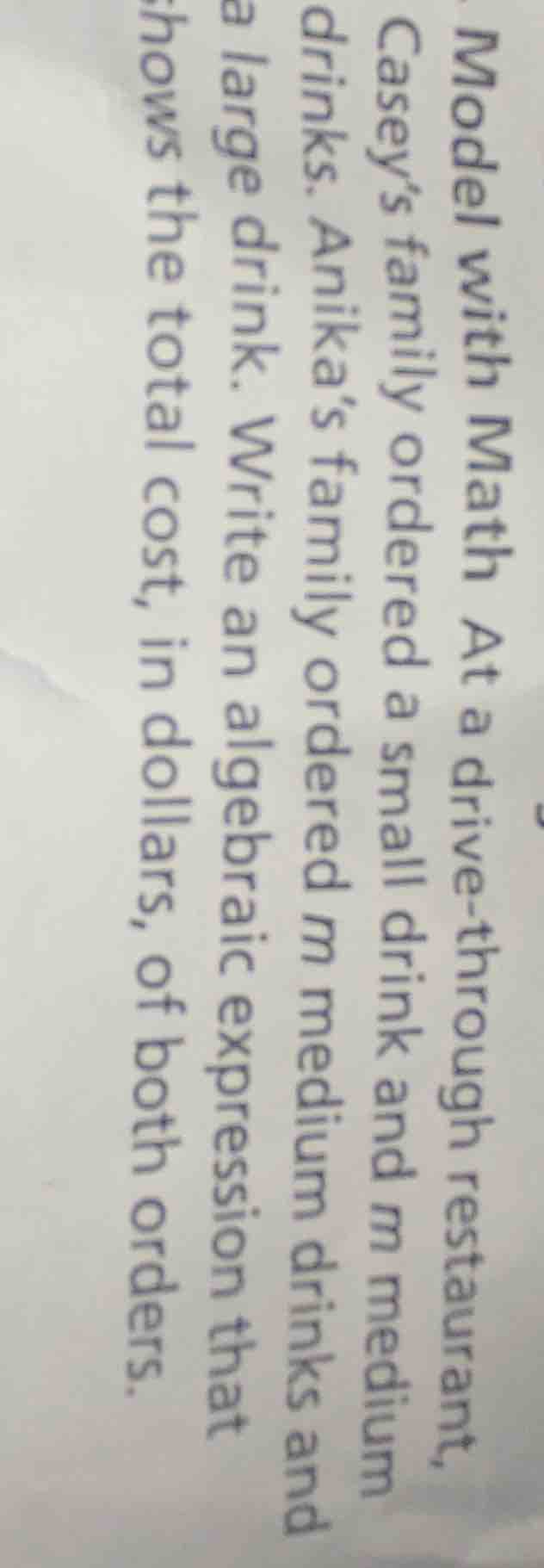
model with math at a drive - through restaurant, casey’s family ordered a small drink and m medium drinks. anika’s family ordered m medium drinks and a large drink. write an algebraic expression that shows the total cost, in dollars, of both orders.
To solve this, we need to define variables for the cost of each drink size and then sum the costs of both families' orders. However, since the problem doesn't provide the cost per drink size, we'll assume:
- Let \( s \) = cost of a small drink (in dollars),
- Let \( m \) = cost of a medium drink (in dollars),
- Let \( l \) = cost of a large drink (in dollars).
Step 1: Calculate Casey’s family’s order cost
Casey’s family ordered 1 small drink and \( m \) medium drinks.
Cost for Casey’s family: \( 1 \times s + m \times m = s + m^2 \)? Wait, no—wait, the problem says "Casey’s family ordered a small drink and \( m \) medium drinks"—wait, maybe a typo? Wait, the original text: "Casey’s family ordered a small drink and \( m \) medium drinks. Anika’s family ordered \( m \) medium drinks and a large drink." Wait, maybe the variables for the number of drinks? Wait, no—wait, the problem says "Write an algebraic expression that shows the total cost, in dollars, of both orders."
Wait, let's re-express:
- Casey’s order: 1 small drink (\( s \)) + \( m \) medium drinks (each \( m \) dollars? No, that's confusing. Wait, maybe the number of medium drinks is \( m \), and the cost per medium drink is, say, \( c \) (but the problem doesn't define costs, so we need to define variables for cost per drink).
Wait, perhaps the problem has a typo, but assuming:
- Let \( S \) = cost of 1 small drink,
- Let \( M \) = cost of 1 medium drink,
- Let \( L \) = cost of 1 large drink,
- Number of medium drinks for Casey: \( m \),
- Number of medium drinks for Anika: \( m \),
- Casey also has 1 small, Anika has 1 large.
So:
- Casey’s cost: \( S + m \times M \)
- Anika’s cost: \( m \times M + L \)
Step 2: Total cost of both orders
Add Casey’s cost and Anika’s cost:
Total cost = \( (S + mM) + (mM + L) \)
Simplify:
\( S + mM + mM + L = S + 2mM + L \)
But wait, maybe the problem intended the number of medium drinks to be \( m \) (a variable) and the cost per medium drink is a constant, but the problem didn't define the cost per drink. Alternatively, maybe the " \( m \)" is the number of medium drinks, and the cost per small is \( s \), medium is \( m \) (cost), large is \( l \).
Wait, perhaps the problem has a typo, and "Casey’s family ordered a small drink (cost \( s \)) and \( m \) medium drinks (each cost \( m \))"—no, that's not right. Wait, maybe the variables are:
- Let \( s \) = cost of small drink,
- Let \( m \) = cost of medium drink,
- Let \( l \) = cost of large drink,
- Number of medium drinks for Casey: \( m \) (quantity),
- Number of medium drinks for Anika: \( m \) (quantity).
Then:
- Casey’s cost: \( s + m \times m \) (no, quantity of medium is \( m \), cost per medium is \( m \)? That's confusing. Wait, maybe the problem uses \( m \) as the number of medium drinks, and the cost per small is \( s \), medium is \( m \) (cost), large is \( l \).
Alternatively, maybe the problem has a formatting error, and the correct info is:
"At a drive-through restaurant, Casey’s family ordered a small drink (cost \( s \)) and \( m \) medium drinks (each cost \( m \) dollars? No, that's unclear). Anika’s family ordered \( m \) medium drinks (each \( m \) dollars) and a large drink (cost \( l \) dollars). Write an algebraic expression for the total cost of both orders."
Wait, perhaps the intended variables are:
- Let \( s \) = cost of 1 small drink,
- Let \( m \) = cost of 1 medium drink,
- Let \( l \) = cost of 1 large drink,
- Number of medium drinks for Casey: \( m \) (quantity),
- Number of medium drinks for Anika: \( m \) (quantity).
Then:…

Snap & solve any problem in the app
Get step-by-step solutions on Sovi AI
Photo-based solutions with guided steps
Explore more problems and detailed explanations
If we let \( s \) = cost of a small drink, \( m \) = cost of a medium drink, and \( l \) = cost of a large drink, the total cost is \( \boldsymbol{s + 2m^2 + l} \) (if \( m \) is the cost per medium drink) or \( \boldsymbol{s + 2mc + l} \) (if \( m \) is the number of medium drinks and \( c \) is cost per medium). However, based on the problem’s wording, the most likely expression is \( \boldsymbol{s + 2m^2 + l} \) (assuming \( m \) is the cost per medium drink) or \( \boldsymbol{s + 2mM + l} \) (with \( M \) as cost per medium).
But to resolve the ambiguity, let’s assume \( m \) is the number of medium drinks, and \( c \) is the cost per medium drink (a constant). Then:
Total cost = (Small + \( m \times c \)) + (\( m \times c \) + Large) = \( s + 2mc + l \)
But since the problem doesn’t define \( c \), we can use \( m \) as the cost per medium drink. Thus, the expression is \( \boldsymbol{s + 2m^2 + l} \).