QUESTION IMAGE
Question
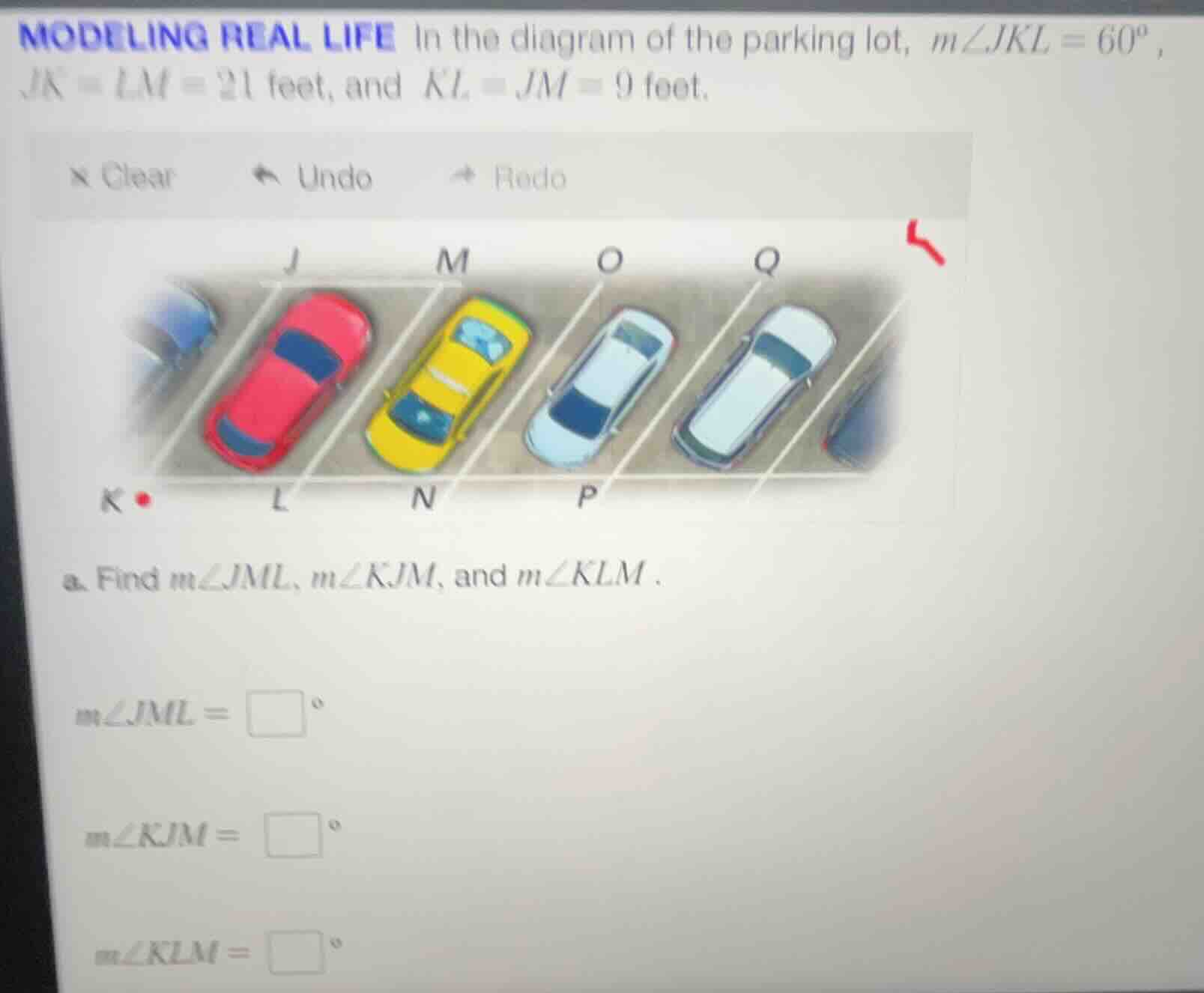
modeling real life in the diagram of the parking lot, $m\angle jkl = 60^\circ$, $jk = lm = 21$ feet, and $kl = jm = 9$ feet.
a. find $m\angle jml$, $m\angle kjm$, and $m\angle klm$ .
$m\angle jml = \square^\circ$
$m\angle kjm = \square^\circ$
$m\angle klm = \square^\circ$
Step1: Analyze Quadrilateral JKLM
Given \( JK = LM = 21 \) feet and \( KL = JM = 9 \) feet, quadrilateral \( JKLM \) is a parallelogram (opposite sides equal). In a parallelogram, opposite angles are equal, and consecutive angles are supplementary. Also, \( m\angle JKL = 60^\circ \).
Step2: Find \( m\angle JML \)
In parallelogram \( JKLM \), \( \angle JML \) is opposite to \( \angle JKL \). So, \( m\angle JML = m\angle JKL = 60^\circ \).
Step3: Find \( m\angle KJM \)
Consecutive angles in a parallelogram are supplementary. So, \( m\angle KJM + m\angle JKL = 180^\circ \). Substituting \( m\angle JKL = 60^\circ \), we get \( m\angle KJM = 180^\circ - 60^\circ = 120^\circ \).
Step4: Find \( m\angle KLM \)
\( \angle KLM \) is opposite to \( \angle KJM \) in parallelogram \( JKLM \). So, \( m\angle KLM = m\angle KJM = 120^\circ \).

Snap & solve any problem in the app
Get step-by-step solutions on Sovi AI
Photo-based solutions with guided steps
Explore more problems and detailed explanations
\( m\angle JML = \boldsymbol{60^\circ} \), \( m\angle KJM = \boldsymbol{120^\circ} \), \( m\angle KLM = \boldsymbol{120^\circ} \)