QUESTION IMAGE
Question
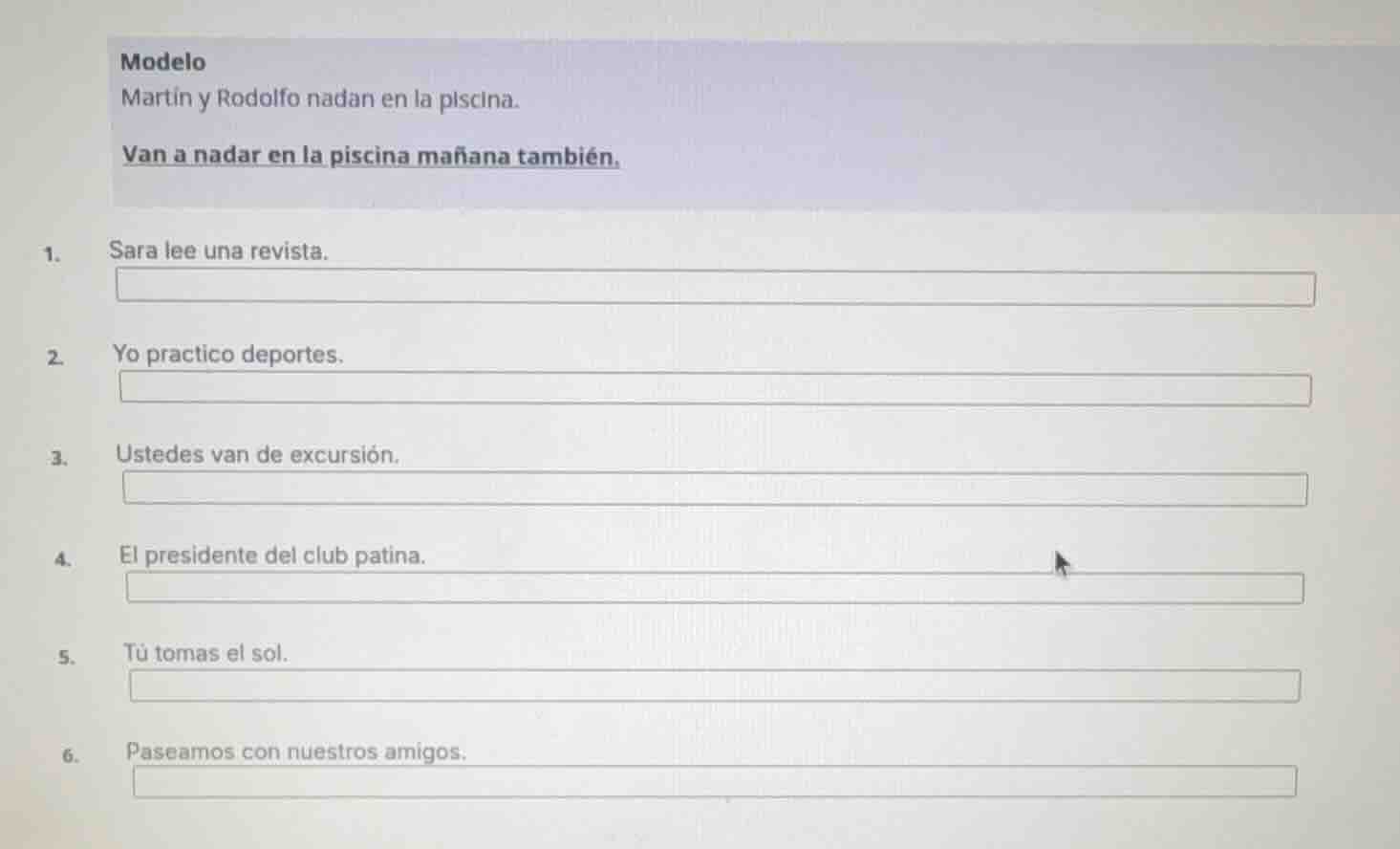
modelo
martín y rodolfo nadan en la piscina.
van a nadar en la piscina mañana también.
- sara lee una revista.
- yo practico deportes.
- ustedes van de excursión.
- el presidente del club patina.
- tú tomas el sol.
- paseamos con nuestros amigos.
To solve this, we follow the model: take the present action and form a future intention using "van a" (adjusting the subject's verb form) + the verb + "mañana también".
1. Sara lee una revista.
Step1: Identify subject and verb.
Subject: Sara (ella), verb: leer (infinitive).
Step2: Form future intention.
Use "va a" (for ella) + leer + "mañana también".
<Va a leer una revista mañana también.>
2. Yo practico deportes.
Step1: Identify subject and verb.
Subject: Yo, verb: practicar (infinitive).
Step2: Form future intention.
Use "voy a" (for yo) + practicar + "mañana también".
<Voy a practicar deportes mañana también.>
3. Ustedes van de excursión.
Step1: Identify subject and verb.
Subject: Ustedes, verb: ir (infinitive, "van" is present, infinitive is "ir"). Wait, action is "van de excursión" (go on a hike), so infinitive of "van" (ir) is "ir", but the action is "ir de excursión". Wait, no: the present is "van de excursión", so the verb is "ir" (to go). For "ustedes", use "van a" + infinitive. Wait, "van" is present, so future intention: "van a ir de excursión mañana también"? Wait no, the model: original is "nadar", present "nadan", future "van a nadar". So the verb in the present is the action, so for "van de excursión" (present: they go on a hike), the future intention is "van a ir de excursión mañana también"? Wait, no, maybe I misread. Wait the model: "Martín y Rodolfo nadan en la piscina." (present: swim), then "Van a nadar en la piscina mañana también." (they are going to swim...). So the verb in the present is the action, so we take that verb (infinitive) and use "van a" + infinitive. Wait, "nadan" is present, infinitive "nadar". So for "van de excursión" (present: they go on a hike), the verb is "ir" (to go), so infinitive "ir". So "Ustedes van a ir de excursión mañana también."? Wait, but maybe the action is "ir de excursión", so the infinitive is "ir de excursión"? No, "ir" is the verb, "de excursión" is the complement. So:
Step1: Subject: Ustedes, verb (action): ir (to go), complement: de excursión.
Step2: Form future intention: "van a" + infinitive (ir) + complement + "mañana también".
<Ustedes van a ir de excursión mañana también.>
4. El presidente del club patina.

Snap & solve any problem in the app
Get step-by-step solutions on Sovi AI
Photo-based solutions with guided steps
Explore more problems and detailed explanations
s:
- Va a leer una revista mañana también.
- Voy a practicar deportes mañana también.
- Ustedes van a ir de excursión mañana también.
- El presidente del club va a patinar mañana también.
- Tú vas a tomar el sol mañana también.
- Vamos a pasear con nuestros amigos mañana también.