QUESTION IMAGE
Question
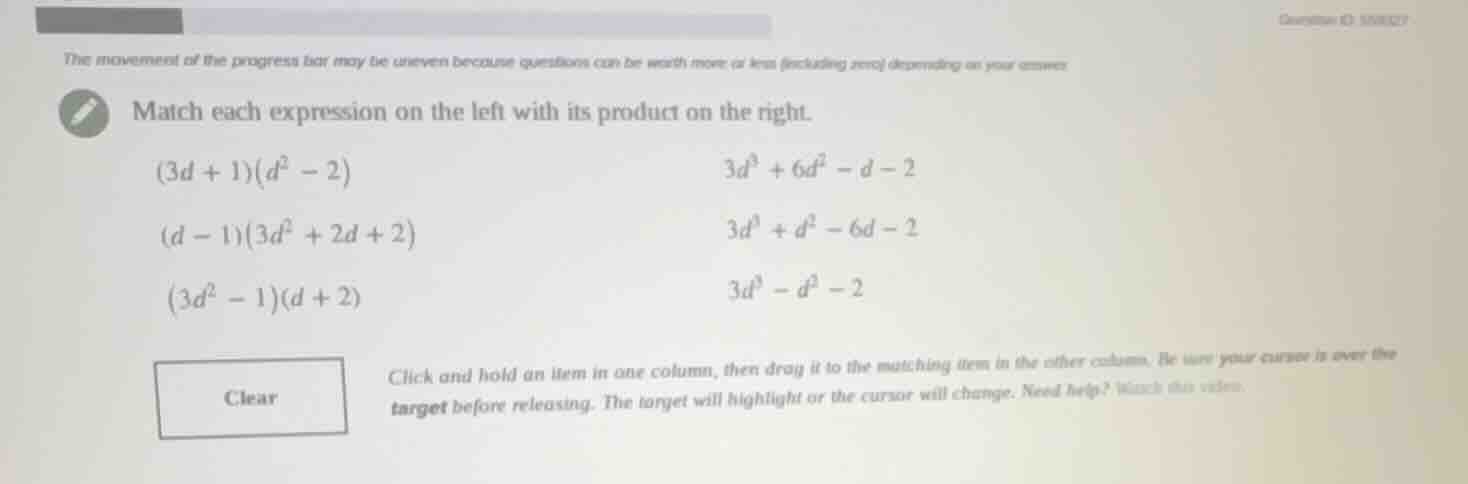
the movement of the progress bar may be uneven because questions can be worth more or less (including zero) depending on your answer match each expression on the left with its product on the right. (3d + 1)(d² - 2) 3d³ + 6d² - d - 2 (d - 1)(3d² + 2d + 2) 3d³ + d² - 6d - 2 (3d² - 1)(d + 2) 3d³ - d² - 2 clear click and hold an item in one column, then drag it to the matching item in the other column. be sure your cursor is over the target before releasing. the target will highlight or the cursor will change. need help? watch the video.
Step1: Expand \((3d + 1)(d^2 - 2)\)
Using the distributive property (FOIL method for binomials, extended for polynomials):
\(3d \times d^2 + 3d \times (-2) + 1 \times d^2 + 1 \times (-2)\)
\(= 3d^3 - 6d + d^2 - 2\)
Wait, no, let's do it correctly. Multiply each term in the first polynomial by each term in the second:
\(3d \times d^2 = 3d^3\), \(3d \times (-2) = -6d\), \(1 \times d^2 = d^2\), \(1 \times (-2) = -2\)
Now combine like terms: \(3d^3 + d^2 - 6d - 2\) Wait, no, that's not right. Wait, let's check again. Wait, \((3d + 1)(d^2 - 2) = 3d \times d^2 + 3d \times (-2) + 1 \times d^2 + 1 \times (-2) = 3d^3 - 6d + d^2 - 2 = 3d^3 + d^2 - 6d - 2\)? Wait, no, maybe I made a mistake. Wait, let's do the second one.
Step2: Expand \((d - 1)(3d^2 + 2d + 2)\)
Multiply \(d\) by each term in the second polynomial: \(d \times 3d^2 = 3d^3\), \(d \times 2d = 2d^2\), \(d \times 2 = 2d\)
Multiply \(-1\) by each term: \(-1 \times 3d^2 = -3d^2\), \(-1 \times 2d = -2d\), \(-1 \times 2 = -2\)
Now combine like terms: \(3d^3 + 2d^2 + 2d - 3d^2 - 2d - 2 = 3d^3 - d^2 - 2\)
Step3: Expand \((3d^2 - 1)(d + 2)\)
Multiply \(3d^2\) by each term: \(3d^2 \times d = 3d^3\), \(3d^2 \times 2 = 6d^2\)
Multiply \(-1\) by each term: \(-1 \times d = -d\), \(-1 \times 2 = -2\)
Combine like terms: \(3d^3 + 6d^2 - d - 2\)
Now let's match:
- \((3d + 1)(d^2 - 2)\) expands to \(3d^3 + d^2 - 6d - 2\) (Wait, no, wait my first expansion was wrong. Wait, let's redo \((3d + 1)(d^2 - 2)\):
\(3d \times d^2 = 3d^3\), \(3d \times (-2) = -6d\), \(1 \times d^2 = d^2\), \(1 \times (-2) = -2\). So combining: \(3d^3 + d^2 - 6d - 2\). Wait, but the right side has \(3d^3 + d^2 - 6d - 2\) as one of the options. Wait, no, the right side options are:
First right option: \(3d^3 + 6d^2 - d - 2\)
Second: \(3d^3 + d^2 - 6d - 2\)
Third: \(3d^3 - d^2 - 2\)
Wait, so:
- \((3d + 1)(d^2 - 2)\) expands to \(3d^3 + d^2 - 6d - 2\) (matches the second right option)
- \((d - 1)(3d^2 + 2d + 2)\) expands to \(3d^3 - d^2 - 2\) (matches the third right option)
- \((3d^2 - 1)(d + 2)\) expands to \(3d^3 + 6d^2 - d - 2\) (matches the first right option)
So the matches are:
\((3d + 1)(d^2 - 2)\) → \(3d^3 + d^2 - 6d - 2\)
\((d - 1)(3d^2 + 2d + 2)\) → \(3d^3 - d^2 - 2\)
\((3d^2 - 1)(d + 2)\) → \(3d^3 + 6d^2 - d - 2\)

Snap & solve any problem in the app
Get step-by-step solutions on Sovi AI
Photo-based solutions with guided steps
Explore more problems and detailed explanations
- \((3d + 1)(d^2 - 2)\) matches \(3d^3 + d^2 - 6d - 2\)
- \((d - 1)(3d^2 + 2d + 2)\) matches \(3d^3 - d^2 - 2\)
- \((3d^2 - 1)(d + 2)\) matches \(3d^3 + 6d^2 - d - 2\)