QUESTION IMAGE
Question
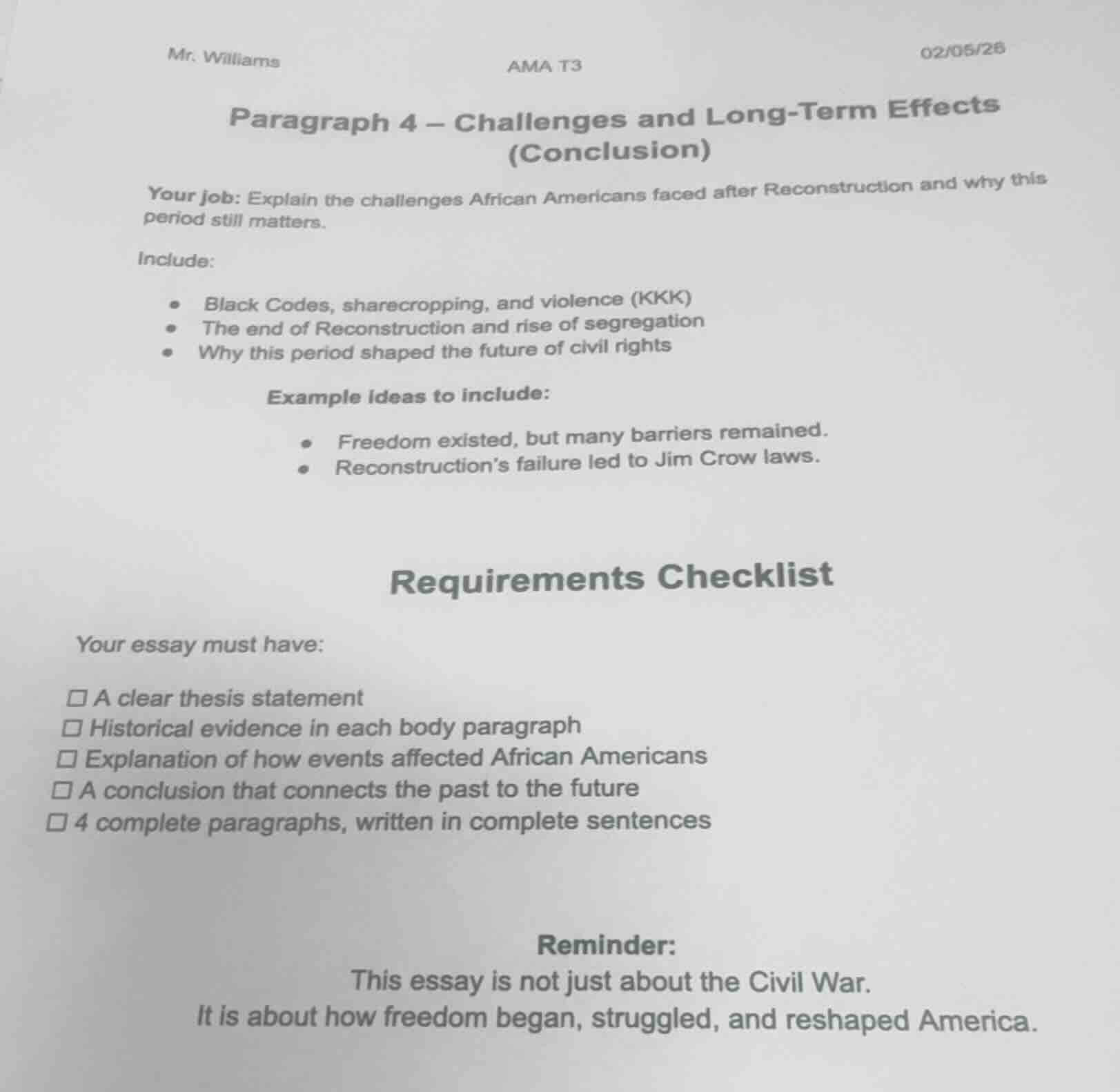
mr. williams
ama t3
02/05/26
paragraph 4 – challenges and long-term effects
(conclusion)
your job: explain the challenges african americans faced after reconstruction and why this
period still matters.
include:
- black codes, sharecropping, and violence (kkk)
- the end of reconstruction and rise of segregation
- why this period shaped the future of civil rights
example ideas to include:
- freedom existed, but many barriers remained.
- reconstruction’s failure led to jim crow laws.
requirements checklist
your essay must have:
☐ a clear thesis statement
☐ historical evidence in each body paragraph
☐ explanation of how events affected african americans
☐ a conclusion that connects the past to the future
☐ 4 complete paragraphs, written in complete sentences
reminder:
this essay is not just about the civil war.
it is about how freedom began, struggled, and reshaped america.
To address this, we analyze the post - Reconstruction challenges for African Americans:
1. Challenges Faced
- Black Codes: After the Civil War, Southern states enacted Black Codes. These laws severely restricted the rights of African Americans. For instance, they limited their ability to own property, enter certain professions, or move freely. This was a direct attempt to maintain a system of racial control similar to slavery, as it forced African Americans into a state of economic and social dependency.
- Sharecropping: This system emerged as a replacement for slavery in the agricultural economy. African American farmers would rent land from white landowners, often at exorbitant rates, and give a large portion of their crop as payment. It trapped them in a cycle of debt and poverty, as they rarely had enough resources left to improve their situation or break free from the arrangement.
- Violence (KKK): The Ku Klux Klan and other white supremacist groups used terror and violence to suppress African Americans. They targeted those who tried to exercise their rights, such as voting or seeking education. This violence created a climate of fear that prevented many African Americans from fully participating in society or advocating for their rights.
- End of Reconstruction and Segregation: The end of the Reconstruction era (around 1877) led to the rise of Jim Crow laws. These laws enforced racial segregation in all aspects of life, from schools and public transportation to restaurants and housing. Segregation denied African Americans equal access to resources, opportunities, and public services, further entrenching racial inequality.
2. Why the Period Matters
- Civil Rights Legacy: The struggles during this period laid the foundation for the modern civil rights movement. The failures of Reconstruction and the subsequent oppression highlighted the need for a more comprehensive fight for equality. Activists in the 20th century, like those in the Montgomery Bus Boycott or the March on Washington, were inspired by the earlier efforts of African Americans to gain their rights and learned from the mistakes of the post - Reconstruction era.
- American Identity: The way the nation dealt with the freedom of African Americans after the Civil War shaped its identity. It revealed deep - seated racial tensions and the struggle between the ideals of liberty and the reality of racial prejudice. This period showed how the concept of freedom was not evenly applied, and the long - term effects of these injustices continued to influence social, political, and economic structures in the United States for decades to come.

Snap & solve any problem in the app
Get step-by-step solutions on Sovi AI
Photo-based solutions with guided steps
Explore more problems and detailed explanations
After Reconstruction, African Americans faced immense challenges. Black Codes restricted their rights, sharecropping trapped them in poverty, and groups like the KKK used violence to suppress them. The end of Reconstruction led to Jim Crow segregation, which enforced racial inequality in all aspects of life. This period matters because its failures and the resulting oppression fueled the modern civil rights movement, and it shaped America’s identity by exposing the struggle between the ideal of freedom and racial prejudice, with long - lasting impacts on the nation’s social, political, and economic structures.