QUESTION IMAGE
Question
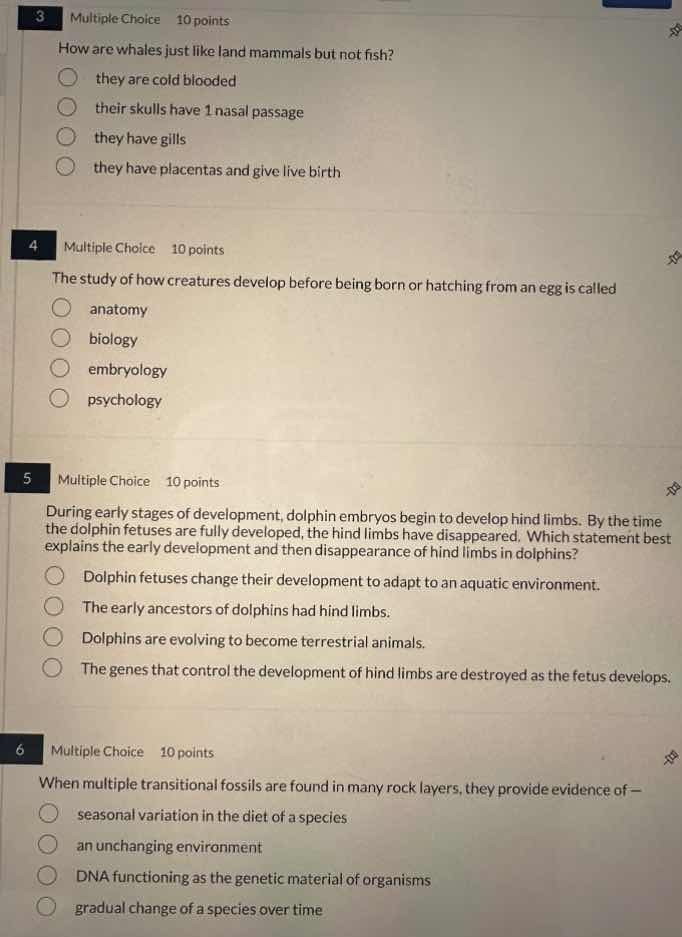
3 multiple choice 10 points
how are whales just like land mammals but not fish?
they are cold blooded
their skulls have 1 nasal passage
they have gills
they have placentas and give live birth
4 multiple choice 10 points
the study of how creatures develop before being born or hatching from an egg is called
anatomy
biology
embryology
psychology
5 multiple choice 10 points
during early stages of development, dolphin embryos begin to develop hind limbs. by the time the dolphin fetuses are fully developed, the hind limbs have disappeared. which statement best explains the early development and then disappearance of hind limbs in dolphins?
dolphin fetuses change their development to adapt to an aquatic environment.
the early ancestors of dolphins had hind limbs.
dolphins are evolving to become terrestrial animals.
the genes that control the development of hind limbs are destroyed as the fetus develops.
6 multiple choice 10 points
when multiple transitional fossils are found in many rock layers, they provide evidence of—
seasonal variation in the diet of a species
an unchanging environment
dna functioning as the genetic material of organisms
gradual change of a species over time
Question 3
- Whales are mammals, so they are warm - blooded (eliminate "they are cold blooded").
- Whale skulls have 2 nasal passages (eliminate "their skulls have 1 nasal passage").
- Fish have gills, whales don't (eliminate "they have gills").
- Mammals (including whales) have placentas and give live birth, while fish lay eggs. So this option is correct.
- Anatomy is the study of the structure of organisms.
- Biology is the study of life in general.
- Embryology is the study of the development of embryos (before birth or hatching).
- Psychology is the study of the mind and behavior. So the correct answer is embryology.
- Dolphin fetuses do not actively change development to adapt (development is guided by genetics/evolutionary history, not active adaptation in the fetal stage, eliminate first option).
- The presence of hind limbs in embryos and their disappearance in fetuses is evidence of evolutionary history - early ancestors of dolphins had hind limbs (this is a case of vestigial - like development in embryos).
- Dolphins are aquatic, not evolving to be terrestrial (eliminate third option).
- Genes are not destroyed, they are either not expressed or their expression is modified (eliminate fourth option).

Snap & solve any problem in the app
Get step-by-step solutions on Sovi AI
Photo-based solutions with guided steps
Explore more problems and detailed explanations
D. they have placentas and give live birth