QUESTION IMAGE
Question
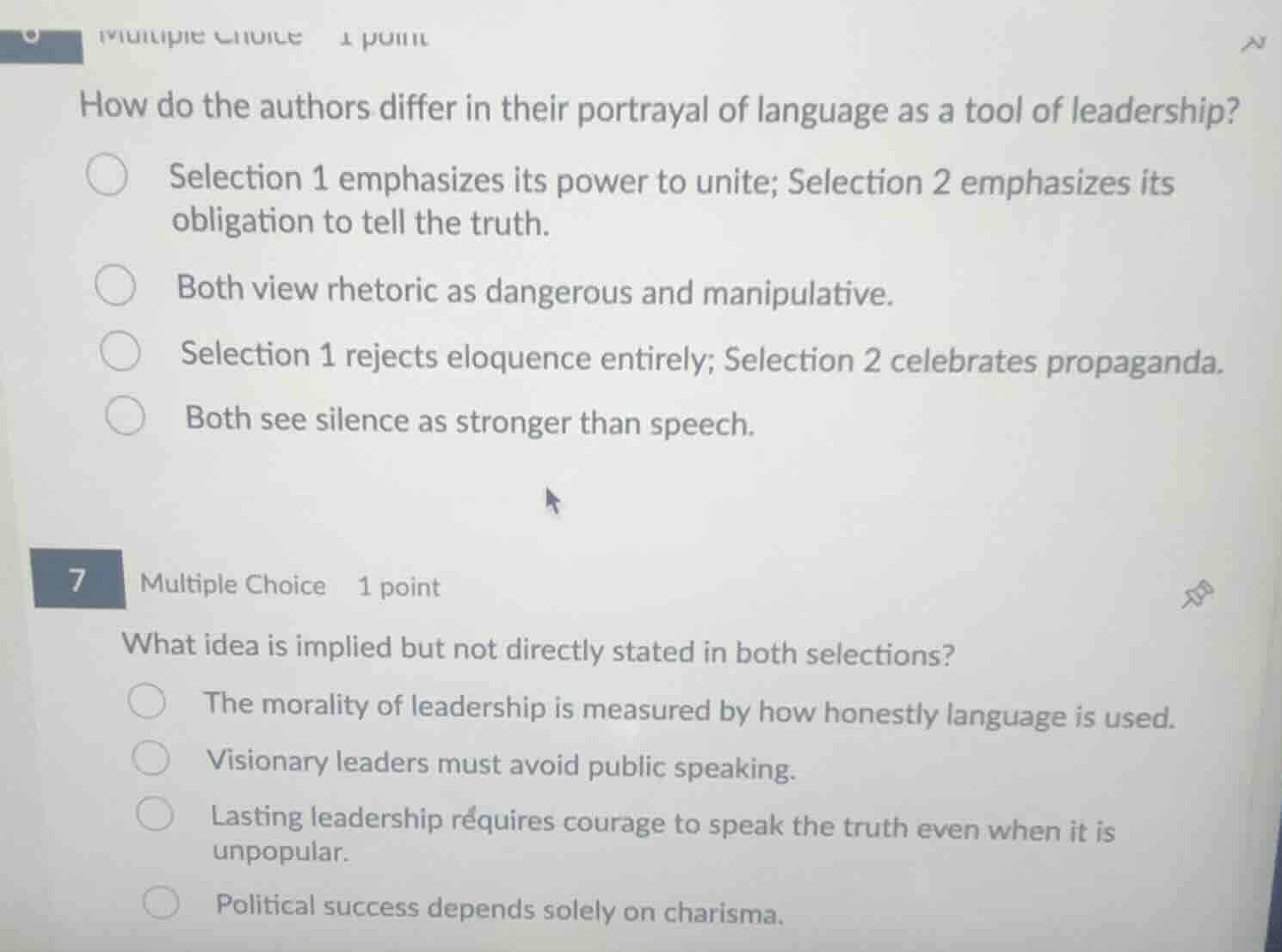
multiple choice 1 point how do the authors differ in their portrayal of language as a tool of leadership? selection 1 emphasizes its power to unite; selection 2 emphasizes its obligation to tell the truth. both view rhetoric as dangerous and manipulative. selection 1 rejects eloquence entirely; selection 2 celebrates propaganda. both see silence as stronger than speech. 7 multiple choice 1 point what idea is implied but not directly stated in both selections? the morality of leadership is measured by how honestly language is used. visionary leaders must avoid public speaking. lasting leadership requires courage to speak the truth even when it is unpopular. political success depends solely on charisma.
Question 6 (How do the authors differ...):
- Analyze each option:
- Option 1: Plausible as different portrayals (unite vs. truth - telling) fit "differ" in portrayal.
- Option 2: "Both view rhetoric as dangerous" is not indicated (no info on both seeing rhetoric as such), eliminate.
- Option 3: "Rejects eloquence entirely" and "celebrates propaganda" are extreme and not supported, eliminate.
- Option 4: "Both see silence as stronger" has no support, eliminate.
- Analyze each option:
- Option 1: The morality of leadership tied to honest language use can be implied from themes of language in leadership (e.g., truth - telling in selection 2, uniting in 1 with honest intent maybe).
- Option 2: "Must avoid public speaking" is not implied (no info on avoiding), eliminate.
- Option 3: "Courage to speak truth" is not directly implied (no mention of courage), eliminate.
- Option 4: "Solely on charisma" is extreme and not implied (language is a tool, so not solely charisma), eliminate.

Snap & solve any problem in the app
Get step-by-step solutions on Sovi AI
Photo-based solutions with guided steps
Explore more problems and detailed explanations
A. Selection 1 emphasizes its power to unite; Selection 2 emphasizes its obligation to tell the truth.