QUESTION IMAGE
Question
multiple choice question
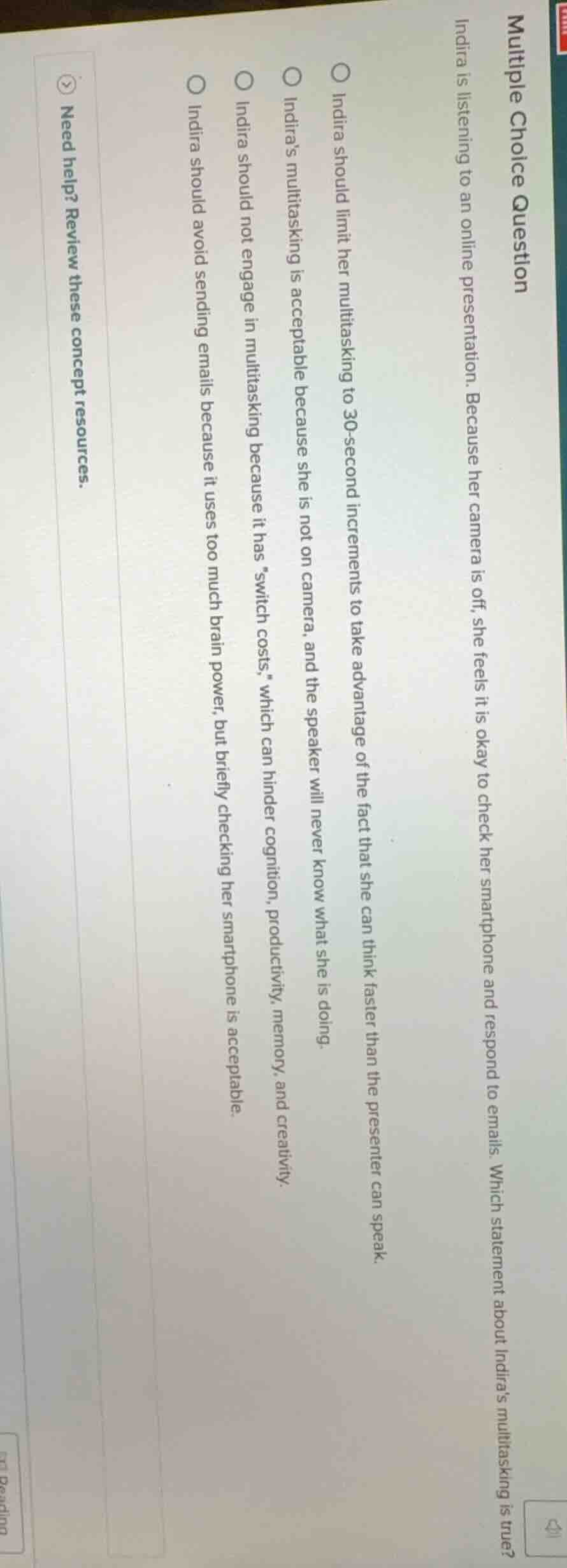
indira is listening to an online presentation. because her camera is off, she feels it is okay to check her smartphone and respond to emails. which statement about indira’s multitasking is true?
indira should limit her multitasking to 30 - second increments to take advantage of the fact that she can think faster than the presenter can speak.
indira’s multitasking is acceptable because she is not on camera, and the speaker will never know what she is doing.
indira should not engage in multitasking because it has “switch costs,” which can hinder cognition, productivity, memory, and creativity.
indira should avoid sending emails because it uses too much brain power, but briefly checking her smartphone is acceptable.
need help? review these concept resources.
Multitasking (switching between listening to a presentation and checking emails/responding to them) incurs "switch costs"—mental overhead from shifting attention. This impairs cognitive functions like focus, memory, productivity, and creativity, regardless of whether the camera is off. The other options are incorrect: limiting multitasking to short increments still carries switch costs, the speaker doesn't need to see her for multitasking to harm her own learning, and even brief smartphone checking involves the same cognitive costs as emailing.

Snap & solve any problem in the app
Get step-by-step solutions on Sovi AI
Photo-based solutions with guided steps
Explore more problems and detailed explanations
Indira should not engage in multitasking because it has "switch costs," which can hinder cognition, productivity, memory, and creativity.