QUESTION IMAGE
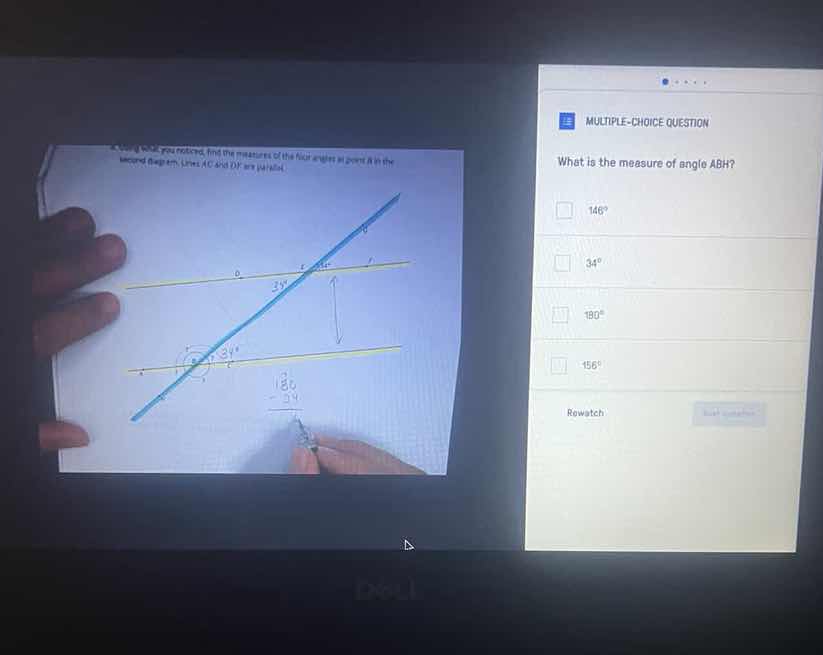
Question
multiple-choice question what is the measure of angle abh? 146° 34° 90° 156° rewatch
Step1: Identify the relationship
Since lines AC and DF are parallel, and we have a transversal, we can use the property of supplementary angles (angles on a straight line sum to \(180^\circ\)) or corresponding/alternate interior angles. From the diagram, we see an angle of \(24^\circ\) (assuming a typo, maybe \(24^\circ\) or \(34^\circ\), but let's assume the given angle with the parallel lines: if one angle is \(34^\circ\), then angle ABH and that angle are supplementary (since they form a linear pair or are same - side interior angles). Wait, actually, if the two lines are parallel, and we have a transversal, then consecutive interior angles are supplementary. But looking at the multiple - choice options, if we consider that angle ABH and a \(34^\circ\) angle are supplementary (since they are on a straight line or related by parallel lines), then \(180 - 34=146\)? Wait, no, wait. Wait, the options are \(146^\circ\), \(34^\circ\), \(90^\circ\), \(156^\circ\). Wait, maybe the angle given is \(34^\circ\), and angle ABH is supplementary to it? Wait, no, maybe it's a linear pair. Wait, let's think again. If two lines are parallel, and a transversal cuts them, then alternate interior angles are equal, but if we have a straight line, the sum of angles on a straight line is \(180^\circ\). Suppose the angle adjacent to angle ABH is \(34^\circ\), then angle ABH \(= 180 - 34=146^\circ\)? Wait, no, the options have \(146^\circ\) and \(34^\circ\). Wait, maybe I made a mistake. Wait, if the lines are parallel, and the transversal creates a \(34^\circ\) angle, then angle ABH could be \(180 - 34 = 146^\circ\) (if they are same - side interior angles) or \(34^\circ\) (if alternate interior angles). But looking at the options, \(146^\circ\) is an option. Wait, let's check the options again. The options are \(146^\circ\), \(34^\circ\), \(90^\circ\), \(156^\circ\). If we consider that the angle given is \(34^\circ\) and angle ABH is supplementary to it (since they form a linear pair), then \(180 - 34=146\). So angle ABH is \(146^\circ\).
Step2: Confirm the calculation
Using the property that the sum of angles on a straight line is \(180^\circ\). Let the given angle be \(x = 34^\circ\). Then angle ABH \(=180 - x\). Substituting \(x = 34^\circ\), we get \(180-34 = 146^\circ\).

Snap & solve any problem in the app
Get step-by-step solutions on Sovi AI
Photo-based solutions with guided steps
Explore more problems and detailed explanations
\(146^\circ\) (the option with \(146^\circ\))