QUESTION IMAGE
Question
multiple-choice questions
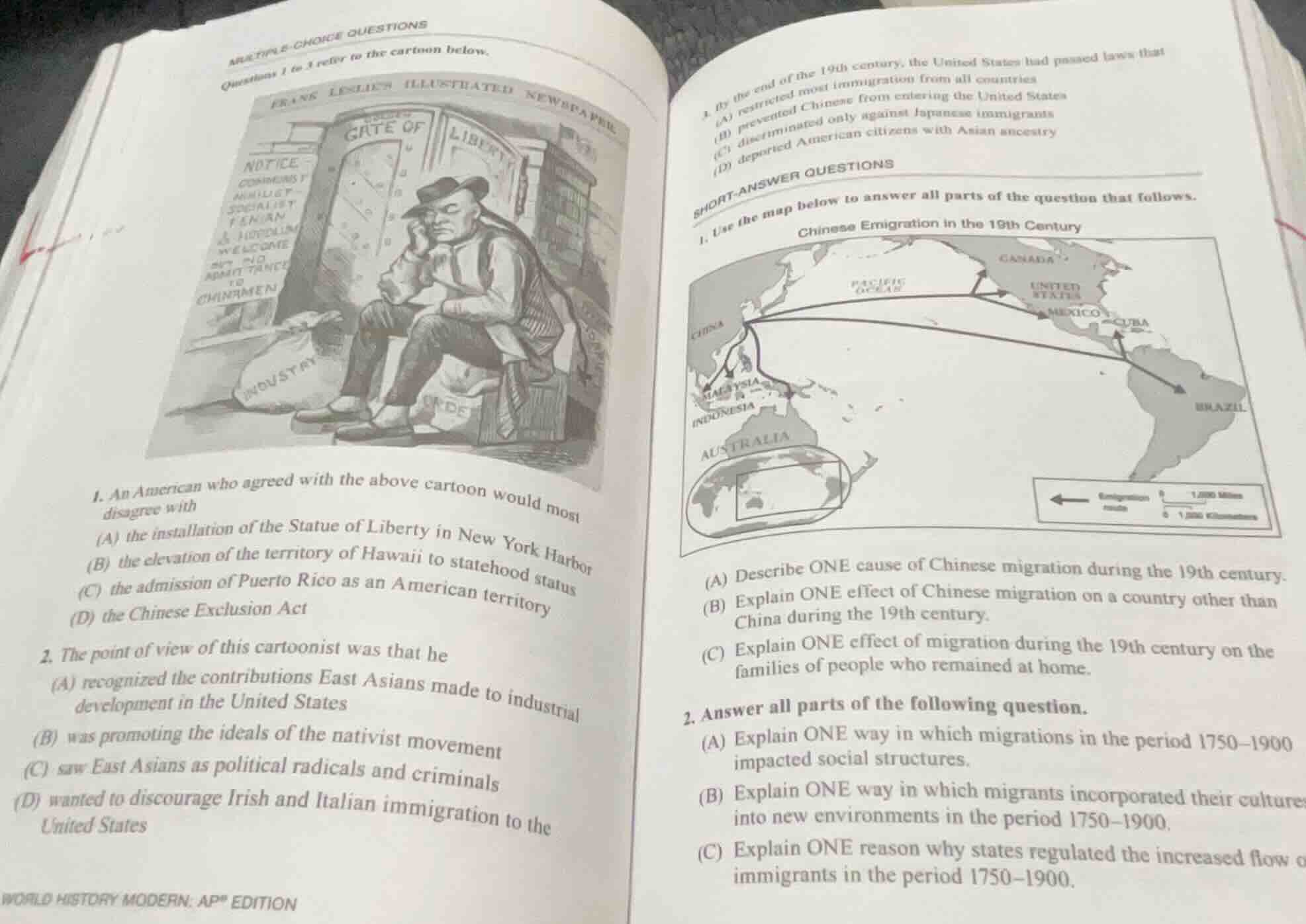
questions 1 to 3 refer to the cartoon below.
- an american who agreed with the above cartoon would most disagree with
(a) the installation of the statue of liberty in new york harbor
(b) the elevation of the territory of hawaii to statehood status
(c) the admission of puerto rico as an american territory
(d) the chinese exclusion act
- the point of view of this cartoonist was that he
(a) recognized the contributions east asians made to industrial development in the united states
(b) was promoting the ideals of the nativist movement
(c) saw east asians as political radicals and criminals
(d) wanted to discourage irish and italian immigration to the united states
- by the end of the 19th century, the united states had passed laws that
(a) restricted most immigration from all countries
(b) prevented chinese from entering the united states
(c) discriminated only against japanese immigrants
(d) deported american citizens with asian ancestry
short-answer questions
- use the map below to answer all parts of the question that follows.
chinese emigration in the 19th century
(a) describe one cause of chinese migration during the 19th century.
(b) explain one effect of chinese migration on a country other than china during the 19th century.
(c) explain one effect of migration during the 19th century on the families of people who remained at home.
- answer all parts of the following question.
(a) explain one way in which migrations in the period 1750–1900 impacted social structures.
(b) explain one way in which migrants incorporated their cultures into new environments in the period 1750–1900.
(c) explain one reason why states regulated the increased flow of immigrants in the period 1750–1900.
Multiple-Choice Questions
- The cartoon shows a Chinese immigrant at the "Gate of Liberty" with a sign welcoming Chinese immigrants, rejecting negative labels. Someone agreeing with this would oppose anti-Chinese policies, so they would disagree with the Chinese Exclusion Act.
- The cartoon defends Chinese immigrants, labeling negative groups (communist, nihilist) separately and welcoming Chinese immigrants, highlighting their "Industry" and "Order" contributions to the U.S.
- By the end of the 19th century, the U.S. only passed the Chinese Exclusion Act, targeting Chinese immigrants, not all countries, Japanese specifically, or deporting citizens.
- (A) 19th-century China faced economic hardship from the Opium Wars and internal unrest like the Taiping Rebellion, pushing many to seek work abroad.
- (B) In the U.S., Chinese immigrants provided cheap labor for railroads and mining, accelerating westward expansion but facing nativist backlash leading to the Chinese Exclusion Act.
- (C) Remaining families often relied on remittances from migrants for income, improving their economic stability but facing social separation.
- (A) Migrations created hierarchical systems; in the Americas, European migrants dominated Indigenous and enslaved African populations, rigidifying racial social structures.
- (B) Immigrants like Italians in the U.S. established ethnic enclaves (Little Italys) preserving language, food, and religious practices, integrating cultural traditions into local life.
- (C) States regulated immigration to protect native-born workers' economic opportunities, as migrants were often willing to work for lower wages, sparking nativist pressure.

Snap & solve any problem in the app
Get step-by-step solutions on Sovi AI
Photo-based solutions with guided steps
Explore more problems and detailed explanations
- (D) the Chinese Exclusion Act
- (A) recognized the contributions East Asians made to industrial development in the United States
- (B) prevented Chinese from entering the United States
---