QUESTION IMAGE
Question
multiple choice
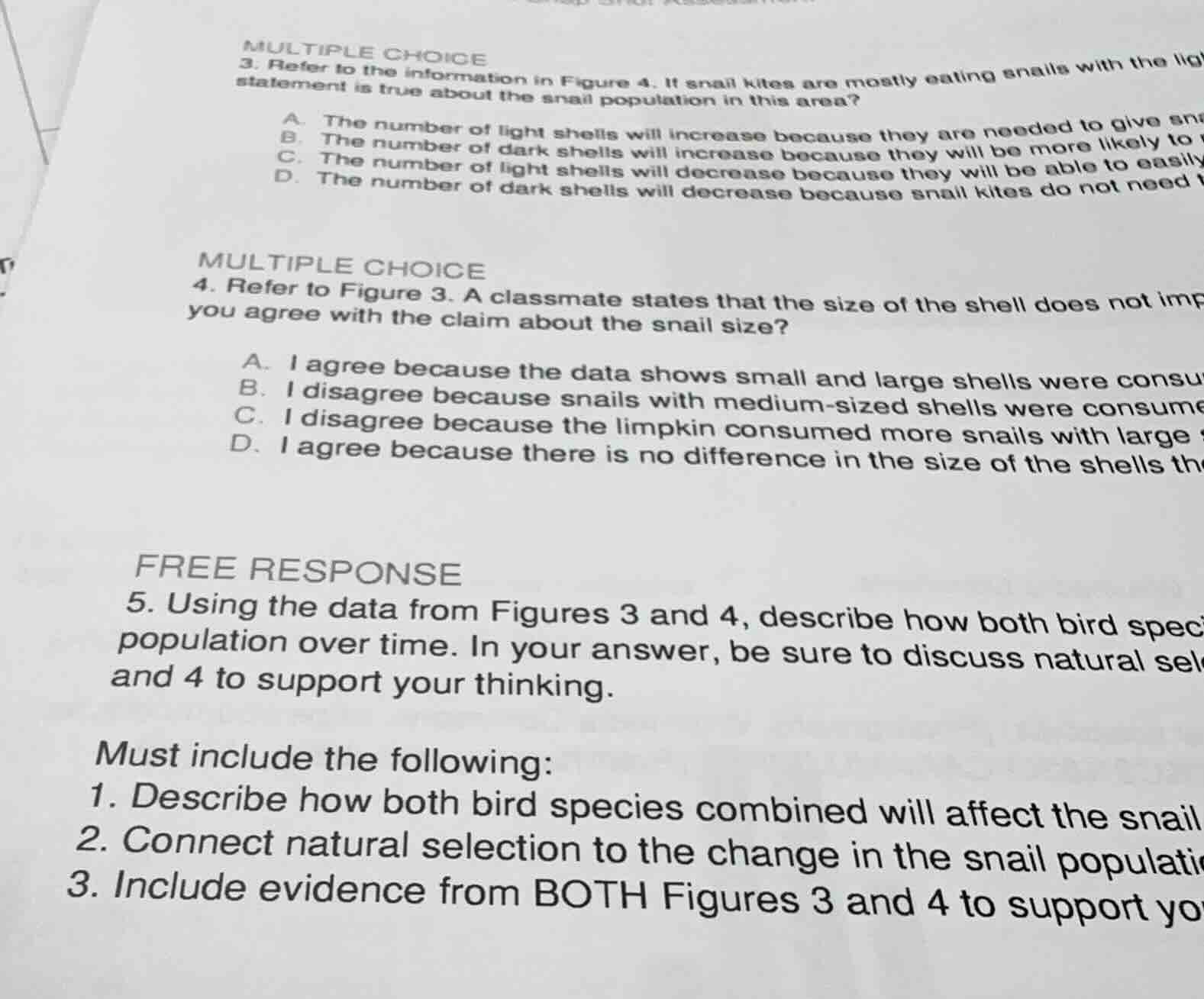
- refer to the information in figure 4. if snail kites are mostly eating snails with the lig
statement is true about the snail population in this area?
a. the number of light shells will increase because they are needed to give sn
b. the number of dark shells will increase because they will be more likely to
c. the number of light shells will decrease because they will be able to easily
d. the number of dark shells will decrease because snail kites do not need
multiple choice
- refer to figure 3. a classmate states that the size of the shell does not imp
you agree with the claim about the snail size?
a. i agree because the data shows small and large shells were consu
b. i disagree because snails with medium - sized shells were consume
c. i disagree because the limpkin consumed more snails with large
d. i agree because there is no difference in the size of the shells th
free response
- using the data from figures 3 and 4, describe how both bird spec
population over time. in your answer, be sure to discuss natural sel
and 4 to support your thinking.
must include the following:
- describe how both bird species combined will affect the snail
- connect natural selection to the change in the snail populati
- include evidence from both figures 3 and 4 to support yo
To answer these questions, we need to analyze the concepts of natural selection, predator - prey relationships, and how shell characteristics (like color and size) influence the snail population in the presence of bird predators (snail kites and limpkins, we can infer from the context). However, since the figures (Figure 3 and Figure 4) are not provided, we can only give a general approach:
Question 3 (Multiple Choice about Snail Kites and Snail Shell Color)
- Recall the concept of natural selection and camouflage. If snail kites are mostly eating snails with light shells, dark - shelled snails will have a survival advantage (they are less likely to be detected by the kites).
- Option A: Saying light shells will increase is wrong because they are being preyed upon.
- Option B: The reason given (to give snails...) is not a valid evolutionary reason.
- Option C: Dark - shelled snails are more likely to survive (not be eaten by kites) so their numbers will increase. This is in line with natural selection (advantageous trait - dark shell - leads to higher survival and reproduction).
- Option D: Saying dark shells will decrease is wrong as they are not the main prey.
So the answer for question 3 is C. The number of dark shells will increase because they will be more likely to (survive as they are not preyed upon as much).
Question 4 (Multiple Choice about Shell Size and Snail Consumption)
- We need to analyze the data on shell size and snail consumption by the predator (limpkin, we can infer). If a classmate says shell size does not impact consumption, we need to check the data.
- Option A: If data shows both small and large shells were consumed equally, then we can agree. But usually, in such problems, there is a difference in consumption based on size.
- Option B: If medium - sized shells were consumed more, it doesn't directly refute the claim about size not mattering (the claim is about size not impacting, not about medium size).
- Option C: If limpkin consumed more large (or a particular size) snails, then shell size does matter, so we disagree with the classmate's claim. This is a more likely correct option as it shows that size does impact consumption.
- Option D: Saying there is no difference in shell size is not a valid reason to agree if the data actually shows a difference.
Assuming the data shows that the predator has a preference for a particular shell size (e.g., more large - shelled snails were eaten), the answer is C. I disagree because the limpkin consumed more snails with large (or a non - random size) shells, showing that size does matter.
Question 5 (Free Response about Bird Species and Snail Population)
- Effect of both bird species on snail population:
- First, identify the two bird species (snail kites and limpkins from context). These birds are predators of snails. The combined predation pressure from both birds will select for snails with traits (shell color, size) that make them less likely to be preyed upon. For example, if one bird preys on light - colored snails and the other on large - sized snails, then dark - colored and small - sized (or other non - preyed - upon size) snails will have a survival advantage.
- Connect to natural selection:
- Natural selection is the process where organisms with advantageous traits (traits that help them survive and reproduce in their environment) are more likely to pass on their genes. In this case, snails with traits (e.g., dark shell, small shell size) that help them avoid being eaten by the birds will survive bette…

Snap & solve any problem in the app
Get step-by-step solutions on Sovi AI
Photo-based solutions with guided steps
Explore more problems and detailed explanations
To answer these questions, we need to analyze the concepts of natural selection, predator - prey relationships, and how shell characteristics (like color and size) influence the snail population in the presence of bird predators (snail kites and limpkins, we can infer from the context). However, since the figures (Figure 3 and Figure 4) are not provided, we can only give a general approach:
Question 3 (Multiple Choice about Snail Kites and Snail Shell Color)
- Recall the concept of natural selection and camouflage. If snail kites are mostly eating snails with light shells, dark - shelled snails will have a survival advantage (they are less likely to be detected by the kites).
- Option A: Saying light shells will increase is wrong because they are being preyed upon.
- Option B: The reason given (to give snails...) is not a valid evolutionary reason.
- Option C: Dark - shelled snails are more likely to survive (not be eaten by kites) so their numbers will increase. This is in line with natural selection (advantageous trait - dark shell - leads to higher survival and reproduction).
- Option D: Saying dark shells will decrease is wrong as they are not the main prey.
So the answer for question 3 is C. The number of dark shells will increase because they will be more likely to (survive as they are not preyed upon as much).
Question 4 (Multiple Choice about Shell Size and Snail Consumption)
- We need to analyze the data on shell size and snail consumption by the predator (limpkin, we can infer). If a classmate says shell size does not impact consumption, we need to check the data.
- Option A: If data shows both small and large shells were consumed equally, then we can agree. But usually, in such problems, there is a difference in consumption based on size.
- Option B: If medium - sized shells were consumed more, it doesn't directly refute the claim about size not mattering (the claim is about size not impacting, not about medium size).
- Option C: If limpkin consumed more large (or a particular size) snails, then shell size does matter, so we disagree with the classmate's claim. This is a more likely correct option as it shows that size does impact consumption.
- Option D: Saying there is no difference in shell size is not a valid reason to agree if the data actually shows a difference.
Assuming the data shows that the predator has a preference for a particular shell size (e.g., more large - shelled snails were eaten), the answer is C. I disagree because the limpkin consumed more snails with large (or a non - random size) shells, showing that size does matter.
Question 5 (Free Response about Bird Species and Snail Population)
- Effect of both bird species on snail population:
- First, identify the two bird species (snail kites and limpkins from context). These birds are predators of snails. The combined predation pressure from both birds will select for snails with traits (shell color, size) that make them less likely to be preyed upon. For example, if one bird preys on light - colored snails and the other on large - sized snails, then dark - colored and small - sized (or other non - preyed - upon size) snails will have a survival advantage.
- Connect to natural selection:
- Natural selection is the process where organisms with advantageous traits (traits that help them survive and reproduce in their environment) are more likely to pass on their genes. In this case, snails with traits (e.g., dark shell, small shell size) that help them avoid being eaten by the birds will survive better, reproduce more, and over time, the frequency of these traits in the snail population will increase.
- Evidence from Figures 3 and 4:
- From Figure 3 (assuming it is about shell size and snail consumption by one bird, say limpkin), we can get data on which shell sizes are consumed more or less. For example, if limpkin eats more large - sized snails, then small - sized snails will be selected for. From Figure 4 (assuming it is about shell color and snail consumption by snail kites), if kites eat more light - colored snails, then dark - colored snails will be selected for. We can then show how these selection pressures from the two birds combined will change the snail population over time (e.g., increase in dark - colored and small - sized snails) as they are more likely to survive and reproduce.
Final Answers
- C. The number of dark shells will increase because they will be more likely to (survive as they are not preyed upon by snail kites as much)
- (Assuming the data supports) C. I disagree because the limpkin consumed more snails with large (or a non - randomly selected size) shells, showing that size does matter.
- (General Answer)
- Effect of both bird species on snail population: The two bird species (snail kites and limpkins) act as predators, exerting selection pressure on the snail population. Snails with traits (shell color, size) that reduce their likelihood of being preyed upon will have a higher chance of survival and reproduction. For example, if snail kites prey more on light - shelled snails and limpkins prey more on large - shelled snails, then dark - shelled and small - shelled snails will be favored.
- Connection to natural selection: Natural selection occurs as snails with advantageous traits (e.g., dark shell, small size) are more likely to survive the predation. These surviving snails will reproduce, passing on their traits to the next generation. Over time, the frequency of these advantageous traits in the snail population will increase.
- Evidence from Figures 3 and 4: From Figure 3 (shell size data), if it shows that a particular shell size (e.g., small) was consumed less by the limpkin, this supports the idea that small - shelled snails have a survival advantage. From Figure 4 (shell color data), if it shows that light - shelled snails were consumed more by snail kites, this supports the idea that dark - shelled snails have a survival advantage. Together, these data show that the combined predation from the two birds is driving the snail population to evolve towards having more snails with the advantageous shell color and size traits.