QUESTION IMAGE
Question
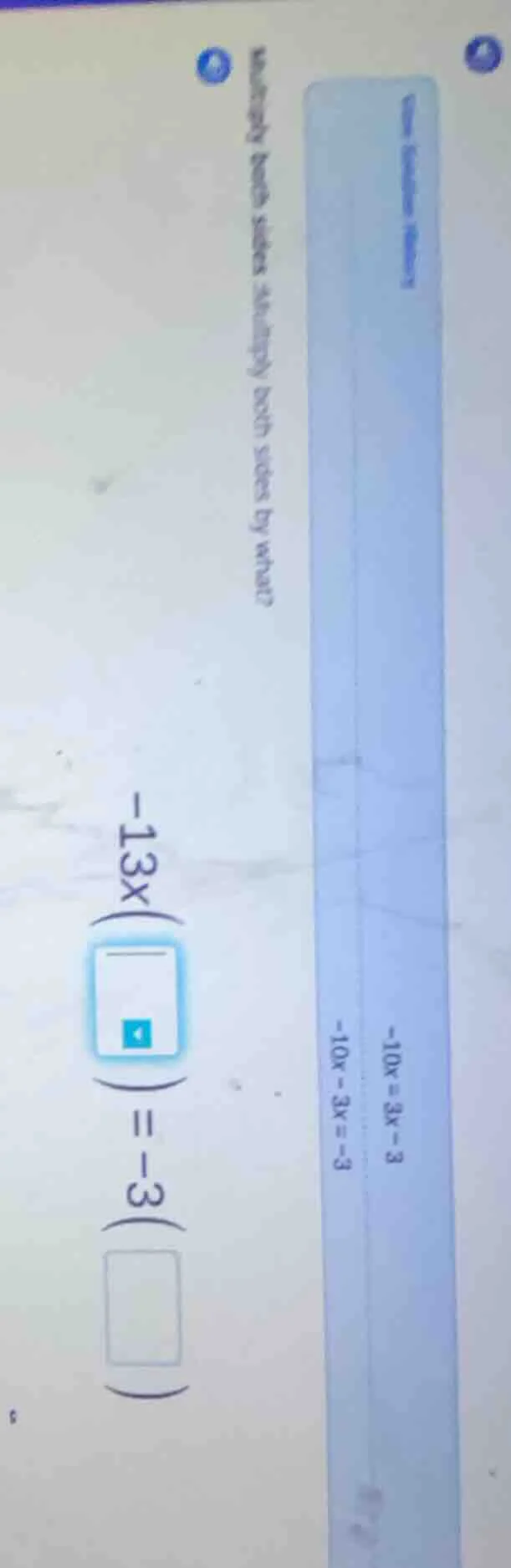
multiply both sides multiply both sides by what?
-10x = 3x - 3
-10x - 3x = -3
-13x (□) = -3 (□)
Step1: Analyze the equation transformation
We have the equation \(-10x = 3x - 3\). To combine like terms, we can subtract \(3x\) from both sides, but here we see a step where we might be multiplying to eliminate a coefficient or balance the equation. Wait, actually, looking at the next step \(-10x - 3x=- 3\), which is equivalent to \(-10x+(-3x)=-3\). But the given step is \(-13x(\square)=-3(\square)\)? Wait, maybe there is a mis - transcription. Wait, actually, if we start from \(-10x = 3x-3\), to get rid of the \(3x\) on the right, we subtract \(3x\) from both sides: \(-10x-3x=3x - 3-3x\), which simplifies to \(-13x=-3\). Wait, no, \(-10x-3x=-13x\) and \(3x - 3-3x=-3\). So if we have an equation like \(\frac{-13x}{k}=\frac{-3}{k}\) (but that's division). Wait, the given format is \(-13x(\square)=-3(\square)\). Wait, maybe it's a multiplication by 1? No, that doesn't make sense. Wait, maybe the original equation was \(\frac{-13x}{k}=\frac{-3}{k}\) and we multiply both sides by \(k\) to get \(-13x=-3\). But in the given problem, the blanks are for what we multiply both sides by. Wait, if we have \(-13x\times1=-3\times1\), but that's trivial. Wait, maybe there is a mistake in the problem presentation. But if we assume that we want to keep the equation balanced, and we are multiplying both sides by the same non - zero number. The most logical number here is 1, but that seems odd. Wait, no, maybe the equation was \(\frac{-13x}{a}=\frac{-3}{a}\) and we multiply both sides by \(a\) (where \(a
eq0\)) to get \(-13x = - 3\). But in the given problem, the blanks are to be filled with the same number. So we multiply both sides by 1 (or any non - zero number, but 1 is the identity element for multiplication). Wait, maybe the problem is about solving \(-13x=-3\) and we are multiplying both sides by 1, but that's not helpful. Wait, perhaps the original equation was \(-13x = - 3\) and we are multiplying both sides by 1. So the number we multiply both sides by is 1.
Step2: Confirm the multiplication
When we multiply both sides of an equation \(a = b\) by a number \(c\) (where \(c
eq0\)), the equation remains balanced (\(a\times c=b\times c\)). In the case of the equation \(-13x=-3\) (derived from \(-10x = 3x - 3\) by subtracting \(3x\) from both sides), if we multiply both sides by 1, we get \(-13x\times1=-3\times1\). So the number to fill in the blanks is 1.

Snap & solve any problem in the app
Get step-by-step solutions on Sovi AI
Photo-based solutions with guided steps
Explore more problems and detailed explanations
The number to multiply both sides by is 1. So we fill in both blanks with 1.