QUESTION IMAGE
Question
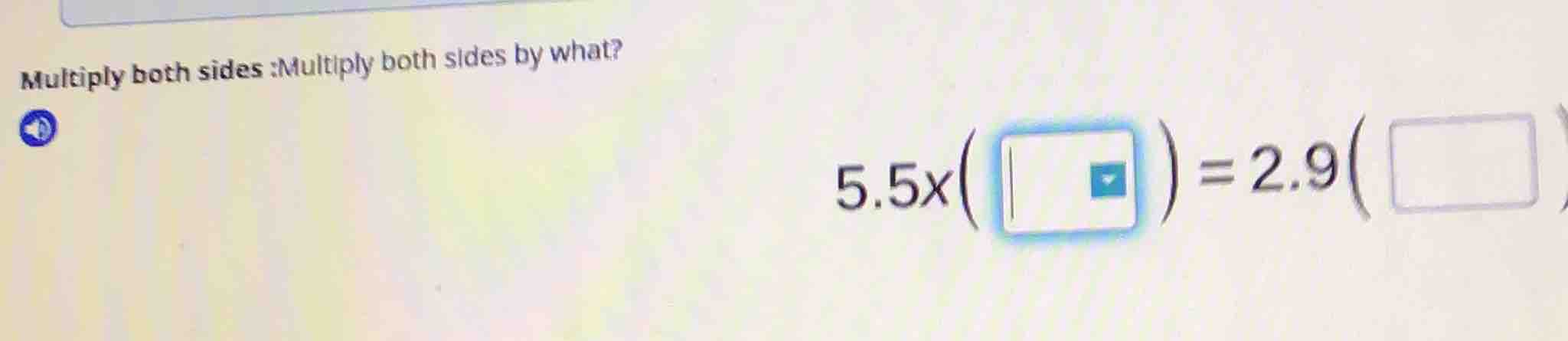
multiply both sides :multiply both sides by what?
$5.5x(\quad)=2.9(\quad)$
Step1: Recall the goal
We want to solve for \( x \) in an equation (implied by the multiplication step). To isolate \( x \), we can multiply both sides by the reciprocal or a number to eliminate the coefficient of \( x \). But here, if we assume the original equation was \( 5.5x = 2.9 \) (since the structure is \( 5.5x(\square)=2.9(\square) \)), we need to multiply both sides by a number to solve for \( x \). Wait, actually, maybe the original equation is something like \( \frac{x}{5.5}=\frac{2.9}{x} \)? No, looking at the form \( 5.5x(\square)=2.9(\square) \), probably to solve for \( x \), we need to multiply both sides by the same number to get rid of denominators or to isolate \( x \). Wait, maybe the equation is \( \frac{x}{5.5}=\frac{2.9}{x} \), cross - multiplying gives \( x\times x = 2.9\times5.5 \), but that's not the case here. Wait, the given form is \( 5.5x(\square)=2.9(\square) \). Wait, maybe it's a typo and the equation is \( 5.5x = 2.9 \), and we want to multiply both sides by \( \frac{1}{5.5} \) to solve for \( x \), but that would be \( 5.5x\times\frac{1}{5.5}=2.9\times\frac{1}{5.5} \). But maybe the intended operation is to multiply both sides by the same number to eliminate decimals. Let's see, 5.5 and 2.9, if we multiply by 10 to eliminate decimals: \( 5.5x\times10 = 2.9\times10 \), which would be \( 55x = 29 \). But the problem says "Multiply both sides :Multiply both sides by what?". Wait, maybe the equation is \( \frac{x}{5.5}=\frac{2.9}{x} \), cross - multiplying gives \( x^{2}=5.5\times2.9 \), but that's not the form here. Wait, the given expression is \( 5.5x(\square)=2.9(\square) \). Let's assume that we want to solve for \( x \), so we need to multiply both sides by the reciprocal of 5.5, which is \( \frac{1}{5.5} \), but \( \frac{1}{5.5}=\frac{2}{11}\approx0.1818 \). But maybe the problem is to multiply both sides by the same number to make the coefficients integers. 5.5 is \( \frac{11}{2} \) and 2.9 is \( \frac{29}{10} \). The least common multiple of 2 and 10 is 10. So if we multiply both sides by 10, we get \( 5.5x\times10 = 2.9\times10 \), which is \( 55x = 29 \). So the number to multiply both sides is 10. So \( 5.5x\times10 = 2.9\times10 \).
Step1: Identify the operation
We need to multiply both sides of the equation (implied by the form \( 5.5x(\square)=2.9(\square) \)) by the same number. To eliminate the decimal points (if that's the goal) or to isolate \( x \). If we consider eliminating decimals, we can multiply both sides by 10 (since 5.5 has one decimal place and 2.9 has one decimal place, multiplying by 10 will convert them to integers).
Step2: Perform the multiplication
If we multiply both sides by 10, we have:
\( 5.5x\times10 = 2.9\times10 \)
So the number to put in both boxes is 10.

Snap & solve any problem in the app
Get step-by-step solutions on Sovi AI
Photo-based solutions with guided steps
Explore more problems and detailed explanations
The number to fill in both boxes is 10. So \( 5.5x\times\boldsymbol{10}=2.9\times\boldsymbol{10} \)