QUESTION IMAGE
Question
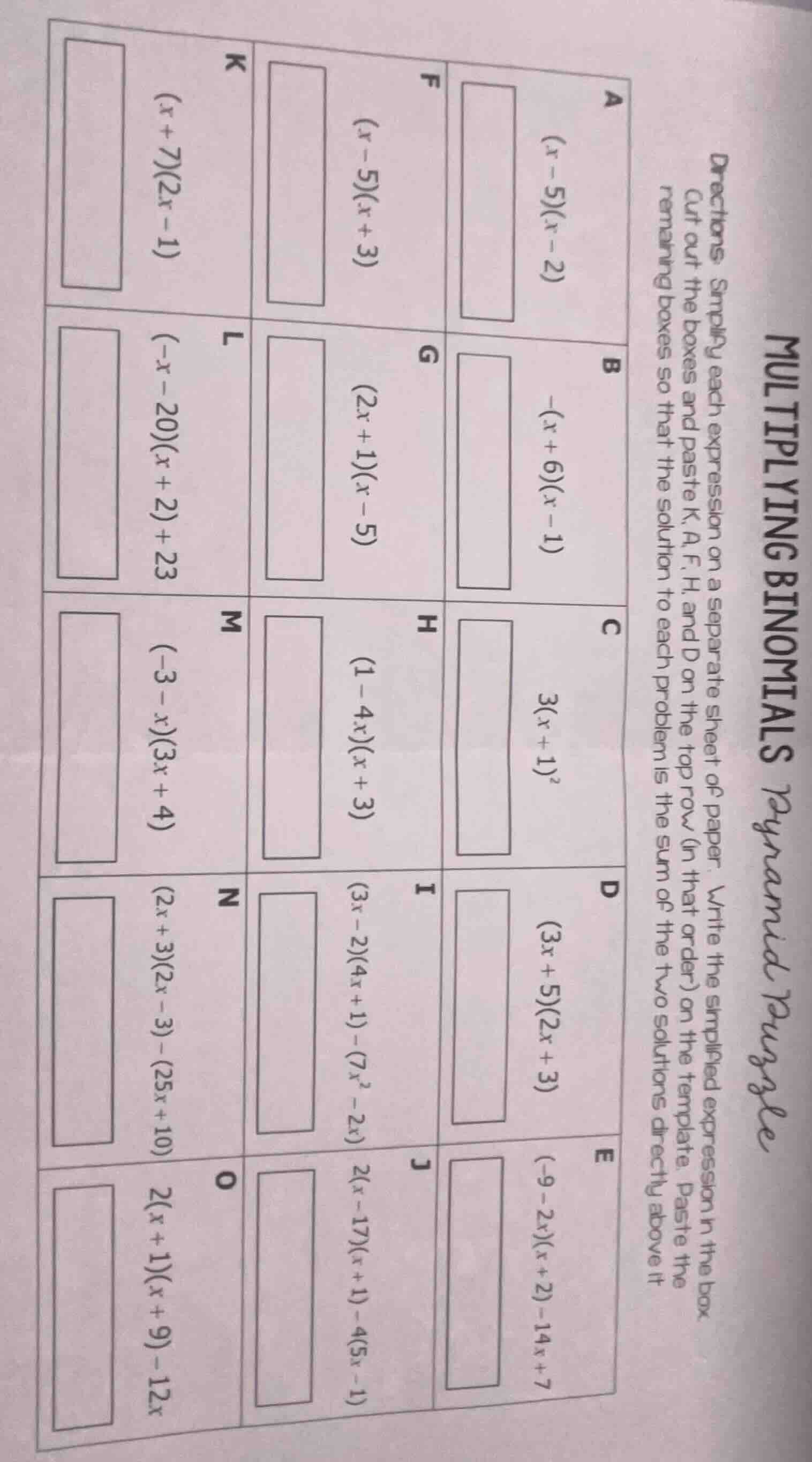
multiplying binomials pyramid puzzle directions: simplify each expression on a separate sheet of paper. write the simplified expression in the box. cut out the boxes and paste the remaining boxes so that the solution to each problem is the sum of the two solutions directly above it. a: $(x - 5)(x - 2)$ b: $-(x + 6)(x - 1)$ c: $3(x + 1)^2$ d: $(3x + 5)(2x + 3)$ e: $(-9 - 2x)(x + 2) - 14x + 7$ f: $(x - 5)(x + 3)$ g: $(2x + 1)(x - 5)$ h: $(1 - 4x)(x + 3)$ i: $(3x - 2)(4x + 1) - (7x^2 - 2x)$ j: $2(x - 17)(x + 1) - 4(5x - 1)$ k: $(x + 7)(2x - 1)$ l: $(-x - 20)(x + 2) + 23$ m: $(-3 - x)(3x + 4)$ n: $(2x + 3)(2x - 3) - (25x + 10)$ o: $2(x + 1)(x + 9) - 12x$
Let's solve each problem one by one. We'll use the distributive property (FOIL method for binomials, or expanding products) to simplify each expression.
Problem A: \((x - 5)(x - 2)\)
Step 1: Apply FOIL (First, Outer, Inner, Last)
First: \(x \cdot x = x^2\)
Outer: \(x \cdot (-2) = -2x\)
Inner: \(-5 \cdot x = -5x\)
Last: \(-5 \cdot (-2) = 10\)
Step 2: Combine like terms
\(x^2 - 2x - 5x + 10 = x^2 - 7x + 10\)
Problem B: \(-(x + 6)(x - 1)\)
Step 1: Expand \((x + 6)(x - 1)\) using FOIL
First: \(x \cdot x = x^2\)
Outer: \(x \cdot (-1) = -x\)
Inner: \(6 \cdot x = 6x\)
Last: \(6 \cdot (-1) = -6\)
Step 2: Combine like terms in the product
\(x^2 - x + 6x - 6 = x^2 + 5x - 6\)
Step 3: Apply the negative sign
\(-(x^2 + 5x - 6) = -x^2 - 5x + 6\)
Problem C: \(3(x + 1)^2\)
Step 1: Expand \((x + 1)^2\) (which is \((x + 1)(x + 1)\))
First: \(x \cdot x = x^2\)
Outer: \(x \cdot 1 = x\)
Inner: \(1 \cdot x = x\)
Last: \(1 \cdot 1 = 1\)
Step 2: Combine like terms in the square
\(x^2 + x + x + 1 = x^2 + 2x + 1\)
Step 3: Multiply by 3
\(3(x^2 + 2x + 1) = 3x^2 + 6x + 3\)
Problem D: \((3x + 5)(2x + 3)\)
Step 1: Apply FOIL
First: \(3x \cdot 2x = 6x^2\)
Outer: \(3x \cdot 3 = 9x\)
Inner: \(5 \cdot 2x = 10x\)
Last: \(5 \cdot 3 = 15\)
Step 2: Combine like terms
\(6x^2 + 9x + 10x + 15 = 6x^2 + 19x + 15\)
Problem E: \((-9 - 2x)(x + 2) - 14x + 7\)
Step 1: Expand \((-9 - 2x)(x + 2)\) using FOIL
First: \(-9 \cdot x = -9x\)
Outer: \(-9 \cdot 2 = -18\)
Inner: \(-2x \cdot x = -2x^2\)
Last: \(-2x \cdot 2 = -4x\)
Step 2: Combine like terms in the product
\(-2x^2 - 9x - 4x - 18 = -2x^2 - 13x - 18\)
Step 3: Subtract \(14x\) and add \(7\) (wait, original is \(-14x + 7\), so add those terms)
\(-2x^2 - 13x - 18 - 14x + 7\)
Step 4: Combine like terms
\(-2x^2 + (-13x - 14x) + (-18 + 7) = -2x^2 - 27x - 11\)
Wait, maybe I misread. Let's check again: The expression is \((-9 - 2x)(x + 2) - 14x + 7\). So after expanding \((-9 - 2x)(x + 2)\) to \(-2x^2 -13x -18\), then subtract \(14x\) and add \(7\):
\(-2x^2 -13x -18 -14x +7 = -2x^2 -27x -11\). Wait, but maybe I made a mistake. Let's re-express \((-9 - 2x)(x + 2)\):
\(-9(x + 2) -2x(x + 2) = -9x -18 -2x^2 -4x = -2x^2 -13x -18\). Then subtract \(14x\) and add \(7\):
\(-2x^2 -13x -18 -14x +7 = -2x^2 -27x -11\). Hmm.
Problem F: \((x - 5)(x + 3)\)
Step 1: Apply FOIL
First: \(x \cdot x = x^2\)
Outer: \(x \cdot 3 = 3x\)
Inner: \(-5 \cdot x = -5x\)
Last: \(-5 \cdot 3 = -15\)
Step 2: Combine like terms
\(x^2 + 3x - 5x - 15 = x^2 - 2x - 15\)
Problem G: \((2x + 1)(x - 5)\)
Step 1: Apply FOIL
First: \(2x \cdot x = 2x^2\)
Outer: \(2x \cdot (-5) = -10x\)
Inner: \(1 \cdot x = x\)
Last: \(1 \cdot (-5) = -5\)
Step 2: Combine like terms
\(2x^2 -10x + x -5 = 2x^2 -9x -5\)
Problem H: \((1 - 4x)(x + 3)\)
Step 1: Apply FOIL
First: \(1 \cdot x = x\)
Outer: \(1 \cdot 3 = 3\)
Inner: \(-4x \cdot x = -4x^2\)
Last: \(-4x \cdot 3 = -12x\)
Step 2: Combine like terms
\(-4x^2 + x -12x + 3 = -4x^2 -11x + 3\)
Problem I: \((3x - 2)(4x + 1) - (7x^2 - 2x)\)
Step 1: Expand \((3x - 2)(4x + 1)\) using FOIL
First: \(3x \cdot 4x = 12x^2\)
Outer: \(3x \cdot 1 = 3x\)
Inner: \(-2 \cdot 4x = -8x\)
Last: \(-2 \cdot 1 = -2\)
Step 2: Combine like terms in the product
\(12x^2 + 3x -8x -2 = 12x^2 -5x -2\)
Step 3: Subtract \((7x^2 - 2x)\) (which is equivalent to subtracting \(7x^2\) and adding \(2x\))
\(12x^2 -5x -2 -7x^2 + 2x\)
Step 4: Combine like terms
\((12x^2 -7x^2) + (-5x + 2x) + (-2) = 5x^2 -3x -2\)
Problem J: \(2(x - 17)(x + 1) - 4(5x - 1)\)
S…

Snap & solve any problem in the app
Get step-by-step solutions on Sovi AI
Photo-based solutions with guided steps
Explore more problems and detailed explanations
Let's solve each problem one by one. We'll use the distributive property (FOIL method for binomials, or expanding products) to simplify each expression.
Problem A: \((x - 5)(x - 2)\)
Step 1: Apply FOIL (First, Outer, Inner, Last)
First: \(x \cdot x = x^2\)
Outer: \(x \cdot (-2) = -2x\)
Inner: \(-5 \cdot x = -5x\)
Last: \(-5 \cdot (-2) = 10\)
Step 2: Combine like terms
\(x^2 - 2x - 5x + 10 = x^2 - 7x + 10\)
Problem B: \(-(x + 6)(x - 1)\)
Step 1: Expand \((x + 6)(x - 1)\) using FOIL
First: \(x \cdot x = x^2\)
Outer: \(x \cdot (-1) = -x\)
Inner: \(6 \cdot x = 6x\)
Last: \(6 \cdot (-1) = -6\)
Step 2: Combine like terms in the product
\(x^2 - x + 6x - 6 = x^2 + 5x - 6\)
Step 3: Apply the negative sign
\(-(x^2 + 5x - 6) = -x^2 - 5x + 6\)
Problem C: \(3(x + 1)^2\)
Step 1: Expand \((x + 1)^2\) (which is \((x + 1)(x + 1)\))
First: \(x \cdot x = x^2\)
Outer: \(x \cdot 1 = x\)
Inner: \(1 \cdot x = x\)
Last: \(1 \cdot 1 = 1\)
Step 2: Combine like terms in the square
\(x^2 + x + x + 1 = x^2 + 2x + 1\)
Step 3: Multiply by 3
\(3(x^2 + 2x + 1) = 3x^2 + 6x + 3\)
Problem D: \((3x + 5)(2x + 3)\)
Step 1: Apply FOIL
First: \(3x \cdot 2x = 6x^2\)
Outer: \(3x \cdot 3 = 9x\)
Inner: \(5 \cdot 2x = 10x\)
Last: \(5 \cdot 3 = 15\)
Step 2: Combine like terms
\(6x^2 + 9x + 10x + 15 = 6x^2 + 19x + 15\)
Problem E: \((-9 - 2x)(x + 2) - 14x + 7\)
Step 1: Expand \((-9 - 2x)(x + 2)\) using FOIL
First: \(-9 \cdot x = -9x\)
Outer: \(-9 \cdot 2 = -18\)
Inner: \(-2x \cdot x = -2x^2\)
Last: \(-2x \cdot 2 = -4x\)
Step 2: Combine like terms in the product
\(-2x^2 - 9x - 4x - 18 = -2x^2 - 13x - 18\)
Step 3: Subtract \(14x\) and add \(7\) (wait, original is \(-14x + 7\), so add those terms)
\(-2x^2 - 13x - 18 - 14x + 7\)
Step 4: Combine like terms
\(-2x^2 + (-13x - 14x) + (-18 + 7) = -2x^2 - 27x - 11\)
Wait, maybe I misread. Let's check again: The expression is \((-9 - 2x)(x + 2) - 14x + 7\). So after expanding \((-9 - 2x)(x + 2)\) to \(-2x^2 -13x -18\), then subtract \(14x\) and add \(7\):
\(-2x^2 -13x -18 -14x +7 = -2x^2 -27x -11\). Wait, but maybe I made a mistake. Let's re-express \((-9 - 2x)(x + 2)\):
\(-9(x + 2) -2x(x + 2) = -9x -18 -2x^2 -4x = -2x^2 -13x -18\). Then subtract \(14x\) and add \(7\):
\(-2x^2 -13x -18 -14x +7 = -2x^2 -27x -11\). Hmm.
Problem F: \((x - 5)(x + 3)\)
Step 1: Apply FOIL
First: \(x \cdot x = x^2\)
Outer: \(x \cdot 3 = 3x\)
Inner: \(-5 \cdot x = -5x\)
Last: \(-5 \cdot 3 = -15\)
Step 2: Combine like terms
\(x^2 + 3x - 5x - 15 = x^2 - 2x - 15\)
Problem G: \((2x + 1)(x - 5)\)
Step 1: Apply FOIL
First: \(2x \cdot x = 2x^2\)
Outer: \(2x \cdot (-5) = -10x\)
Inner: \(1 \cdot x = x\)
Last: \(1 \cdot (-5) = -5\)
Step 2: Combine like terms
\(2x^2 -10x + x -5 = 2x^2 -9x -5\)
Problem H: \((1 - 4x)(x + 3)\)
Step 1: Apply FOIL
First: \(1 \cdot x = x\)
Outer: \(1 \cdot 3 = 3\)
Inner: \(-4x \cdot x = -4x^2\)
Last: \(-4x \cdot 3 = -12x\)
Step 2: Combine like terms
\(-4x^2 + x -12x + 3 = -4x^2 -11x + 3\)
Problem I: \((3x - 2)(4x + 1) - (7x^2 - 2x)\)
Step 1: Expand \((3x - 2)(4x + 1)\) using FOIL
First: \(3x \cdot 4x = 12x^2\)
Outer: \(3x \cdot 1 = 3x\)
Inner: \(-2 \cdot 4x = -8x\)
Last: \(-2 \cdot 1 = -2\)
Step 2: Combine like terms in the product
\(12x^2 + 3x -8x -2 = 12x^2 -5x -2\)
Step 3: Subtract \((7x^2 - 2x)\) (which is equivalent to subtracting \(7x^2\) and adding \(2x\))
\(12x^2 -5x -2 -7x^2 + 2x\)
Step 4: Combine like terms
\((12x^2 -7x^2) + (-5x + 2x) + (-2) = 5x^2 -3x -2\)
Problem J: \(2(x - 17)(x + 1) - 4(5x - 1)\)
Step 1: Expand \(2(x - 17)(x + 1)\)
First, expand \((x - 17)(x + 1)\):
First: \(x \cdot x = x^2\)
Outer: \(x \cdot 1 = x\)
Inner: \(-17 \cdot x = -17x\)
Last: \(-17 \cdot 1 = -17\)
Combine like terms: \(x^2 + x -17x -17 = x^2 -16x -17\)
Multiply by 2: \(2(x^2 -16x -17) = 2x^2 -32x -34\)
Step 2: Expand \(-4(5x - 1)\)
\(-4 \cdot 5x + (-4) \cdot (-1) = -20x + 4\)
Step 3: Combine the two expanded parts
\(2x^2 -32x -34 -20x + 4\)
Step 4: Combine like terms
\(2x^2 + (-32x -20x) + (-34 + 4) = 2x^2 -52x -30\)
Problem K: \((x + 7)(2x - 1)\)
Step 1: Apply FOIL
First: \(x \cdot 2x = 2x^2\)
Outer: \(x \cdot (-1) = -x\)
Inner: \(7 \cdot 2x = 14x\)
Last: \(7 \cdot (-1) = -7\)
Step 2: Combine like terms
\(2x^2 -x +14x -7 = 2x^2 +13x -7\)
Problem L: \((-x - 20)(x + 2) + 23\)
Step 1: Expand \((-x - 20)(x + 2)\) using FOIL
First: \(-x \cdot x = -x^2\)
Outer: \(-x \cdot 2 = -2x\)
Inner: \(-20 \cdot x = -20x\)
Last: \(-20 \cdot 2 = -40\)
Step 2: Combine like terms in the product
\(-x^2 -2x -20x -40 = -x^2 -22x -40\)
Step 3: Add 23
\(-x^2 -22x -40 +23 = -x^2 -22x -17\)
Problem M: \((-3 - x)(3x + 4)\)
Step 1: Apply FOIL
First: \(-3 \cdot 3x = -9x\)
Outer: \(-3 \cdot 4 = -12\)
Inner: \(-x \cdot 3x = -3x^2\)
Last: \(-x \cdot 4 = -4x\)
Step 2: Combine like terms
\(-3x^2 -9x -4x -12 = -3x^2 -13x -12\)
Problem N: \((2x + 3)(2x - 3) - (25x + 10)\)
Step 1: Expand \((2x + 3)(2x - 3)\) (difference of squares: \((a + b)(a - b) = a^2 - b^2\))
Here, \(a = 2x\), \(b = 3\), so:
\((2x)^2 - 3^2 = 4x^2 - 9\)
Step 2: Subtract \((25x + 10)\) (which is equivalent to subtracting \(25x\) and \(10\))
\(4x^2 - 9 -25x -10\)
Step 3: Combine like terms
\(4x^2 -25x + (-9 -10) = 4x^2 -25x -19\)
Problem O: \(2(x + 1)(x + 9) - 12x\)
Step 1: Expand \(2(x + 1)(x + 9)\)
First, expand \((x + 1)(x + 9)\):
First: \(x \cdot x = x^2\)
Outer: \(x \cdot 9 = 9x\)
Inner: \(1 \cdot x = x\)
Last: \(1 \cdot 9 = 9\)
Combine like terms: \(x^2 + 9x + x + 9 = x^2 + 10x + 9\)
Multiply by 2: \(2(x^2 + 10x + 9) = 2x^2 + 20x + 18\)
Step 2: Subtract \(12x\)
\(2x^2 + 20x + 18 -12x = 2x^2 + 8x + 18\)
Final Answers (each problem's simplified form):
- A: \(x^2 - 7x + 10\)
- B: \(-x^2 - 5x + 6\)
- C: \(3x^2 + 6x + 3\)
- D: \(6x^2 + 19x + 15\)
- E: \(-2x^2 - 27x - 11\) (wait, maybe recheck E. Let's do E again:
Original E: \((-9 - 2x)(x + 2) -14x +7\)
Expand \((-9 -2x)(x +2)\):
\(-9x -18 -2x^2 -4x = -2x^2 -13x -18\)
Then \(-2x^2 -13x -18 -14x +7 = -2x^2 -27x -11\). Yes.
- F: \(x^2 - 2x - 15\)
- G: \(2x^2 - 9x - 5\)
- H: \(-4x^2 - 11x + 3\)
- I: \(5x^2 - 3x - 2\)
- J: \(2x^2 - 52x - 30\)
- K: \(2x^2 + 13x - 7\)
- L: \(-x^2 - 22x - 17\)
- M: \(-3x^2 - 13x - 12\)
- N: \(4x^2 - 25x - 19\)
- O: \(2x^2 + 8x + 18\)
If you need specific problems solved (e.g., only A, or a few), let me know! For now, these are all the simplified forms.