QUESTION IMAGE
Question
name
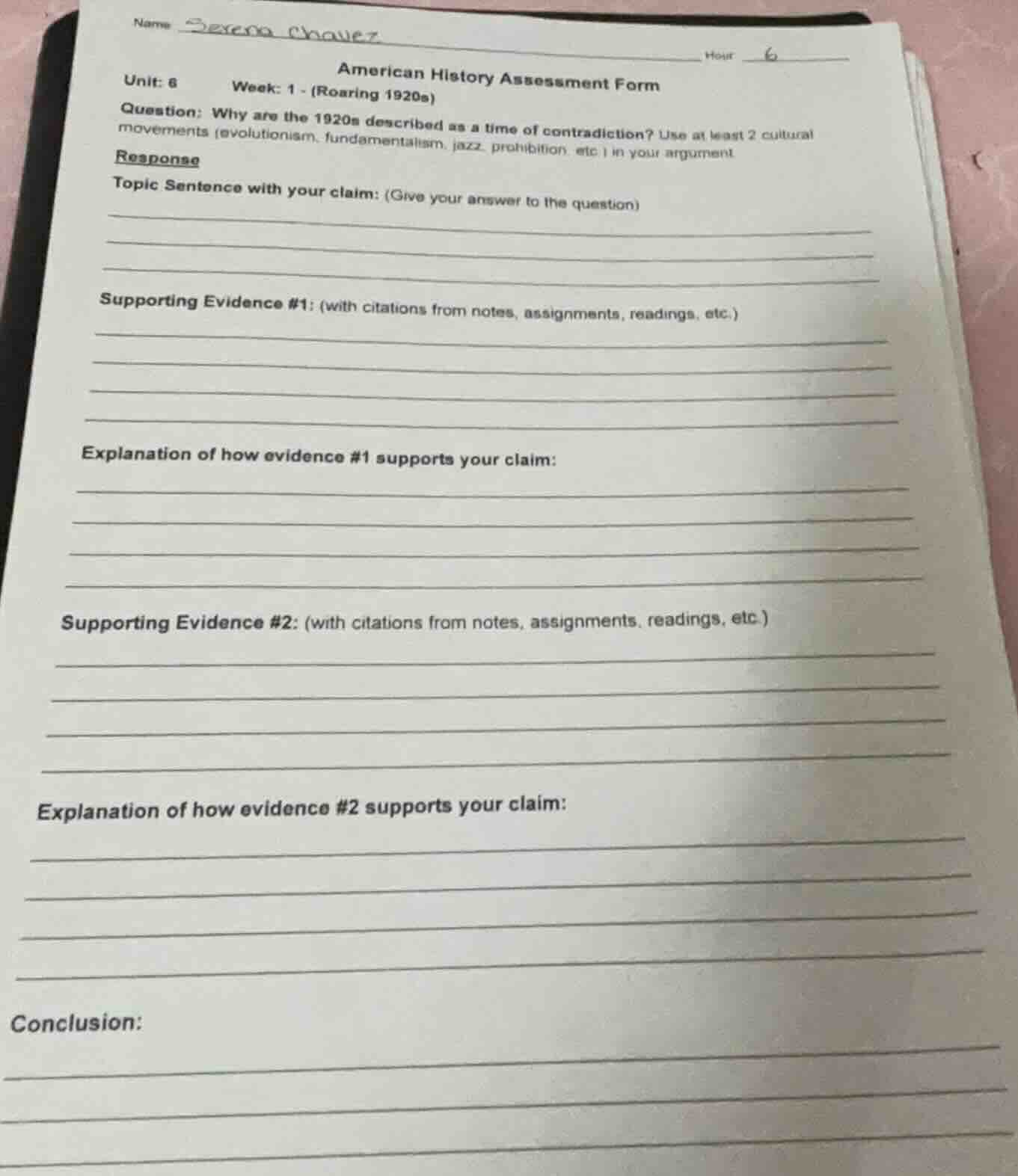
american history assessment form
unit: 6 week: 1 - (roaring 1920s)
question: why are the 1920s described as a time of contradiction? use at least 2 cultural movements (evolutionism, fundamentalism, jazz, prohibition, etc ) in your argument
response
topic sentence with your claim: (give your answer to the question)
supporting evidence #1: (with citations from notes, assignments, readings, etc.)
explanation of how evidence #1 supports your claim:
supporting evidence #2: (with citations from notes, assignments, readings, etc.)
explanation of how evidence #2 supports your claim:
conclusion:
To answer why the 1920s were a time of contradiction, we can use the following structure:
Topic Sentence with your claim:
The 1920s were a time of contradiction because cultural movements like fundamentalism vs. evolutionism and prohibition vs. jazz culture represented clashing values and behaviors.
Supporting Evidence #1:
Evidence: The Scopes Trial (1925) pitted fundamentalist Christians, who believed in a literal interpretation of the Bible (including creationism), against proponents of evolutionism, who supported the teaching of Darwin’s theory of evolution in schools. (Citation: Historical records of the Scopes Trial, textbook readings on the 1920s cultural conflicts)
**: This trial showed a contradiction between traditional religious beliefs and modern scientific ideas. Fundamentalists wanted to preserve old - fashioned religious values in education, while evolutionists were pushing for the acceptance of new scientific understandings, highlighting a clash in societal values.
Supporting Evidence #2:
Evidence: Prohibition (1920 - 1933) made the sale, production, and transportation of alcohol illegal, yet the rise of speakeasies and the jazz culture (where alcohol was often consumed and jazz, a new, lively form of music, thrived) contradicted the law. (Citation: Historical accounts of speakeasies, studies on 1920s jazz culture and Prohibition - era social behavior)
**: Prohibition was an attempt to enforce moral and social order by eliminating alcohol, but the existence of speakeasies and the vibrant jazz culture that often centered around alcohol - related socializing showed that many people were rejecting this attempt at control, creating a contradiction between legal restrictions and actual social behavior.
Conclusion:
In conclusion, the 1920s were a time of contradiction as seen in the conflict between fundamentalism and evolutionism (over scientific and religious values in education) and between Prohibition and the jazz - speakeasy culture (over legal restrictions and social behavior). These cultural movements demonstrated how different groups held opposing values and engaged in contrasting behaviors during the decade.
of how evidence #1 supports your claim:
This trial showed a contradiction between traditional religious beliefs and modern scientific ideas. Fundamentalists wanted to preserve old - fashioned religious values in education, while evolutionists were pushing for the acceptance of new scientific understandings, highlighting a clash in societal values.
Supporting Evidence #2:
Prohibition (1920 - 1933) made the sale, production, and transportation of alcohol illegal, yet the rise of speakeasies and the jazz culture (where alcohol was often consumed and jazz, a new, lively form of music, thrived) contradicted the law. (Citation: Historical accounts of speakeasies, studies on 1920s jazz culture and Prohibition - era social behavior)

Snap & solve any problem in the app
Get step-by-step solutions on Sovi AI
Photo-based solutions with guided steps
Explore more problems and detailed explanations
Topic Sentence with your claim:
The 1920s were a time of contradiction because cultural movements like fundamentalism vs. evolutionism and prohibition vs. jazz culture represented clashing values and behaviors.
Supporting Evidence #1:
The Scopes Trial (1925) pitted fundamentalist Christians, who believed in a literal interpretation of the Bible (including creationism), against proponents of evolutionism, who supported the teaching of Darwin’s theory of evolution in schools. (Citation: Historical records of the Scopes Trial, textbook readings on the 1920s cultural conflicts)