QUESTION IMAGE
Question
name: _______________________ class: ___________________
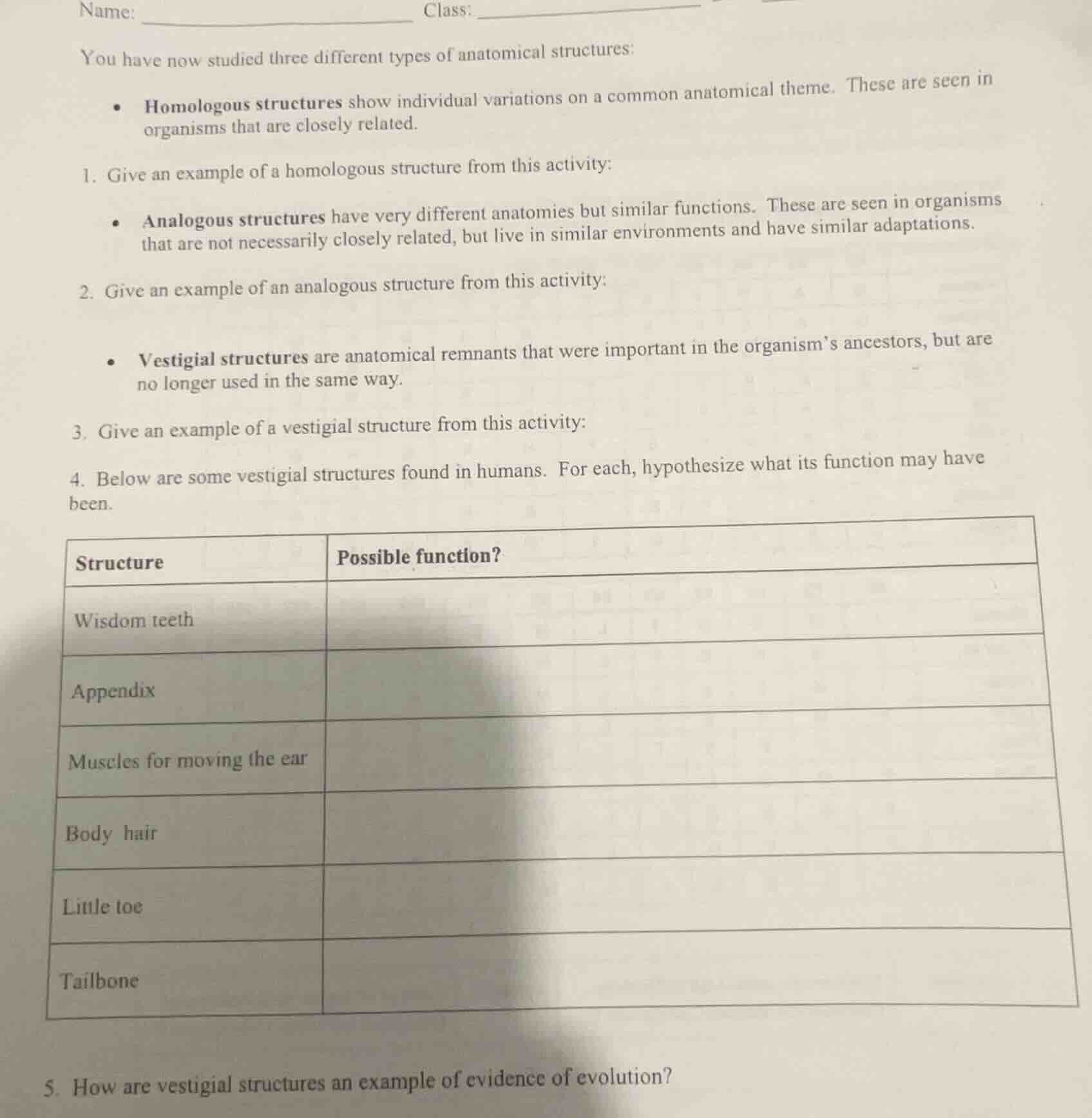
you have now studied three different types of anatomical structures:
- homologous structures show individual variations on a common anatomical theme. these are seen in organisms that are closely related.
- give an example of a homologous structure from this activity:
- analogous structures have very different anatomies but similar functions. these are seen in organisms that are not necessarily closely related, but live in similar environments and have similar adaptations.
- give an example of an analogous structure from this activity:
- vestigial structures are anatomical remnants that were important in the organism’s ancestors, but are no longer used in the same way.
- give an example of a vestigial structure from this activity:
- below are some vestigial structures found in humans. for each, hypothesize what its function may have been.
| structure | possible function? |
|---|---|
| appendix | |
| muscles for moving the ear | |
| body hair | |
| little toe | |
| tailbone |
- how are vestigial structures an example of evidence of evolution?
Brief Explanations
- Homologous structures share a common anatomical origin; a standard activity example is the forelimbs of humans, bats, and whales.
- Analogous structures have similar functions but different origins; a standard activity example is the wings of insects and birds.
- Vestigial structures are unused ancestral remnants; a standard activity example is the hip bones in snakes.
- For human vestigial structures:
- Wisdom teeth: Our ancestors had larger jaws, and these teeth helped chew tough, raw plant material.
- Appendix: Likely aided in digesting fibrous plant matter and may have played a role in the immune system for early humans.
- Muscles for moving the ear: Allowed ancestors to rotate ears to localize sounds from predators or prey.
- Body hair: Provided insulation for hairier ancestors and may have helped with sensing small insects on the skin.
- Little toe: Aided in balance and stability when our ancestors climbed trees or walked on uneven terrain.
- Tailbone: Supported a tail in our primate ancestors, which was used for balance and grasping.
- Vestigial structures show that organisms have inherited traits from ancestors that are no longer needed, indicating that species change over time (evolve) as their environments and lifestyles shift.

Snap & solve any problem in the app
Get step-by-step solutions on Sovi AI
Photo-based solutions with guided steps
Explore more problems and detailed explanations
- Example: Forelimbs of humans, bats, and whales
- Example: Wings of insects and birds
- Example: Hip bones in snakes
4.
| Structure | Possible function? |
|---|---|
| Appendix | Digesting fibrous plants, immune support |
| Muscles for moving the ear | Localizing sounds from threats/prey |
| Body hair | Insulation, detecting small insects |
| Little toe | Balance for climbing, uneven terrain travel |
| Tailbone | Supporting a tail for balance/grasping |
- They demonstrate that species inherit traits from ancestral forms, and as environments/lifestyles changed, these structures lost their original purpose, showing evolutionary change over time.