QUESTION IMAGE
Question
name:
date: feb 6
world religions chart
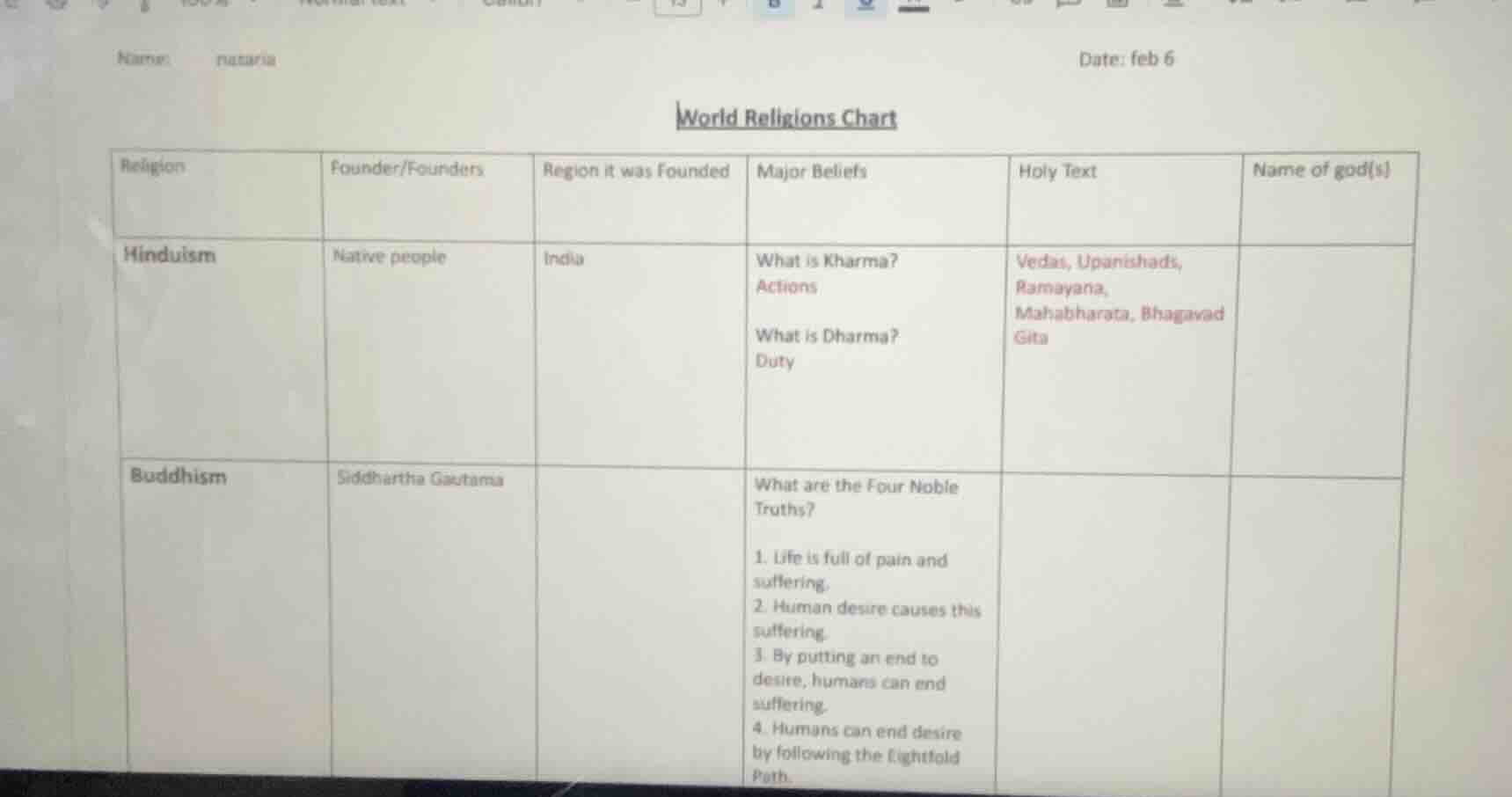
religion | founder/founders | region it was founded | major beliefs | holy text | name of god(s)
hinduism | native people | india | what is kharma?
actions
what is dharma?
duty | vedas, upanishads,
ramayana,
mahabharata, bhagavad
gita |
buddhism | siddhartha gautama | | what are the four noble
truths?
- life is full of pain and
suffering.
- human desire causes this
suffering.
- by putting an end to
desire, humans can end
suffering.
- humans can end desire
by following the eightfold
path. | |
To complete the "World Religions Chart", we analyze each religion:
Hinduism
- Name of god(s): Hinduism is polytheistic with major deities like Brahma (creator), Vishnu (preserver), Shiva (destroyer), and many others (e.g., Devi, Ganesha).
Buddhism
- Region it was Founded: India (specifically in ancient India, around present - day Nepal/India border where Siddhartha Gautama lived).
- Holy Text: Tripitaka (Pali Canon) is the primary Buddhist scripture, containing teachings, rules for monastics, and philosophical discourses.
- Name of god(s): Buddhism (in its original form, Theravada) is non - theistic (does not focus on a creator god). Some later Buddhist traditions (Mahayana) incorporate deities/ bodhisattvas as spiritual guides, but the core is not centered on a god - worship model.
Filled Chart (Key Additions):
| Religion | Founder/Founders | Region it was Founded | Major Beliefs | Holy Text | Name of god(s) |
|---|---|---|---|---|---|
| Buddhism | Siddhartha Gautama | India (ancient) | What are the Four Noble Truths? <br> 1. Life is full of pain and suffering. <br> 2. Human desire causes this suffering. <br> 3. By putting an end to desire, humans can end suffering. <br> 4. Humans can end desire by following the Eightfold Path. | Tripitaka (Pali Canon) | Non - theistic (no primary god; later traditions have bodhisattvas/deities as guides) |
These additions align with the core tenets and historical context of Hinduism and Buddhism.

Snap & solve any problem in the app
Get step-by-step solutions on Sovi AI
Photo-based solutions with guided steps
Explore more problems and detailed explanations
To complete the "World Religions Chart", we analyze each religion:
Hinduism
- Name of god(s): Hinduism is polytheistic with major deities like Brahma (creator), Vishnu (preserver), Shiva (destroyer), and many others (e.g., Devi, Ganesha).
Buddhism
- Region it was Founded: India (specifically in ancient India, around present - day Nepal/India border where Siddhartha Gautama lived).
- Holy Text: Tripitaka (Pali Canon) is the primary Buddhist scripture, containing teachings, rules for monastics, and philosophical discourses.
- Name of god(s): Buddhism (in its original form, Theravada) is non - theistic (does not focus on a creator god). Some later Buddhist traditions (Mahayana) incorporate deities/ bodhisattvas as spiritual guides, but the core is not centered on a god - worship model.
Filled Chart (Key Additions):
| Religion | Founder/Founders | Region it was Founded | Major Beliefs | Holy Text | Name of god(s) |
|---|---|---|---|---|---|
| Buddhism | Siddhartha Gautama | India (ancient) | What are the Four Noble Truths? <br> 1. Life is full of pain and suffering. <br> 2. Human desire causes this suffering. <br> 3. By putting an end to desire, humans can end suffering. <br> 4. Humans can end desire by following the Eightfold Path. | Tripitaka (Pali Canon) | Non - theistic (no primary god; later traditions have bodhisattvas/deities as guides) |
These additions align with the core tenets and historical context of Hinduism and Buddhism.