QUESTION IMAGE
Question
name
date
page 1
sequences of congruence transformations
translations, reflections, and rotations are congruence transformations. if a figure goes through a sequence of congruence transformations, the resulting figure and the original figure are congruent.
try it! graph each transformed figure and label its vertices. the first problem has been done for you
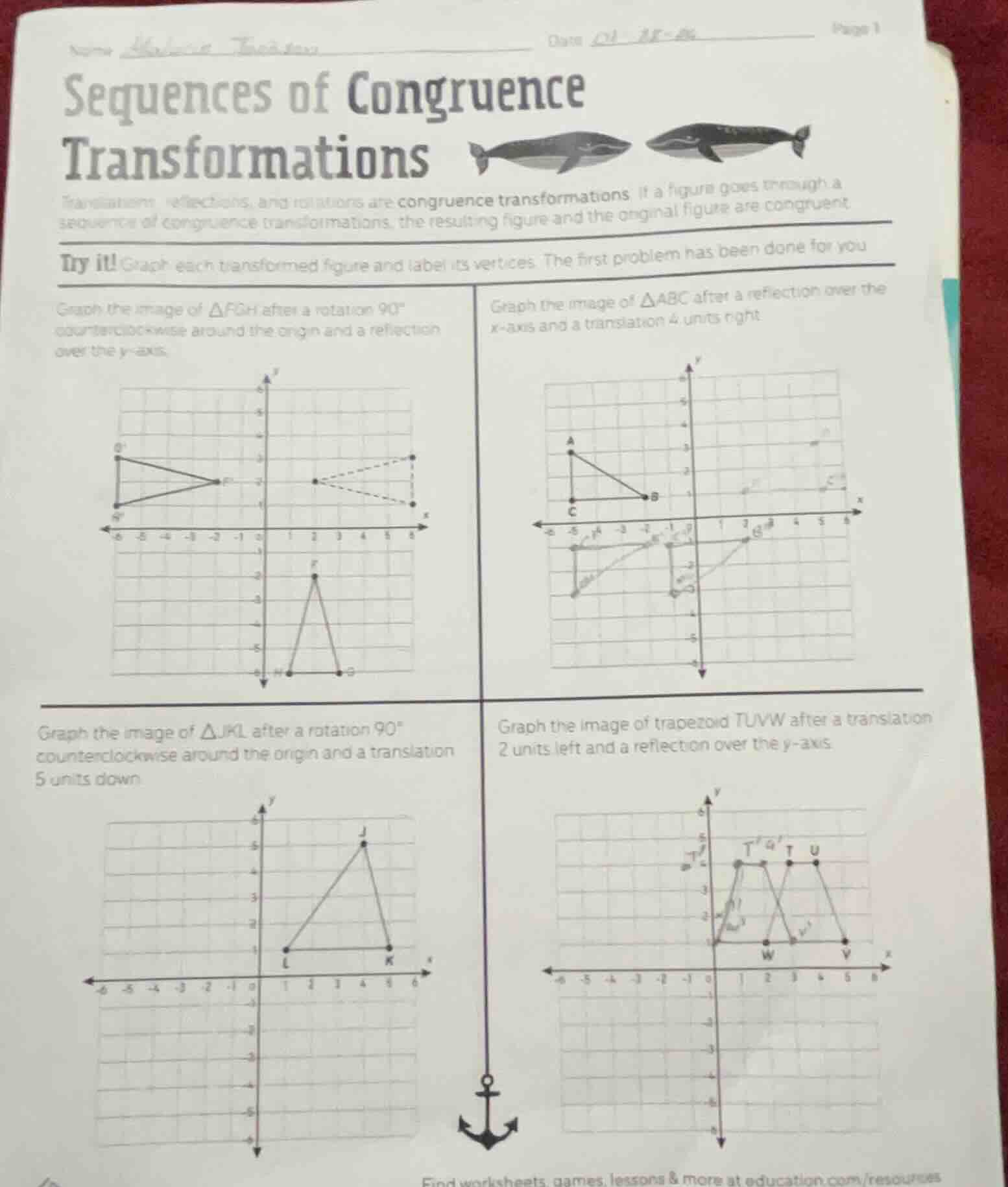
graph the image of $\triangle fgh$ after a rotation $90^\circ$ counterclockwise around the origin and a reflection over the $y$-axis.
graph the image of $\triangle abc$ after a reflection over the $x$-axis and a translation 4 units right
graph the image of $\triangle jkl$ after a rotation $90^\circ$ counterclockwise around the origin and a translation 5 units down
graph the image of trapezoid tuvw after a translation 2 units left and a reflection over the $y$-axis.
find worksheets, games, lessons & more at education.com/resources
To solve problems involving sequences of congruence transformations (rotations, reflections, translations), we follow these general steps for a single problem (e.g., graphing the image of \(\triangle ABC\) after a reflection over the \(x\)-axis and a translation 4 units right):
Step 1: Identify the original coordinates of the vertices
For \(\triangle ABC\) (from the graph):
- Let’s assume the coordinates are: \(A(-5, 3)\), \(B(-1, 1)\), \(C(-5, 1)\) (by reading from the grid).
Step 2: Apply the first transformation (reflection over the \(x\)-axis)
The rule for reflecting a point \((x, y)\) over the \(x\)-axis is \((x, -y)\).
- For \(A(-5, 3)\): \(A'(-5, -3)\)
- For \(B(-1, 1)\): \(B'(-1, -1)\)
- For \(C(-5, 1)\): \(C'(-5, -1)\)
Step 3: Apply the second transformation (translation 4 units right)
The rule for translating a point \((x, y)\) \(h\) units right is \((x + h, y)\) (here, \(h = 4\)).
- For \(A'(-5, -3)\): \(A''(-5 + 4, -3) = (-1, -3)\)
- For \(B'(-1, -1)\): \(B''(-1 + 4, -1) = (3, -1)\)
- For \(C'(-5, -1)\): \(C''(-5 + 4, -1) = (-1, -1)\)
Step 4: Graph the transformed vertices
Plot \(A''(-1, -3)\), \(B''(3, -1)\), and \(C''(-1, -1)\) on the coordinate plane and connect them to form the image of \(\triangle ABC\) after the two transformations.
General Approach for All Problems:
- Identify Original Coordinates: Read the coordinates of the vertices of the original figure from the grid.
- Apply First Transformation: Use the appropriate transformation rule (rotation, reflection, or translation) to find the intermediate coordinates.
- Rotation \(90^\circ\) counterclockwise: \((x, y) \to (-y, x)\)
- Reflection over \(y\)-axis: \((x, y) \to (-x, y)\)
- Translation: \((x, y) \to (x + h, y + k)\) (where \(h\) is horizontal shift, \(k\) is vertical shift)
- Apply Subsequent Transformations: Use the result of the first transformation as the input for the next transformation, applying the corresponding rule.
- Graph the Final Image: Plot the final coordinates of the vertices and connect them to form the transformed figure.
For example, for the problem of graphing \(\triangle FGH\) after a \(90^\circ\) counterclockwise rotation around the origin and a reflection over the \(y\)-axis:
- Original Coordinates of \(\triangle FGH\): Assume \(F(3, -2)\), \(G(1, -6)\), \(H(5, -6)\) (from the grid).
- First Transformation: \(90^\circ\) Counterclockwise Rotation (rule: \((x, y) \to (-y, x)\)):
- \(F(3, -2) \to F'(2, 3)\)
- \(G(1, -6) \to G'(6, 1)\)
- \(H(5, -6) \to H'(6, 5)\)
- Second Transformation: Reflection over \(y\)-axis (rule: \((x, y) \to (-x, y)\)):
- \(F'(2, 3) \to F''(-2, 3)\)
- \(G'(6, 1) \to G''(-6, 1)\)
- \(H'(6, 5) \to H''(-6, 5)\)
- Graph \(F''\), \(G''\), \(H''\) to get the final image.
By following these steps for each problem (identifying coordinates, applying transformations, graphing), you can solve all the sequence of congruence transformation problems.

Snap & solve any problem in the app
Get step-by-step solutions on Sovi AI
Photo-based solutions with guided steps
Explore more problems and detailed explanations
To solve problems involving sequences of congruence transformations (rotations, reflections, translations), we follow these general steps for a single problem (e.g., graphing the image of \(\triangle ABC\) after a reflection over the \(x\)-axis and a translation 4 units right):
Step 1: Identify the original coordinates of the vertices
For \(\triangle ABC\) (from the graph):
- Let’s assume the coordinates are: \(A(-5, 3)\), \(B(-1, 1)\), \(C(-5, 1)\) (by reading from the grid).
Step 2: Apply the first transformation (reflection over the \(x\)-axis)
The rule for reflecting a point \((x, y)\) over the \(x\)-axis is \((x, -y)\).
- For \(A(-5, 3)\): \(A'(-5, -3)\)
- For \(B(-1, 1)\): \(B'(-1, -1)\)
- For \(C(-5, 1)\): \(C'(-5, -1)\)
Step 3: Apply the second transformation (translation 4 units right)
The rule for translating a point \((x, y)\) \(h\) units right is \((x + h, y)\) (here, \(h = 4\)).
- For \(A'(-5, -3)\): \(A''(-5 + 4, -3) = (-1, -3)\)
- For \(B'(-1, -1)\): \(B''(-1 + 4, -1) = (3, -1)\)
- For \(C'(-5, -1)\): \(C''(-5 + 4, -1) = (-1, -1)\)
Step 4: Graph the transformed vertices
Plot \(A''(-1, -3)\), \(B''(3, -1)\), and \(C''(-1, -1)\) on the coordinate plane and connect them to form the image of \(\triangle ABC\) after the two transformations.
General Approach for All Problems:
- Identify Original Coordinates: Read the coordinates of the vertices of the original figure from the grid.
- Apply First Transformation: Use the appropriate transformation rule (rotation, reflection, or translation) to find the intermediate coordinates.
- Rotation \(90^\circ\) counterclockwise: \((x, y) \to (-y, x)\)
- Reflection over \(y\)-axis: \((x, y) \to (-x, y)\)
- Translation: \((x, y) \to (x + h, y + k)\) (where \(h\) is horizontal shift, \(k\) is vertical shift)
- Apply Subsequent Transformations: Use the result of the first transformation as the input for the next transformation, applying the corresponding rule.
- Graph the Final Image: Plot the final coordinates of the vertices and connect them to form the transformed figure.
For example, for the problem of graphing \(\triangle FGH\) after a \(90^\circ\) counterclockwise rotation around the origin and a reflection over the \(y\)-axis:
- Original Coordinates of \(\triangle FGH\): Assume \(F(3, -2)\), \(G(1, -6)\), \(H(5, -6)\) (from the grid).
- First Transformation: \(90^\circ\) Counterclockwise Rotation (rule: \((x, y) \to (-y, x)\)):
- \(F(3, -2) \to F'(2, 3)\)
- \(G(1, -6) \to G'(6, 1)\)
- \(H(5, -6) \to H'(6, 5)\)
- Second Transformation: Reflection over \(y\)-axis (rule: \((x, y) \to (-x, y)\)):
- \(F'(2, 3) \to F''(-2, 3)\)
- \(G'(6, 1) \to G''(-6, 1)\)
- \(H'(6, 5) \to H''(-6, 5)\)
- Graph \(F''\), \(G''\), \(H''\) to get the final image.
By following these steps for each problem (identifying coordinates, applying transformations, graphing), you can solve all the sequence of congruence transformation problems.