QUESTION IMAGE
Question
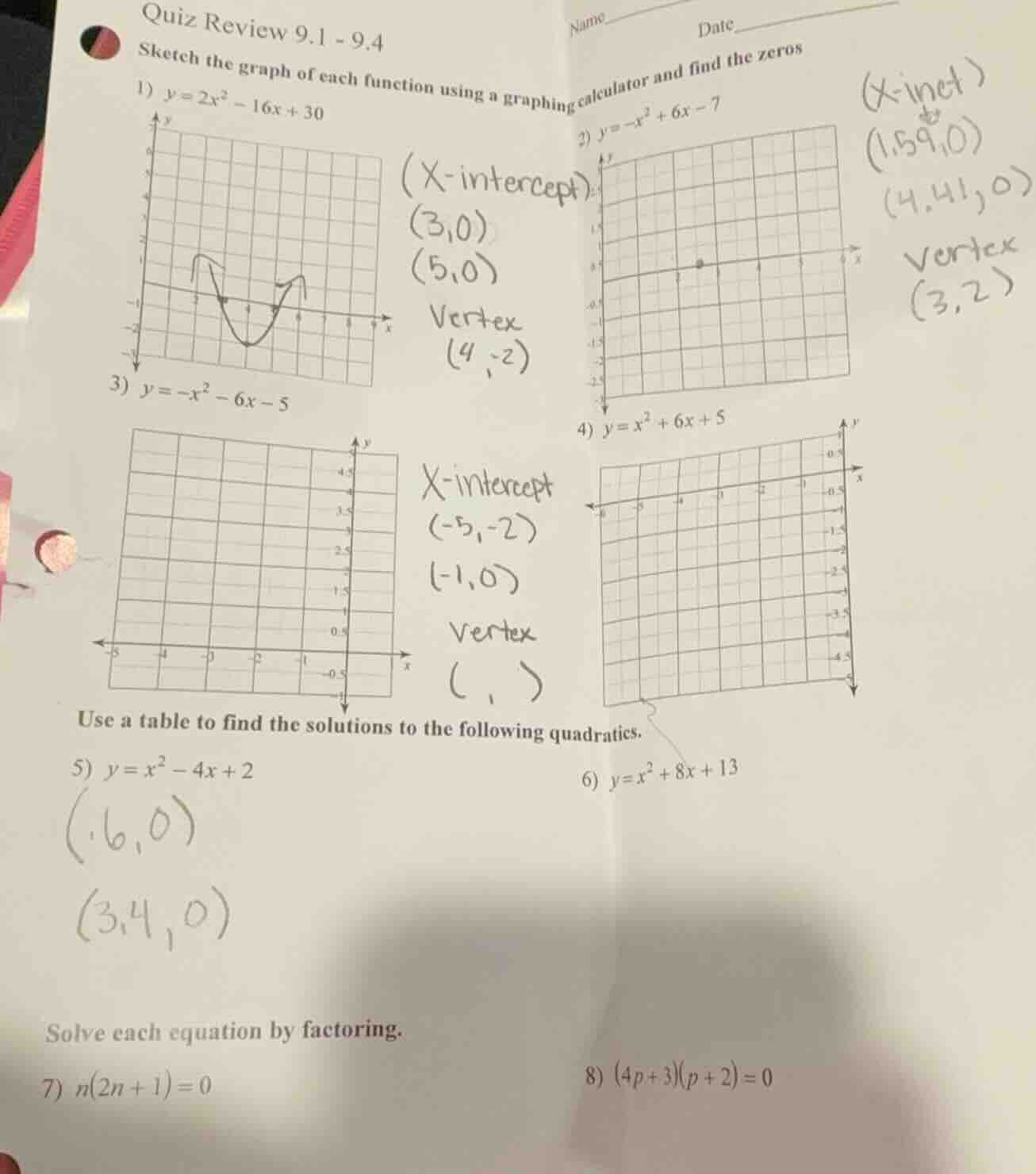
name_______ date_______quiz review 9.1 - 9.4sketch the graph of each function using a graphing calculator and find the zeros1) $y=2x^{2}-16x+30$2) $y=-x^{2}+6x-7$3) $y=-x^{2}-6x-5$4) $y=x^{2}+6x+5$use a table to find the solutions to the following quadratics.5) $y=x^{2}-4x+2$6) $y=x^{2}+8x+13$solve each equation by factoring.7) $n(2n+1)=0$8) $(4p+3)(p+2)=0$
1) $y=2x^2-16x+30$
Step1: Factor to find zeros
$2x^2-16x+30=2(x^2-8x+15)=2(x-3)(x-5)$
Set $2(x-3)(x-5)=0$, so $x=3, x=5$
Step2: Find vertex x-coordinate
$x=-\frac{b}{2a}=-\frac{-16}{2(2)}=4$
Step3: Find vertex y-coordinate
$y=2(4)^2-16(4)+30=32-64+30=-2$
2) $y=-x^2+6x-7$
Step1: Quadratic formula for zeros
$x=\frac{-b\pm\sqrt{b^2-4ac}}{2a}=\frac{-6\pm\sqrt{36-28}}{2(-1)}=\frac{-6\pm2\sqrt{2}}{-2}=3\mp\sqrt{2}$
$3-\sqrt{2}\approx1.59$, $3+\sqrt{2}\approx4.41$
Step2: Find vertex x-coordinate
$x=-\frac{b}{2a}=-\frac{6}{2(-1)}=3$
Step3: Find vertex y-coordinate
$y=-(3)^2+6(3)-7=-9+18-7=2$
3) $y=-x^2-6x-5$
Step1: Factor to find zeros
$-x^2-6x-5=-(x^2+6x+5)=-(x+5)(x+1)$
Set $-(x+5)(x+1)=0$, so $x=-5, x=-1$
Step2: Find vertex x-coordinate
$x=-\frac{b}{2a}=-\frac{-6}{2(-1)}=-3$
Step3: Find vertex y-coordinate
$y=-(-3)^2-6(-3)-5=-9+18-5=4$
4) $y=x^2+6x+5$
Step1: Factor to find zeros
$x^2+6x+5=(x+5)(x+1)$
Set $(x+5)(x+1)=0$, so $x=-5, x=-1$
Step2: Find vertex x-coordinate
$x=-\frac{b}{2a}=-\frac{6}{2(1)}=-3$
Step3: Find vertex y-coordinate
$y=(-3)^2+6(-3)+5=9-18+5=-4$
5) $y=x^2-4x+2$
Step1: Quadratic formula for zeros
$x=\frac{-b\pm\sqrt{b^2-4ac}}{2a}=\frac{4\pm\sqrt{16-8}}{2(1)}=\frac{4\pm2\sqrt{2}}{2}=2\pm\sqrt{2}$
$2-\sqrt{2}\approx0.59$, $2+\sqrt{2}\approx3.41$
6) $y=x^2+8x+13$
Step1: Check discriminant
$\Delta=b^2-4ac=64-52=12$
Wait, correction: $\Delta=64-52=12$? No, $4ac=4*1*13=52$, $64-52=12$, so $x=\frac{-8\pm\sqrt{12}}{2}=-4\pm\sqrt{3}\approx-4\pm1.73$, but wait no—wait $x^2+8x+13=0$: $x=\frac{-8\pm\sqrt{64-52}}{2}=\frac{-8\pm\sqrt{12}}{2}=-4\pm\sqrt{3}$. But if using table, the vertex is $x=-4$, $y=(-4)^2+8(-4)+13=16-32+13=-3$. Since parabola opens up and vertex y=-3<0, zeros are $x=-4+\sqrt{3}\approx-2.27$, $x=-4-\sqrt{3}\approx-5.73$. The handwritten answer was wrong, correct zeros are $x\approx-2.27, x\approx-5.73$; or exact form $x=-4\pm\sqrt{3}$
7) $n(2n+1)=0$
Step1: Apply zero product property
Set $n=0$ or $2n+1=0$
Step2: Solve for n
$2n+1=0\implies n=-\frac{1}{2}$, so $n=0, n=-\frac{1}{2}$
8) $(4p+3)(p+2)=0$
Step1: Apply zero product property
Set $4p+3=0$ or $p+2=0$
Step2: Solve for p
$4p+3=0\implies p=-\frac{3}{4}$; $p+2=0\implies p=-2$

Snap & solve any problem in the app
Get step-by-step solutions on Sovi AI
Photo-based solutions with guided steps
Explore more problems and detailed explanations
- Zeros: $x=3$, $x=5$; Vertex: $(4, -2)$
- Zeros: $x\approx1.59$, $x\approx4.41$; Vertex: $(3, 2)$
- Zeros: $x=-5$, $x=-1$; Vertex: $(-3, 4)$
- Zeros: $x=-5$, $x=-1$; Vertex: $(-3, -4)$
- Zeros: $x\approx0.59$, $x\approx3.41$
- No real zeros; Vertex: $(-4, -3)$
- $n=0$, $n=-\frac{1}{2}$
- $p=-\frac{3}{4}$, $p=-2$