QUESTION IMAGE
Question
name:
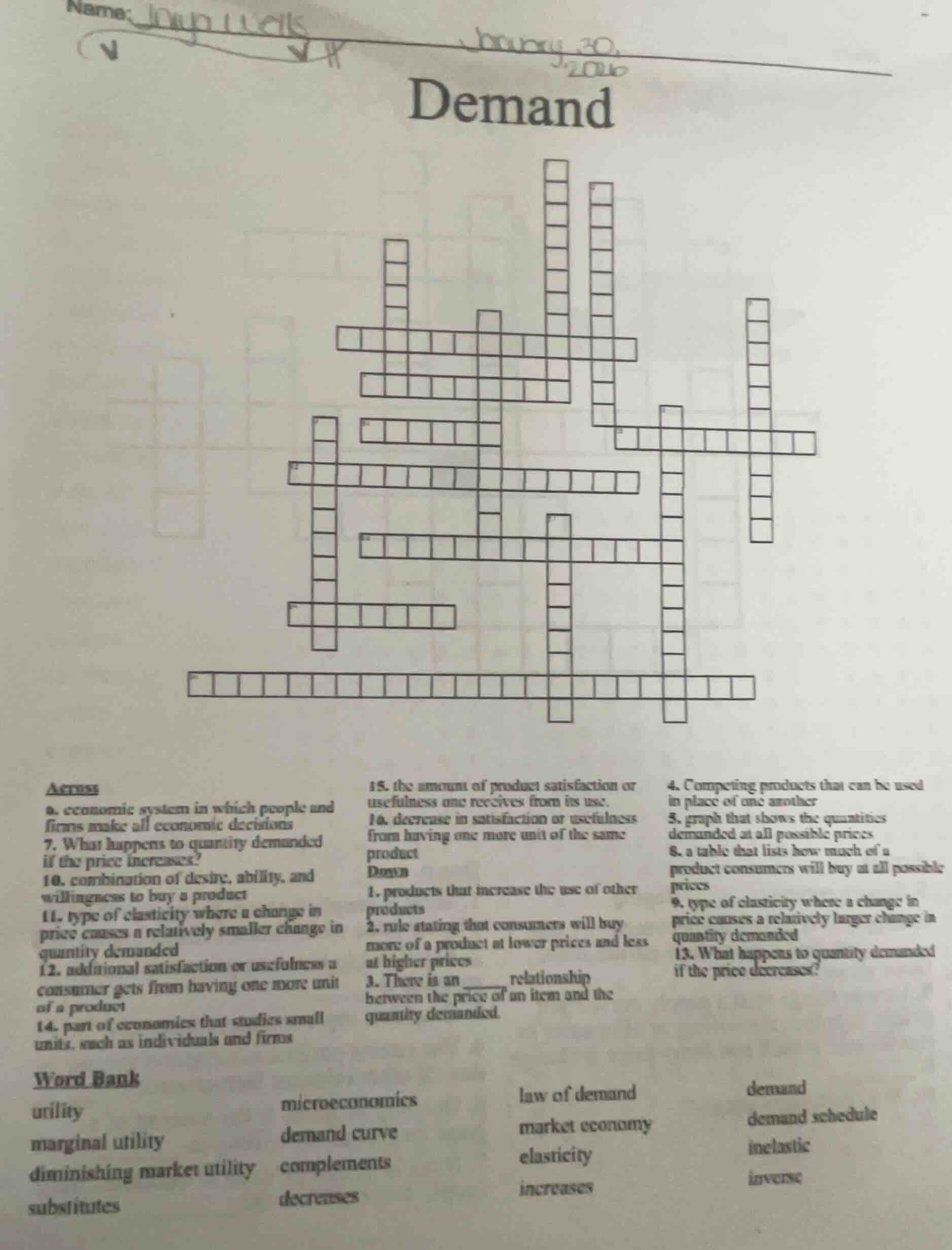
demand
across
- economic system in which people and firms make all economic decisions
- what happens to quantity demanded if the price increases?
- combination of desire, ability, and willingness to buy a product
- type of elasticity where a change in price causes a relatively smaller change in quantity demanded
- additional satisfaction or usefulness a consumer gets from having one more unit of a product
- part of economics that studies small units, such as individuals and firms
- the amount of product satisfaction or usefulness one receives from its use.
down
- products that increase the use of other products
- rule stating that consumers will buy more of a product at lower prices and less at higher prices
- there is an ______ relationship between the price of an item and the quantity demanded.
- competing products that can be used in place of one another
- graph that shows the quantities demanded at all possible prices
- a table that lists how much of a product consumers will buy at all possible prices
- type of elasticity where a change in price causes a relatively larger change in quantity demanded
- what happens to quantity demanded if the price decreases?
word bank
utility \t\tmicroeconomics \t\tlaw of demand \t\tdemand
marginal utility \tdemand curve \t\tmarket economy \tdemand schedule
diminishing market utility \tcomplements \t\telasticity \t\tinelastic
substitutes \t\tdecreases \t\t\tincreases \t\tinverse
To solve the crossword, we match each clue to the appropriate term from the word bank:
Across
- 6: Economic system with individual/firm decisions → market economy
- 7: Quantity demanded when price increases → decreases (price up → quantity demanded down)
- 10: Desire + ability + willingness to buy → demand
- 11: Price change causes smaller quantity change → inelastic (inelastic demand)
- 12: Extra satisfaction from one more unit → marginal utility
- 14: Studies individuals/firms → microeconomics
- 15: Product satisfaction/usefulness → utility
- 16: Decrease in satisfaction from more units → diminishing marginal utility (note: likely typo, should be “marginal”)
Down
- 1: Products that increase use of others → complements (e.g., peanut butter and jelly)
- 2: Consumers buy more at low prices, less at high → law of demand
- 3: Relationship between price and quantity demanded → inverse (price and quantity demanded are inversely related)
- 4: Competing products (replaceable) → substitutes (e.g., Coke and Pepsi)
- 5: Graph of quantities demanded at all prices → demand curve
- 8: Table of quantities demanded at all prices → demand schedule
- 9: Price change causes larger quantity change → elastic (elastic demand)
- 13: Quantity demanded when price decreases → increases (price down → quantity demanded up)
Filled Crossword (Key Terms):
| Across | Down |
|---|---|
| 7. decreases | 2. law of demand |
| 10. demand | 3. inverse |
| 11. inelastic | 4. substitutes |
| 12. marginal utility | 5. demand curve |
| 14. microeconomics | 8. demand schedule |
| 15. utility | 9. elastic |
| 16. diminishing marginal utility | 13. increases |
(Note: Ensure grid letters align with word lengths. For example, “market economy” (12 letters) fits 6-Across, “decreases” (8 letters) fits 7-Across, etc.)

Snap & solve any problem in the app
Get step-by-step solutions on Sovi AI
Photo-based solutions with guided steps
Explore more problems and detailed explanations
To solve the crossword, we match each clue to the appropriate term from the word bank:
Across
- 6: Economic system with individual/firm decisions → market economy
- 7: Quantity demanded when price increases → decreases (price up → quantity demanded down)
- 10: Desire + ability + willingness to buy → demand
- 11: Price change causes smaller quantity change → inelastic (inelastic demand)
- 12: Extra satisfaction from one more unit → marginal utility
- 14: Studies individuals/firms → microeconomics
- 15: Product satisfaction/usefulness → utility
- 16: Decrease in satisfaction from more units → diminishing marginal utility (note: likely typo, should be “marginal”)
Down
- 1: Products that increase use of others → complements (e.g., peanut butter and jelly)
- 2: Consumers buy more at low prices, less at high → law of demand
- 3: Relationship between price and quantity demanded → inverse (price and quantity demanded are inversely related)
- 4: Competing products (replaceable) → substitutes (e.g., Coke and Pepsi)
- 5: Graph of quantities demanded at all prices → demand curve
- 8: Table of quantities demanded at all prices → demand schedule
- 9: Price change causes larger quantity change → elastic (elastic demand)
- 13: Quantity demanded when price decreases → increases (price down → quantity demanded up)
Filled Crossword (Key Terms):
| Across | Down |
|---|---|
| 7. decreases | 2. law of demand |
| 10. demand | 3. inverse |
| 11. inelastic | 4. substitutes |
| 12. marginal utility | 5. demand curve |
| 14. microeconomics | 8. demand schedule |
| 15. utility | 9. elastic |
| 16. diminishing marginal utility | 13. increases |
(Note: Ensure grid letters align with word lengths. For example, “market economy” (12 letters) fits 6-Across, “decreases” (8 letters) fits 7-Across, etc.)