QUESTION IMAGE
Question
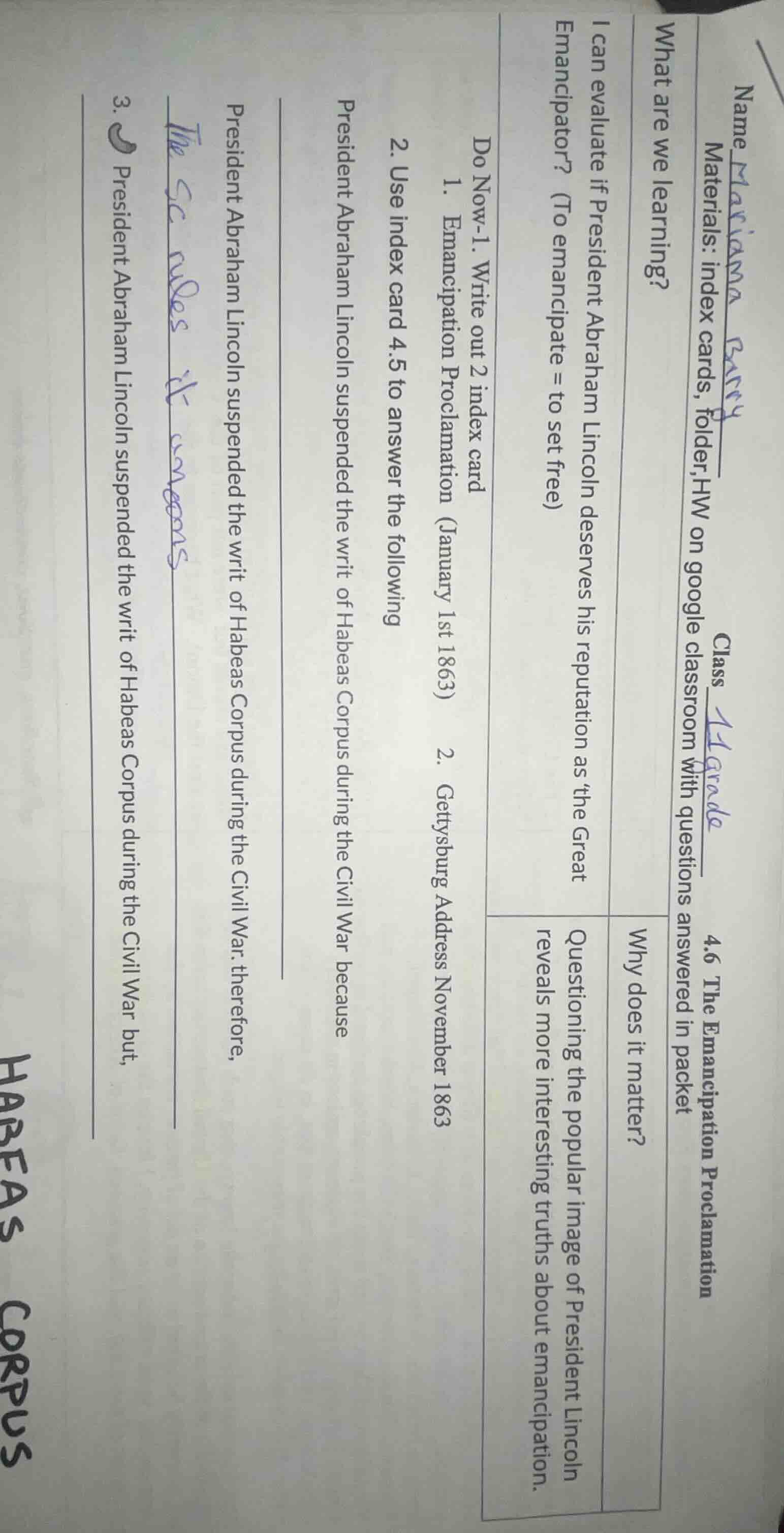
name: mariana barry
class: 7th grade
materials: index cards, folder, hw on google classroom with questions answered in packet
4.6 the emancipation proclamation
what are we learning?
i can evaluate if president abraham lincoln deserves his reputation as the great emancipator? (to emancipate = to set free)
questioning the popular image of president lincoln reveals more interesting truths about emancipation.
why does it matter?
do now-1. write out 2 index card
- emancipation proclamation (january 1st 1863)
- gettysburg address november 1863
- use index card 4.5 to answer the following
president abraham lincoln suspended the writ of habeas corpus during the civil war because
president abraham lincoln suspended the writ of habeas corpus during the civil war, therefore,
the sc rules it unconstitutional
- 😉 president abraham lincoln suspended the writ of habeas corpus during the civil war but,
To answer the question about why it matters (related to the Emancipation Proclamation and Lincoln's actions), we can use the following reasoning:
The Emancipation Proclamation and Lincoln's actions (like suspending habeas corpus) mattered for several reasons. The Emancipation Proclamation (January 1, 1863) transformed the Civil War's purpose, turning it into a fight against slavery, which boosted Union morale and gained international support (e.g., preventing Britain/France from aiding the Confederacy). Suspending habeas corpus (a legal protection against unlawful detention) allowed Lincoln to deal with Confederate sympathizers and maintain order during the war, showing the need for strong executive action in a crisis. These actions shaped the nation's path toward ending slavery and redefining presidential power, impacting American history, civil rights, and the balance of government powers.

Snap & solve any problem in the app
Get step-by-step solutions on Sovi AI
Photo-based solutions with guided steps
Explore more problems and detailed explanations
It mattered because the Emancipation Proclamation redefined the Civil War’s goal (fighting slavery), boosted Union support, and Lincoln’s suspension of habeas corpus helped maintain order during the crisis, both shaping U.S. history, civil rights, and governmental power dynamics.