QUESTION IMAGE
Question
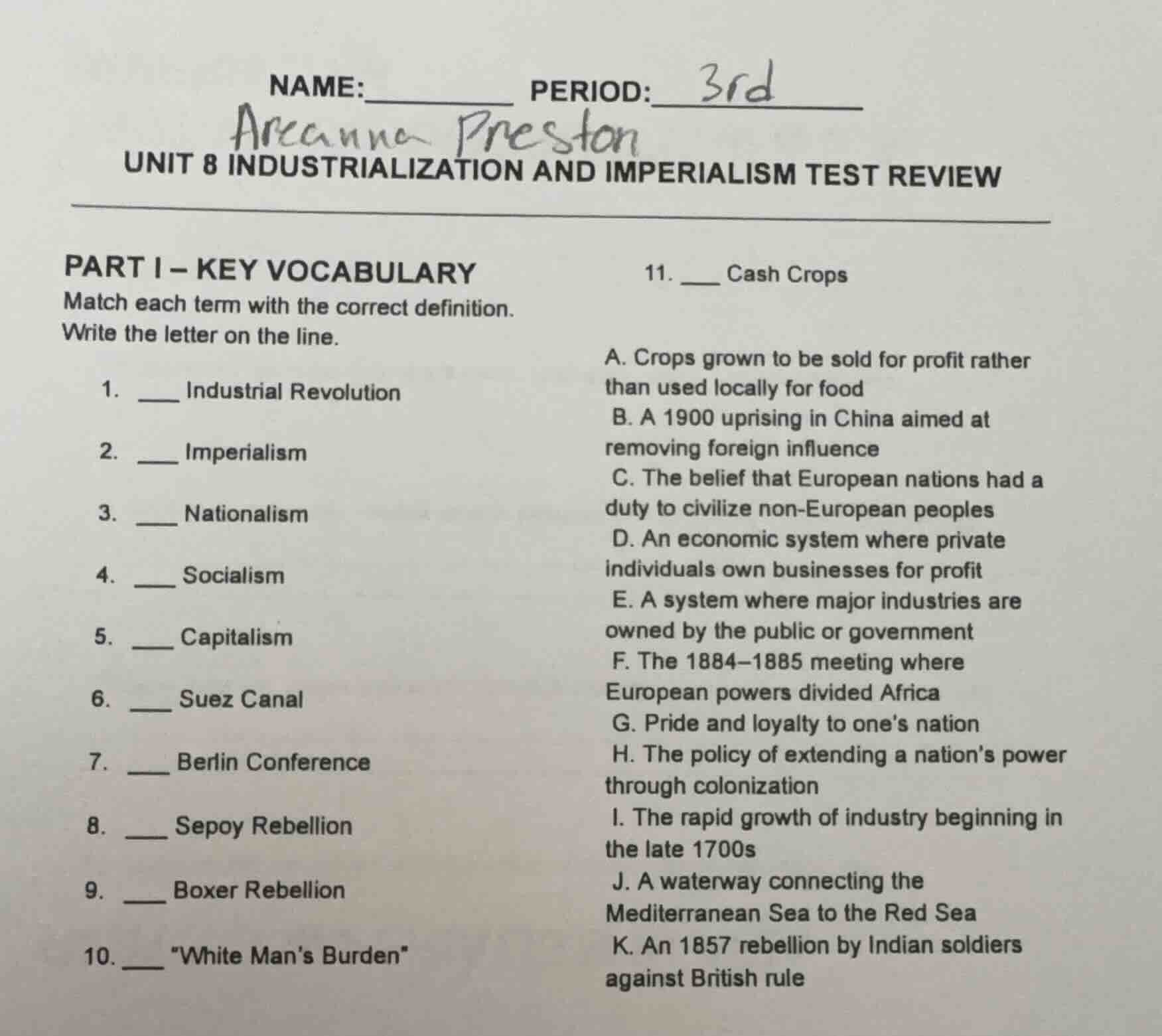
name:______ period:3rd_areanna prestonunit 8 industrialization and imperialism test reviewpart i - key vocabularymatch each term with the correct definition.write the letter on the line.1. industrial revolution2. imperialism3. nationalism4. socialism5. capitalism6. suez canal7. berlin conference8. sepoy rebellion9. boxer rebellion10. \white mans burden\11. __ cash cropsa. crops grown to be sold for profit rather than used locally for foodb. a 1900 uprising in china aimed at removing foreign influencec. the belief that european nations had a duty to civilize non-european peoplesd. an economic system where private individuals own businesses for profite. a system where major industries are owned by the public or governmentf. the 1884-1885 meeting where european powers divided africag. pride and loyalty to ones nationh. the policy of extending a nations power through colonizationi. the rapid growth of industry beginning in the late 1700sj. a waterway connecting the mediterranean sea to the red seak. an 1857 rebellion by indian soldiers against british rule
Each term is matched to its standard historical definition related to industrialization and imperialism:
- Industrial Revolution refers to the late 1700s rapid industrial growth.
- Imperialism is extending power via colonization.
- Nationalism is pride/loyalty to one's nation.
- Socialism is public/government-owned major industries.
- Capitalism is private ownership for profit.
- Suez Canal links Mediterranean and Red Seas.
- Berlin Conference divided Africa (1884-1885).
- Sepoy Rebellion was 1857 Indian soldier uprising.
- Boxer Rebellion was 1900 China anti-foreign uprising.
- "White Man's Burden" is the European civilizing duty idea.
- Cash Crops are grown for profit, not local food.

Snap & solve any problem in the app
Get step-by-step solutions on Sovi AI
Photo-based solutions with guided steps
Explore more problems and detailed explanations
- I. The rapid growth of industry beginning in the late 1700s
- H. The policy of extending a nation's power through colonization
- G. Pride and loyalty to one's nation
- E. A system where major industries are owned by the public or government
- D. An economic system where private individuals own businesses for profit
- J. A waterway connecting the Mediterranean Sea to the Red Sea
- F. The 1884-1885 meeting where European powers divided Africa
- K. An 1857 rebellion by Indian soldiers against British rule
- B. A 1900 uprising in China aimed at removing foreign influence
- C. The belief that European nations had a duty to civilize non-European peoples
- A. Crops grown to be sold for profit rather than used locally for food