QUESTION IMAGE
Question
name: ____________________________ period: _ date: _/_/___
animal cell diagram
directions: color each organelle and use the terms below to correctly
identify the organelles.
cell membrane lysosome nucleus
centrioles mitochondrion peroxisome
chromatin nuclear membrane ribosomes
cytoplasm nuclear pore rough er
cytoskeleton nucleolus secretory vesicle
golgi body smooth er
d chromatin
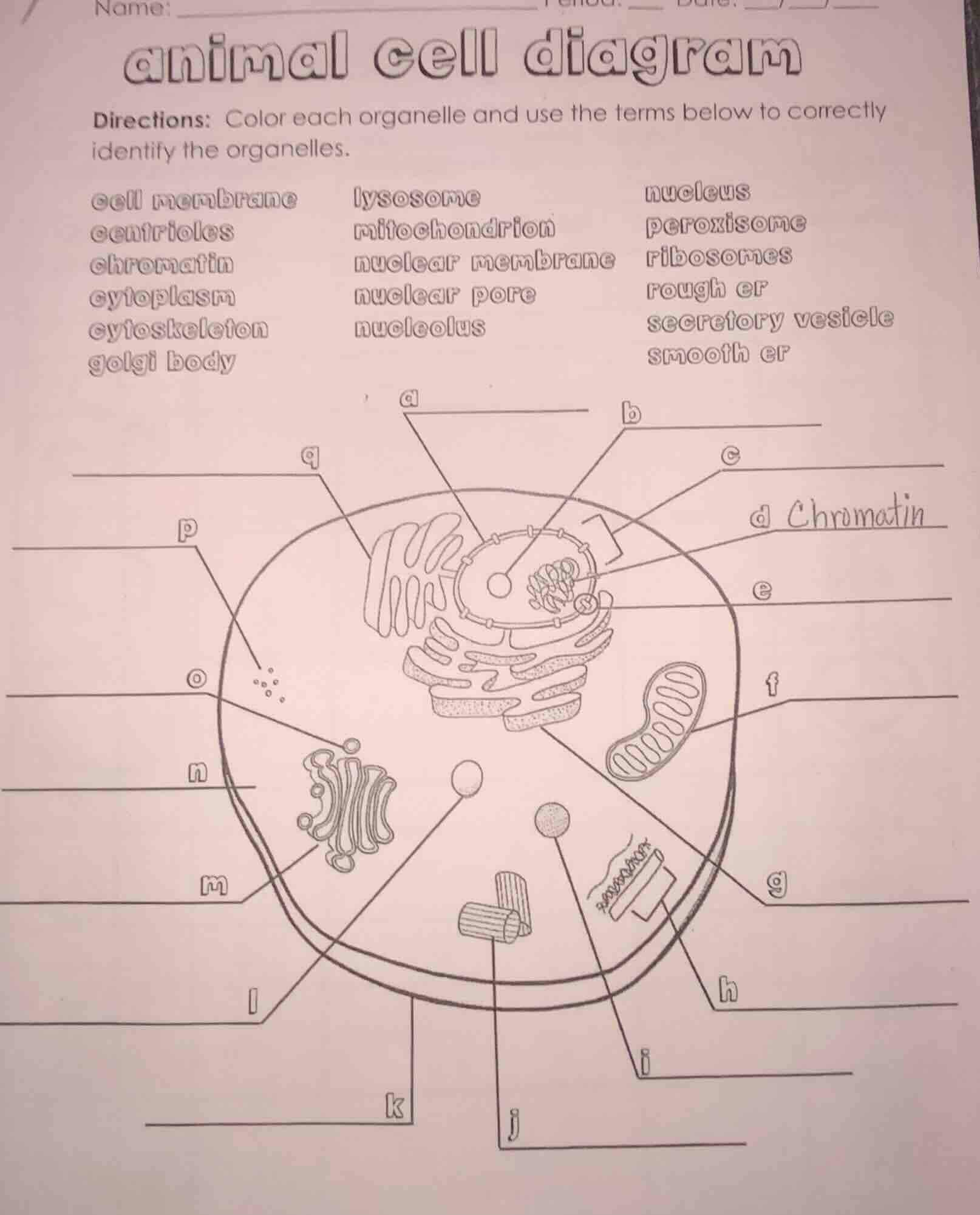
Each label is matched to the corresponding animal cell organelle based on standard cell anatomy:
- a: The outer boundary of the nucleus is the nuclear membrane.
- b: The dense structure inside the nucleus is the nucleolus.
- c: The small openings on the nuclear membrane are nuclear pores.
- d: Labeled as chromatin, this is the DNA-protein complex in the nucleus.
- e: The large, rounded structure containing chromatin is the nucleus.
- f: The oval, double-membraned organelle is a mitochondrion.
- g: The membrane network with ribosomes attached is rough ER.
- h: The membrane network without ribosomes is smooth ER.
- i: The small, spherical organelle involved in lipid breakdown is a peroxisome.
- j: The cylindrical, paired organelles are centrioles.
- k: The outer boundary of the entire cell is the cell membrane.
- l: The small, spherical organelle with digestive enzymes is a lysosome.
- m: The stacked, flattened membrane sacs are the golgi body.
- n: The gel-like substance filling the cell is cytoplasm.
- o: The small, spherical structure for transport is a secretory vesicle.
- p: The tiny dot-like structures are ribosomes.
- q: The thread-like structures supporting the cell are the cytoskeleton.

Snap & solve any problem in the app
Get step-by-step solutions on Sovi AI
Photo-based solutions with guided steps
Explore more problems and detailed explanations
a. nuclear membrane
b. nucleolus
c. nuclear pore
d. chromatin
e. nucleus
f. mitochondrion
g. rough er
h. smooth er
i. peroxisome
j. centrioles
k. cell membrane
l. lysosome
m. golgi body
n. cytoplasm
o. secretory vesicle
p. ribosomes
q. cytoskeleton