QUESTION IMAGE
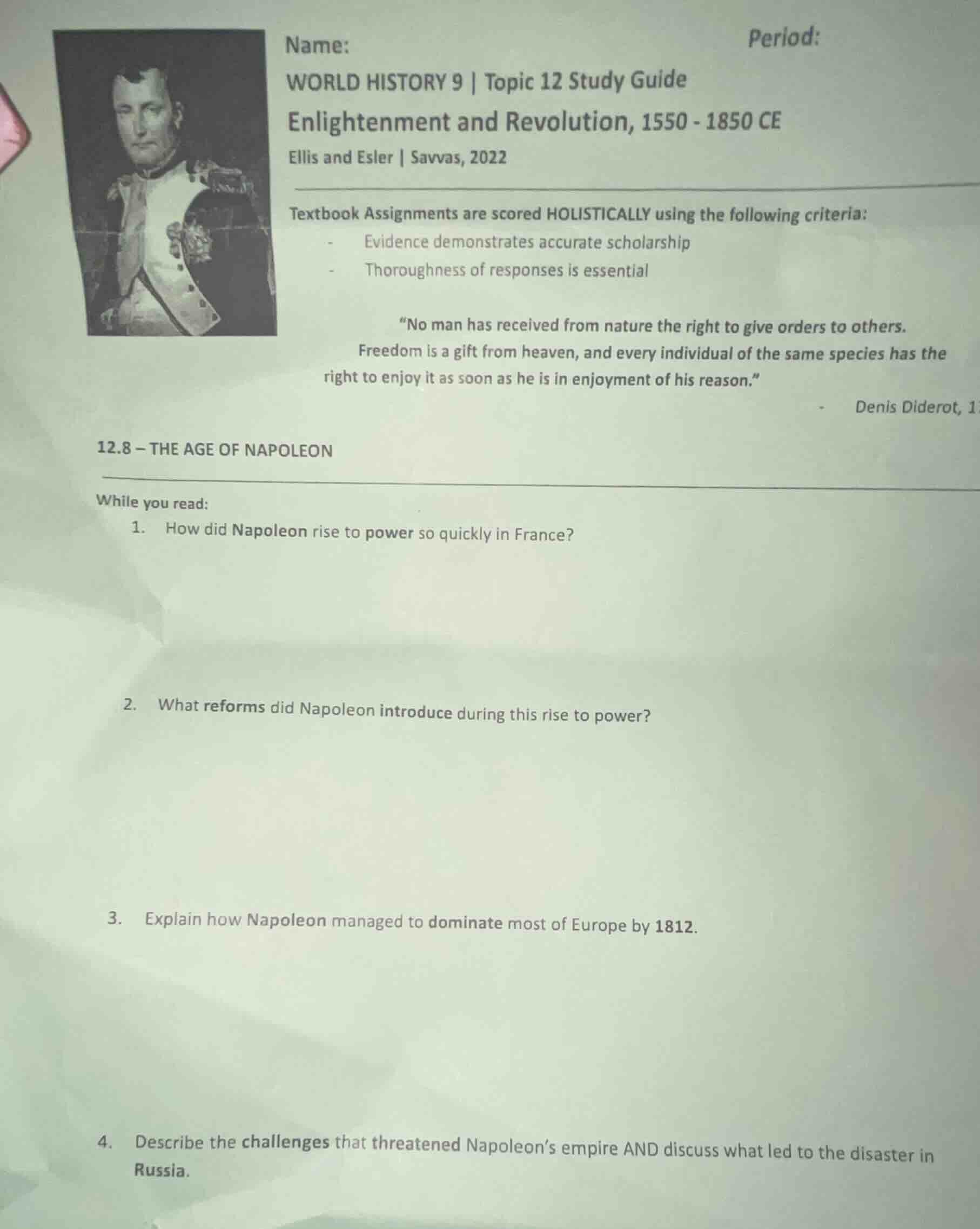
Question
name:
period:
world history 9 | topic 12 study guide
enlightenment and revolution, 1550 - 1850 ce
ellis and esler | savvas, 2022
textbook assignments are scored holistically using the following criteria:
- evidence demonstrates accurate scholarship
- thoroughness of responses is essential
o man has received from nature the right to give orders to others.
freedom is a gift from heaven, and every individual of the same species has the
right to enjoy it as soon as he is in enjoyment of his reason.\
- denis diderot, 1
12.8 – the age of napoleon
while you read:
- how did napoleon rise to power so quickly in france?
- what reforms did napoleon introduce during this rise to power?
- explain how napoleon managed to dominate most of europe by 1812.
- describe the challenges that threatened napoleon’s empire and discuss what led to the disaster in
russia.
Sub - Question 1: How did Napoleon rise to power so quickly in France?
After the French Revolution, France was in a period of political instability and chaos. Napoleon was a brilliant military leader. He gained fame through his military victories against France's enemies, which made him popular among the French people and the military. The weak and ineffective Directory (the governing body at that time) was unable to maintain order and stability. Napoleon took advantage of this situation. In 1799, he led a coup d'état (the Coup of 18 Brumaire) and overthrew the Directory, establishing the Consulate with himself as the First Consul. His military success, the political weakness of the existing government, and the desire of the French people for stability and strong leadership all contributed to his rapid rise to power.
One of the most significant reforms was the Napoleonic Code (Civil Code). It unified French law, abolished feudal privileges, established equality before the law, and protected property rights. He also reformed the education system, creating a system of public schools (lycées) to provide a more standardized and merit - based education, which helped in training a new generation of officials and professionals. In the economic sphere, he established the Bank of France to stabilize the economy, regulate finances, and promote economic growth. He also made peace with the Catholic Church through the Concordat of 1801, which restored some of the Church's status in France while still maintaining state control over religious affairs, which helped to reconcile many French Catholics who were alienated during the Revolution.
Napoleon used a combination of military force, diplomacy, and the establishment of client states. His Grand Army was highly disciplined and well - led, and he won a series of decisive battles against the armies of other European powers, such as the Austrians, Prussians, and Russians. Through these victories, he forced many European countries to sign treaties that were favorable to France. He also established the Continental System, which was an economic blockade against Britain, aiming to weaken Britain economically. Additionally, he placed his relatives and loyal supporters in positions of power in conquered or allied states (client states), like making his brother Joseph the king of Spain and his brother Louis the king of Holland. This system of client states and military dominance allowed him to extend French influence and control over most of Europe by 1812.

Snap & solve any problem in the app
Get step-by-step solutions on Sovi AI
Photo-based solutions with guided steps
Explore more problems and detailed explanations
Napoleon rose to power quickly due to his military brilliance (gaining fame from victories), the political instability/weakness of the Directory, and the French people's desire for stability/strong leadership. He led a coup in 1799 (Coup of 18 Brumaire) to overthrow the Directory and establish the Consulate.