QUESTION IMAGE
Question
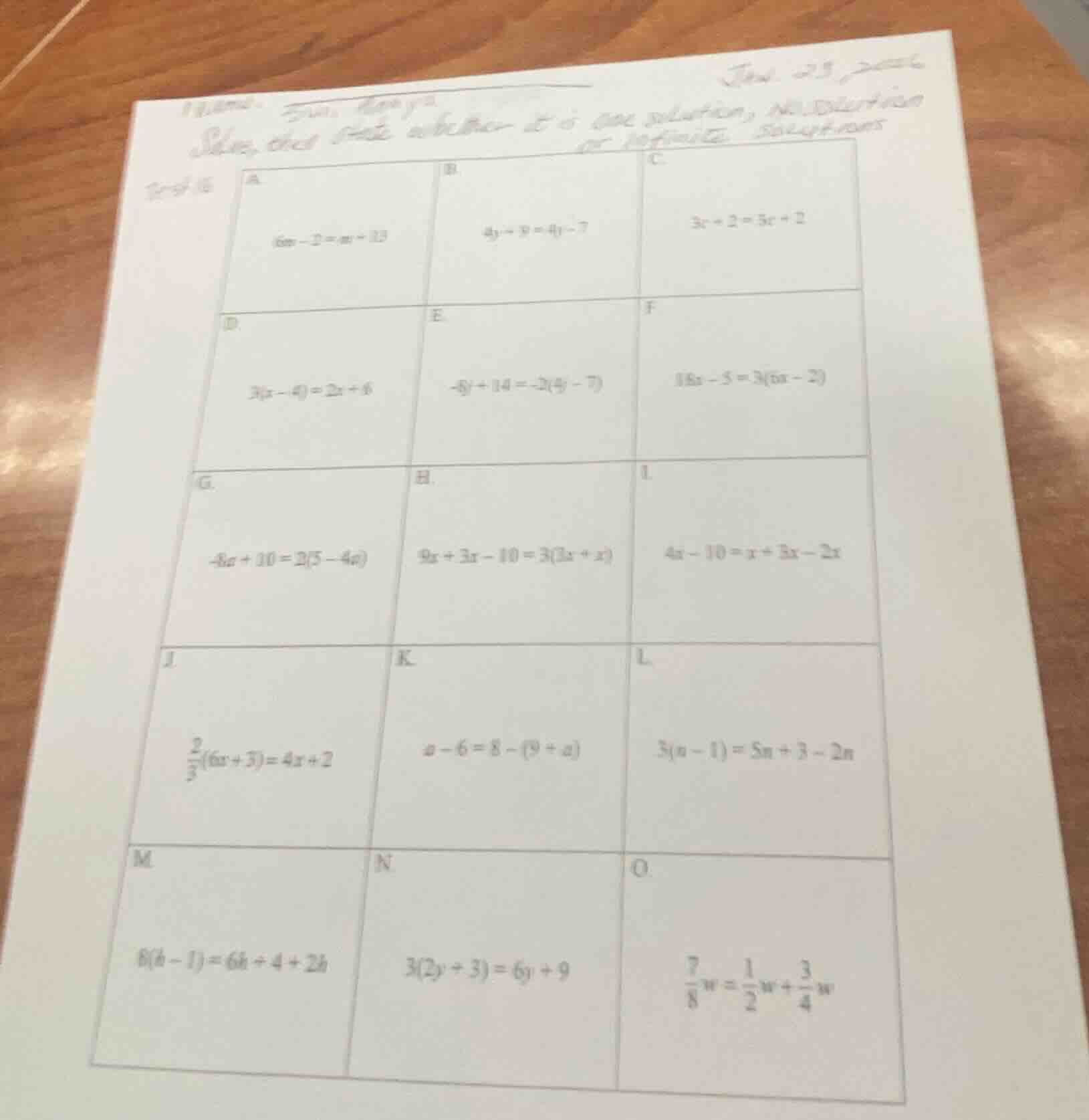
name: solve, then state whether it is one solution, no solution or infinite solutions a. (6m - 2 = m + 13) b. (4y + 9 = 4y - 7) c. (3c + 2 = 3c + 2) d. (3(x - 4) = 2x + 6) e. (-8y + 14 = -2(4y - 7)) f. (18x - 5 = 3(6x - 2)) g. (-8a + 10 = 2(5 - 4a)) h. (9x + 3x - 10 = 3(2x + x)) i. (4x - 10 = x + 3x - 2x) j. (\frac{2}{3}(6x + 3) = 4x + 2) k. (a - 6 = 8 - (9 + a)) l. (3(n - 1) = 5n + 3 - 2n) m. (6(h - 1) = 6h + 4 + 2h) n. (3(2y + 3) = 6y + 9) o. (\frac{7}{8}w = \frac{1}{2}w + \frac{3}{4}w)
A.
Step1: Isolate $m$ terms
$6m - m = 13 + 2$
Step2: Simplify to solve for $m$
$5m = 15 \implies m = \frac{15}{5} = 3$
Step3: Classify solution type
One unique solution.
B.
Step1: Expand and simplify both sides
$4y + 9 = 4y - 7$
Step2: Subtract $4y$ from both sides
$9 = -7$
Step3: Classify solution type
No solution (contradiction).
C.
Step1: Subtract $3x$ from both sides
$2 = 2$
Step2: Classify solution type
Infinite solutions (identity).
D.
Step1: Expand left-hand side
$3x - 12 = 2x + 6$
Step2: Isolate $x$ terms
$3x - 2x = 6 + 12$
Step3: Simplify to solve for $x$
$x = 18$
Step4: Classify solution type
One unique solution.
E.
Step1: Simplify both sides
$-8j + 14 = -8j + 14$
Step2: Classify solution type
Infinite solutions (identity).
F.
Step1: Expand right-hand side
$18x - 5 = 18x - 6$
Step2: Subtract $18x$ from both sides
$-5 = -6$
Step3: Classify solution type
No solution (contradiction).
G.
Step1: Expand right-hand side
$-8a + 10 = 10 - 8a$
Step2: Classify solution type
Infinite solutions (identity).
H.
Step1: Simplify both sides
$12x - 10 = 12x$
Step2: Subtract $12x$ from both sides
$-10 = 0$
Step3: Classify solution type
No solution (contradiction).
I.
Step1: Simplify both sides
$4x - 10 = 2x$
Step2: Isolate $x$ terms
$4x - 2x = 10$
Step3: Simplify to solve for $x$
$2x = 10 \implies x = 5$
Step4: Classify solution type
One unique solution.
J.
Step1: Expand left-hand side
$\frac{2}{3}(6x) + \frac{2}{3}(3) = 4x + 2 \implies 4x + 2 = 4x + 2$
Step2: Classify solution type
Infinite solutions (identity).
K.
Step1: Simplify right-hand side
$a - 6 = 8 - 9 - a \implies a - 6 = -1 - a$
Step2: Isolate $a$ terms
$a + a = -1 + 6$
Step3: Simplify to solve for $a$
$2a = 5 \implies a = \frac{5}{2}$
Step4: Classify solution type
One unique solution.
L.
Step1: Simplify both sides
$3n - 3 = 3n + 3$
Step2: Subtract $3n$ from both sides
$-3 = 3$
Step3: Classify solution type
No solution (contradiction).
M.
Step1: Simplify both sides
$8h - 8 = 8h + 4$
Step2: Subtract $8h$ from both sides
$-8 = 4$
Step3: Classify solution type
No solution (contradiction).
N.
Step1: Expand left-hand side
$6y + 9 = 6y + 9$
Step2: Classify solution type
Infinite solutions (identity).
O.
Step1: Multiply all terms by 8 to eliminate fractions
$7w = 4w + 6w$
Step2: Simplify right-hand side
$7w = 10w$
Step3: Isolate $w$ terms
$7w - 10w = 0 \implies -3w = 0$
Step4: Solve for $w$
$w = 0$
Step5: Classify solution type
One unique solution.

Snap & solve any problem in the app
Get step-by-step solutions on Sovi AI
Photo-based solutions with guided steps
Explore more problems and detailed explanations
A. $m=3$, One solution
B. No solution
C. Infinite solutions
D. $x=18$, One solution
E. Infinite solutions
F. No solution
G. Infinite solutions
H. No solution
I. $x=5$, One solution
J. Infinite solutions
K. $a=\frac{5}{2}$, One solution
L. No solution
M. No solution
N. Infinite solutions
O. $w=0$, One solution