QUESTION IMAGE
Question
name:
topic:
date:
class:
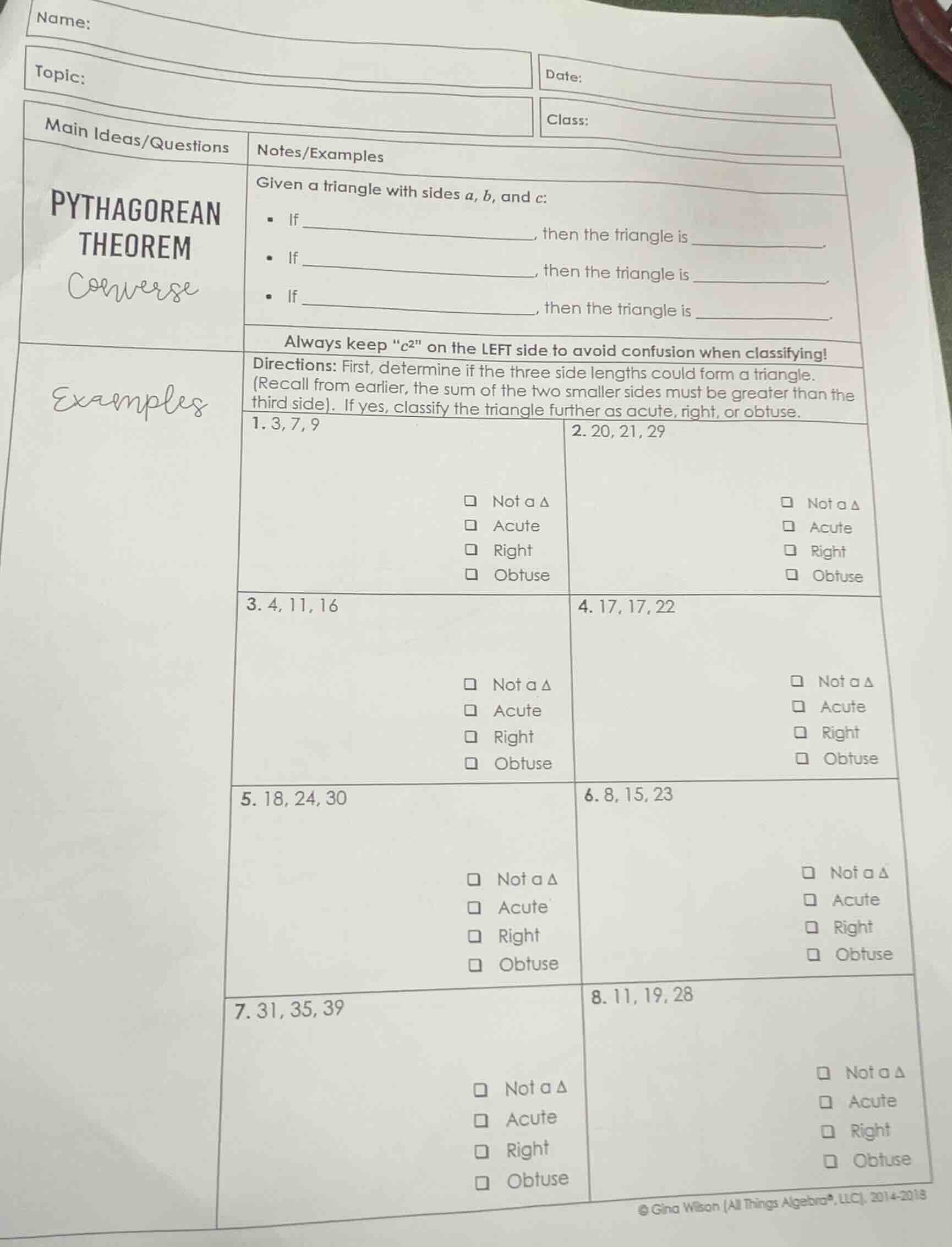
main ideas/questions | notes/examples
pythagorean theorem
converse
given a triangle with sides $a$, $b$, and $c$:
- if _______________________, then the triangle is _____________.
- if _______________________, then the triangle is _____________.
- if _______________________, then the triangle is _____________.
always keep \$c^2$\ on the left side to avoid confusion when classifying!
examples
directions: first, determine if the three side lengths could form a triangle. (recall from earlier, the sum of the two smaller sides must be greater than the third side). if yes, classify the triangle further as acute, right, or obtuse.
- 3, 7, 9
$square$ not a $delta$
$square$ acute
$square$ right
$square$ obtuse
- 20, 21, 29
$square$ not a $delta$
$square$ acute
$square$ right
$square$ obtuse
- 4, 11, 16
$square$ not a $delta$
$square$ acute
$square$ right
$square$ obtuse
- 17, 17, 22
$square$ not a $delta$
$square$ acute
$square$ right
$square$ obtuse
- 18, 24, 30
$square$ not a $delta$
$square$ acute
$square$ right
$square$ obtuse
- 8, 15, 23
$square$ not a $delta$
$square$ acute
$square$ right
$square$ obtuse
- 31, 35, 39
$square$ not a $delta$
$square$ acute
$square$ right
$square$ obtuse
- 11, 19, 28
$square$ not a $delta$
$square$ acute
$square$ right
$square$ obtuse
© gina wilson (all things algebra®, llc), 2014-2018
Step1: Fill Pythagorean Converse Rules
For a triangle with sides \(a, b, c\) (where \(c\) is the longest side):
- If \(c^2 = a^2 + b^2\), then the triangle is right.
- If \(c^2 < a^2 + b^2\), then the triangle is acute.
- If \(c^2 > a^2 + b^2\), then the triangle is obtuse.
Step2: Verify triangle validity first
For 3 side lengths to form a triangle: sum of two smaller sides > longest side. Then use the converse rules.
---
Example 1: 3, 7, 9
Step1: Check triangle validity
\(3 + 7 = 10 > 9\), valid triangle.
Step2: Apply converse rule
\(c=9\), compute \(9^2 = 81\), \(3^2 + 7^2 = 9 + 49 = 58\).
Since \(81 > 58\), \(c^2 > a^2 + b^2\).
Classification: Obtuse
---
Example 2: 20, 21, 29
Step1: Check triangle validity
\(20 + 21 = 41 > 29\), valid triangle.
Step2: Apply converse rule
\(c=29\), compute \(29^2 = 841\), \(20^2 + 21^2 = 400 + 441 = 841\).
Since \(841 = 841\), \(c^2 = a^2 + b^2\).
Classification: Right
---
Example 3: 4, 11, 16
Step1: Check triangle validity
\(4 + 11 = 15 < 16\), does not satisfy triangle inequality.
Classification: Not a Δ
---
Example 4: 17, 17, 22
Step1: Check triangle validity
\(17 + 17 = 34 > 22\), valid triangle.
Step2: Apply converse rule
\(c=22\), compute \(22^2 = 484\), \(17^2 + 17^2 = 289 + 289 = 578\).
Since \(484 < 578\), \(c^2 < a^2 + b^2\).
Classification: Acute
---
Example 5: 18, 24, 30
Step1: Check triangle validity
\(18 + 24 = 42 > 30\), valid triangle.
Step2: Apply converse rule
\(c=30\), compute \(30^2 = 900\), \(18^2 + 24^2 = 324 + 576 = 900\).
Since \(900 = 900\), \(c^2 = a^2 + b^2\).
Classification: Right
---
Example 6: 8, 15, 23
Step1: Check triangle validity
\(8 + 15 = 23\), does not satisfy sum > longest side.
Classification: Not a Δ
---
Example 7: 31, 35, 39
Step1: Check triangle validity
\(31 + 35 = 66 > 39\), valid triangle.
Step2: Apply converse rule
\(c=39\), compute \(39^2 = 1521\), \(31^2 + 35^2 = 961 + 1225 = 2186\).
Since \(1521 < 2186\), \(c^2 < a^2 + b^2\).
Classification: Acute
---
Example 8: 11, 19, 28
Step1: Check triangle validity
\(11 + 19 = 30 > 28\), valid triangle.
Step2: Apply converse rule
\(c=28\), compute \(28^2 = 784\), \(11^2 + 19^2 = 121 + 361 = 482\).
Since \(784 > 482\), \(c^2 > a^2 + b^2\).
Classification: Obtuse
---

Snap & solve any problem in the app
Get step-by-step solutions on Sovi AI
Photo-based solutions with guided steps
Explore more problems and detailed explanations
Pythagorean Converse Fill-Ins:
- If $\boldsymbol{c^2 = a^2 + b^2}$, then the triangle is $\boldsymbol{\text{right}}$.
- If $\boldsymbol{c^2 < a^2 + b^2}$, then the triangle is $\boldsymbol{\text{acute}}$.
- If $\boldsymbol{c^2 > a^2 + b^2}$, then the triangle is $\boldsymbol{\text{obtuse}}$.
Example Classifications:
- Obtuse
- Right
- Not a Δ
- Acute
- Right
- Not a Δ
- Acute
- Obtuse