QUESTION IMAGE
Question
name: travis hobbs
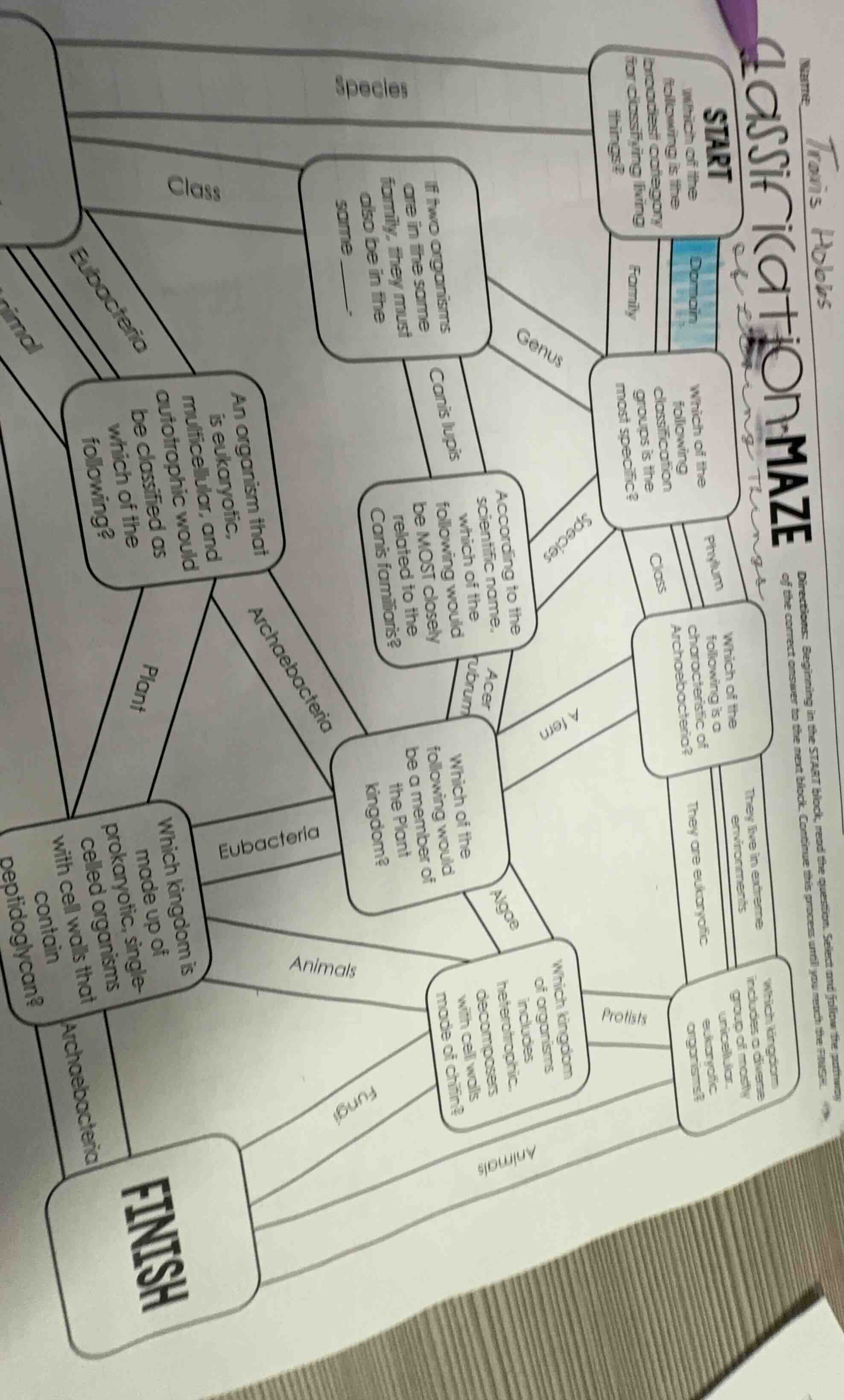
classification maze
directions: beginning in the start block, read the question. select and follow the pathway of the correct answer to the next block. continue this process until you reach the finish.
start
which of the following is the broadest category for classifying living things?
domain family
which of the following classification groups is the most specific?
phylum class species
which of the following is a characteristic of archaebacteria?
they live in extreme environments they are eukaryotic
which kingdom includes a diverse group of mostly unicellular eukaryotic organisms?
which kingdom of organisms includes heterotrophic decomposers with cell walls made of chitin?
protists fungi animals
which of the following would be a member of the plant kingdom?
algae nooe fern
which kingdom is made up of prokaryotic, single - celled organisms with cell walls that contain peptidoglycan?
archaebacteria eubacteria animals
an organism that is eukaryotic, multicellular, and autotrophic would be classified as which of the following?
plant eubacteria animal
if two organisms are in the same family, they must also be in the same ______.
class genus species
according to the scientific name, which of the following would be most closely related to the canis familiaris?
acer rubrum canis lupus acer platanoides
To solve the Classification Maze, we analyze each question and follow the correct paths:
1. First Question (START):
Question: Which of the following is the broadest category for classifying living things?
- Options: Family, Domain
- Explanation: In biological classification, Domain is the broadest (highest) taxonomic rank, broader than Family.
- Path: Take the “Domain” path.
2. Second Question:
Question: Which of the following classification groups is the most specific?
- Options: Phylum, Class, Species
- Explanation: In taxonomy, Species is the most specific rank (organisms in the same species can interbreed).
- Path: Take the “Species” path.
3. Third Question:
Question: According to the scientific name [Canis lupus], which of the following would be MOST closely related to the Canis familiaris?
- Explanation: Scientific names use binomial nomenclature: Genus species. Organisms with the same Genus (e.g., Canis) are more closely related. The genus here is Canis, so follow the “Genus” path.
- Path: Take the “Genus” path.
4. Fourth Question:
Question: If two organisms are in the same family, they must also be in the same ______.
- Explanation: Taxonomic hierarchy: Domain → Kingdom → Phylum → Class → Order → Family → Genus → Species. If two organisms share a family, they must share all higher (broader) ranks (e.g., Class, Phylum, Kingdom, Domain). The path here connects to “Class” (consistent with hierarchy).
- Path: Take the “Class” path.
5. Fifth Question:
Question: An organism that is eukaryotic, multicellular, and autotrophic would be classified as which of the following?
- Explanation: Eukaryotic, multicellular, and autotrophic (makes its own food) describes Plants (Plantae kingdom: eukaryotic, multicellular, autotrophic via photosynthesis).
- Path: Take the “Plant” path.
6. Sixth Question:
Question: Which of the following would be a member of the Plant kingdom?
- Explanation: The Plant kingdom includes organisms like trees, flowers, etc. The path here connects to “Aloe” (a plant) or similar; follow the “Plant” - related path.
7. Seventh Question:
Question: Which kingdom is made up of prokaryotic, single - celled organisms with cell walls that contain peptidoglycan?
- Explanation: Eubacteria (or Bacteria) are prokaryotic, single - celled, and have cell walls with peptidoglycan (Archaebacteria have different cell wall components and live in extreme environments).
- Path: Take the “Eubacteria” path.
8. Eighth Question:
Question: Which kingdom includes heterotrophic decomposers with cell walls made of chitin?
- Explanation: Fungi are heterotrophic (absorb nutrients), decompose organic matter, and have cell walls of chitin.
- Path: Take the “Fungi” path.
9. Final Path to FINISH:
After following the correct taxonomic logic and paths for each question, the final path leads to the “FINISH” block.
The key is to apply taxonomic hierarchy (Domain → Kingdom → Phylum → Class → Order → Family → Genus → Species) and characteristics of each kingdom (e.g., Plantae: eukaryotic, multicellular, autotrophic; Eubacteria: prokaryotic, peptidoglycan cell walls; Fungi: heterotrophic, chitin cell walls) to navigate the maze.
(Note: The exact wording of some questions may vary, but the taxonomic principles remain the same. Follow the path that aligns with biological classification rules at each step.)

Snap & solve any problem in the app
Get step-by-step solutions on Sovi AI
Photo-based solutions with guided steps
Explore more problems and detailed explanations
To solve the Classification Maze, we analyze each question and follow the correct paths:
1. First Question (START):
Question: Which of the following is the broadest category for classifying living things?
- Options: Family, Domain
- Explanation: In biological classification, Domain is the broadest (highest) taxonomic rank, broader than Family.
- Path: Take the “Domain” path.
2. Second Question:
Question: Which of the following classification groups is the most specific?
- Options: Phylum, Class, Species
- Explanation: In taxonomy, Species is the most specific rank (organisms in the same species can interbreed).
- Path: Take the “Species” path.
3. Third Question:
Question: According to the scientific name [Canis lupus], which of the following would be MOST closely related to the Canis familiaris?
- Explanation: Scientific names use binomial nomenclature: Genus species. Organisms with the same Genus (e.g., Canis) are more closely related. The genus here is Canis, so follow the “Genus” path.
- Path: Take the “Genus” path.
4. Fourth Question:
Question: If two organisms are in the same family, they must also be in the same ______.
- Explanation: Taxonomic hierarchy: Domain → Kingdom → Phylum → Class → Order → Family → Genus → Species. If two organisms share a family, they must share all higher (broader) ranks (e.g., Class, Phylum, Kingdom, Domain). The path here connects to “Class” (consistent with hierarchy).
- Path: Take the “Class” path.
5. Fifth Question:
Question: An organism that is eukaryotic, multicellular, and autotrophic would be classified as which of the following?
- Explanation: Eukaryotic, multicellular, and autotrophic (makes its own food) describes Plants (Plantae kingdom: eukaryotic, multicellular, autotrophic via photosynthesis).
- Path: Take the “Plant” path.
6. Sixth Question:
Question: Which of the following would be a member of the Plant kingdom?
- Explanation: The Plant kingdom includes organisms like trees, flowers, etc. The path here connects to “Aloe” (a plant) or similar; follow the “Plant” - related path.
7. Seventh Question:
Question: Which kingdom is made up of prokaryotic, single - celled organisms with cell walls that contain peptidoglycan?
- Explanation: Eubacteria (or Bacteria) are prokaryotic, single - celled, and have cell walls with peptidoglycan (Archaebacteria have different cell wall components and live in extreme environments).
- Path: Take the “Eubacteria” path.
8. Eighth Question:
Question: Which kingdom includes heterotrophic decomposers with cell walls made of chitin?
- Explanation: Fungi are heterotrophic (absorb nutrients), decompose organic matter, and have cell walls of chitin.
- Path: Take the “Fungi” path.
9. Final Path to FINISH:
After following the correct taxonomic logic and paths for each question, the final path leads to the “FINISH” block.
The key is to apply taxonomic hierarchy (Domain → Kingdom → Phylum → Class → Order → Family → Genus → Species) and characteristics of each kingdom (e.g., Plantae: eukaryotic, multicellular, autotrophic; Eubacteria: prokaryotic, peptidoglycan cell walls; Fungi: heterotrophic, chitin cell walls) to navigate the maze.
(Note: The exact wording of some questions may vary, but the taxonomic principles remain the same. Follow the path that aligns with biological classification rules at each step.)