QUESTION IMAGE
Question
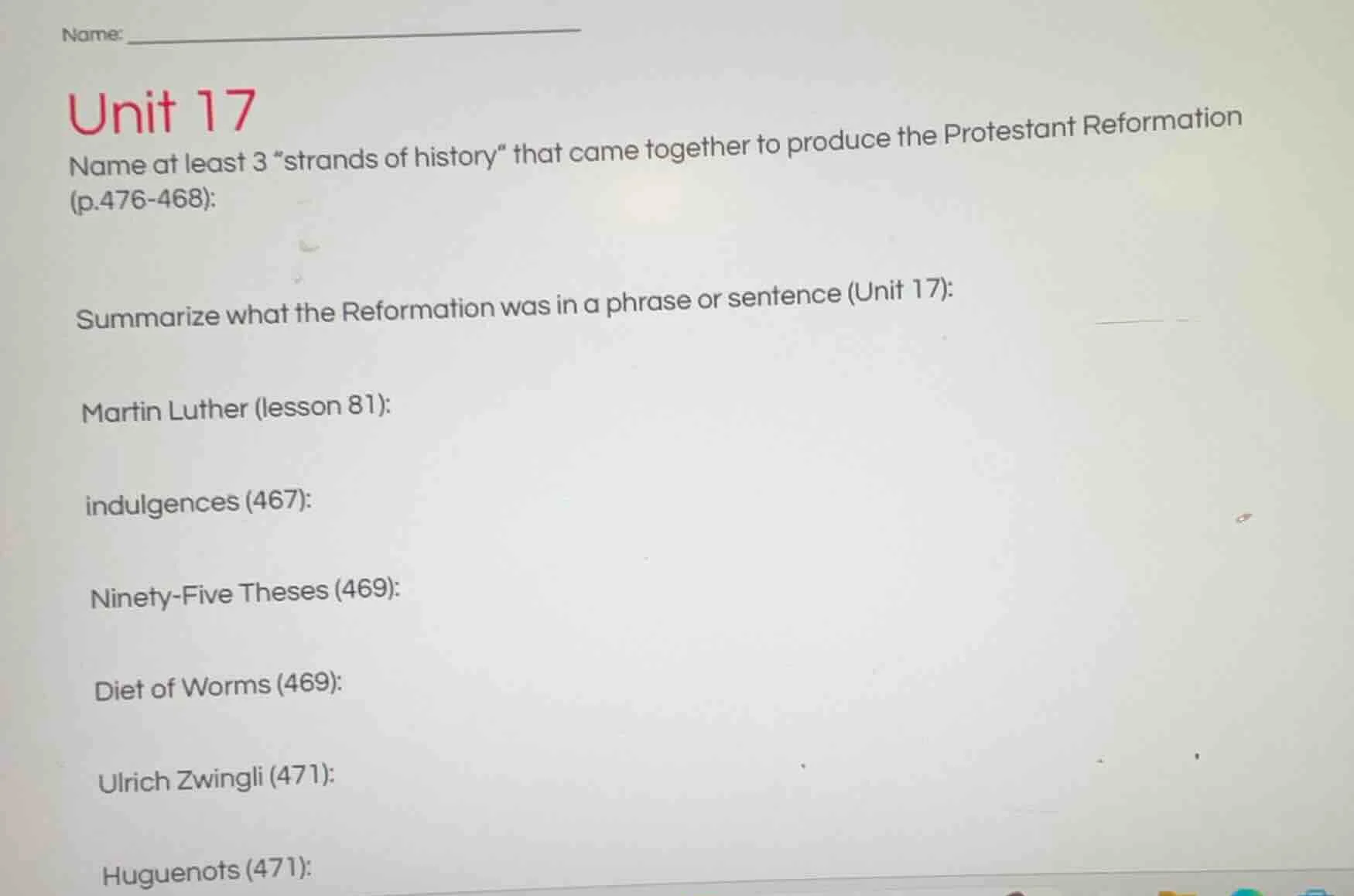
name:
unit 17
name at least 3 \strands of history\ that came together to produce the protestant reformation (p.476-468):
summarize what the reformation was in a phrase or sentence (unit 17):
martin luther (lesson 81):
indulgences (467):
ninety - five theses (469):
diet of worms (469):
ulrich zwingli (471):
huguenots (471):
Brief Explanations
- For the historical strands, these are key preconditions that enabled the Reformation's spread and start.
- The summary captures the core nature of the Reformation as a religious and social split.
- Each term/person is defined by their core role or meaning in the Reformation context.

Snap & solve any problem in the app
Get step-by-step solutions on Sovi AI
Photo-based solutions with guided steps
Explore more problems and detailed explanations
- At least 3 strands of history:
- The rise of Renaissance humanism, which emphasized critical thinking about religious texts and challenged traditional clerical authority.
- Growing dissatisfaction with the Catholic Church's corruption, including simony, nepotism, and the sale of spiritual privileges.
- The invention of the printing press, which allowed rapid spread of reformist ideas across Europe.
- Reformation summary: The Protestant Reformation was a 16th-century religious and social movement that split Western Christianity, challenging Catholic Church authority and establishing new Protestant denominations based on revised theological beliefs.
- Martin Luther: A German monk and theologian who is the foundational figure of the Protestant Reformation, known for his critiques of Catholic Church practices.
- indulgences: A Catholic Church practice where people paid money to the Church to reduce the punishment (temporal purgatorial suffering) for their sins, a key target of Reformation criticism.
- Ninety-Five Theses: A list of 95 arguments against indulgences and other Church practices written by Martin Luther, posted in 1517, which sparked the Protestant Reformation.
- Diet of Worms: A 1521 imperial assembly in Worms, Germany, where Martin Luther was ordered to recant his theological views; he refused, leading to his excommunication and outlawing.
- Ulrich Zwingli: A Swiss theologian and leader of the Protestant Reformation in Switzerland, who developed his own distinct theological reforms separate from Luther's.
- Huguenots: French Protestant followers of Calvinist theology, who faced severe persecution in France during and after the Reformation.