QUESTION IMAGE
Question
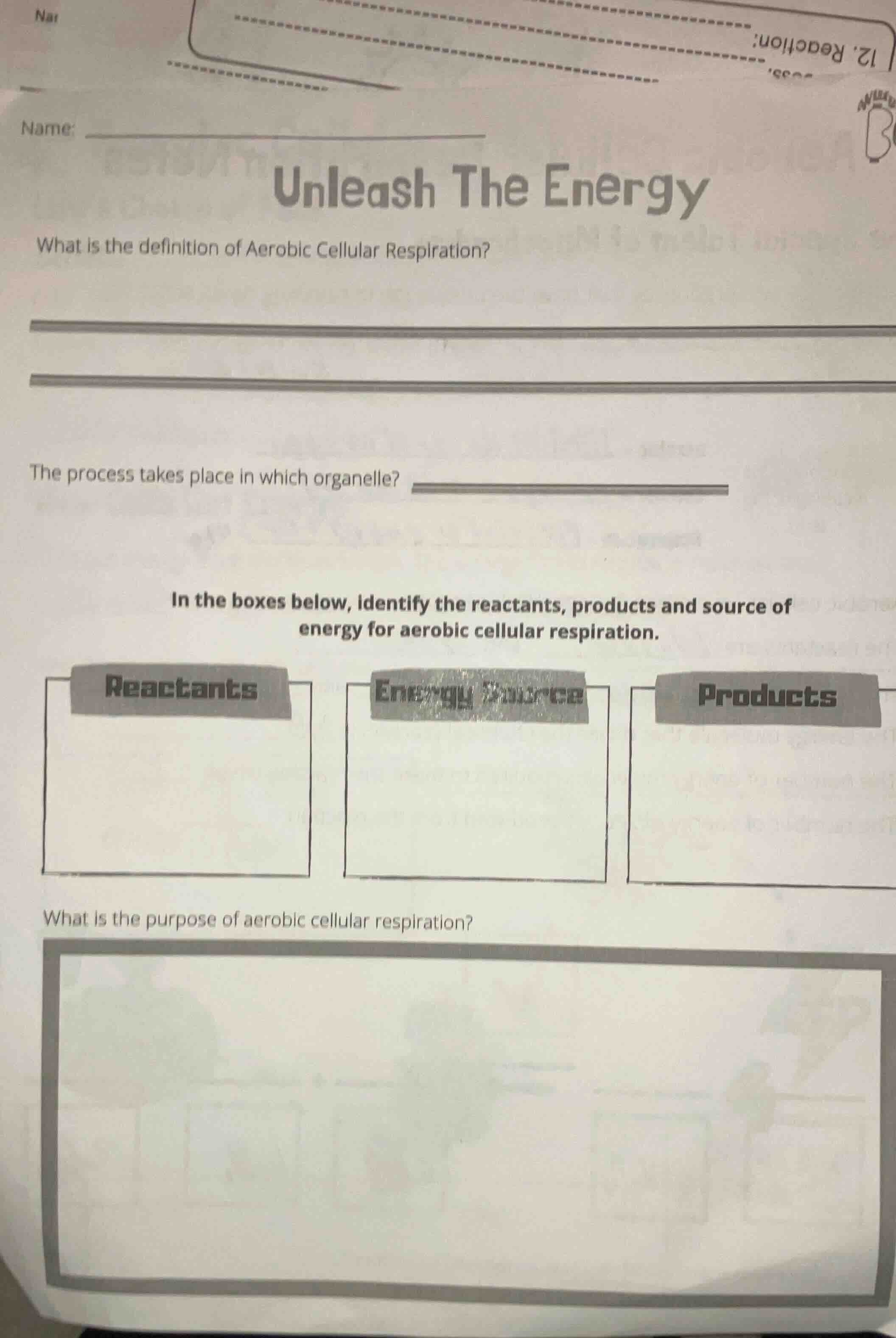
name:unleash the energywhat is the definition of aerobic cellular respiration?the process takes place in which organelle?in the boxes below, identify the reactants, products and source of energy for aerobic cellular respiration.reactantsenergy sourceproductswhat is the purpose of aerobic cellular respiration?
Brief Explanations
- Definition: Aerobic cellular respiration is a core biological process that uses oxygen to break down glucose.
- Organelle: The process relies on the mitochondria's specialized structures.
- Reactants/Products/Energy: Glucose and oxygen drive the reaction, which produces waste products and captures energy in ATP.
- Purpose: The process generates usable energy for all cellular functions.

Snap & solve any problem in the app
Get step-by-step solutions on Sovi AI
Photo-based solutions with guided steps
Explore more problems and detailed explanations
- Definition of Aerobic Cellular Respiration: Aerobic cellular respiration is the oxygen-dependent process by which eukaryotic cells break down glucose (and other organic molecules) to produce usable cellular energy, releasing carbon dioxide and water as byproducts.
- Organelle where the process takes place: Mitochondria
- Reactants, Energy Source, and Products:
- Reactants: Glucose ($\text{C}_6\text{H}_{12}\text{O}_6$) and Oxygen ($\text{O}_2$)
- Energy Source: Chemical energy stored in glucose
- Products: Carbon dioxide ($\text{CO}_2$), Water ($\text{H}_2\text{O}$), and Adenosine Triphosphate (ATP)
- Purpose of aerobic cellular respiration: To convert the chemical energy stored in glucose molecules into a readily usable form (ATP) that powers all essential cellular activities, such as growth, movement, and metabolic processes.