QUESTION IMAGE
Question
names: devon nush
instructions: the purpose of this assignment is to apply your neuroscience knowledge! please complete items 1 - 6 as a group. you may use your notes.
- please describe neuroscience in your own words. then, state how this area of study might contribute to our understanding of mental processes and behavior.
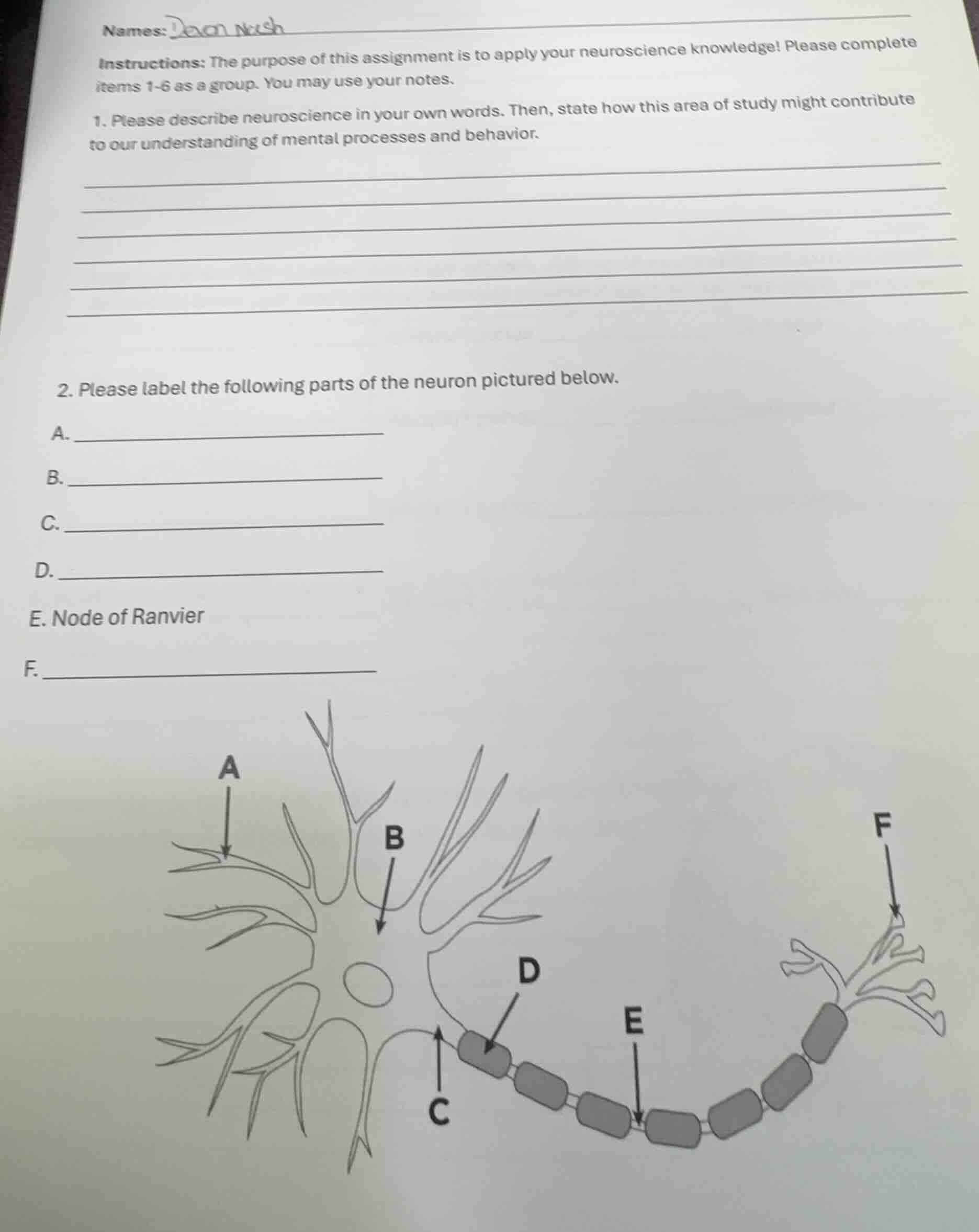
- please label the following parts of the neuron pictured below.
a.
b.
c.
d.
e. node of ranvier
f.
(neuron diagram with labels a, b, c, d, e, f)
Brief Explanations
- For question 1: Neuroscience is the study of the nervous system (brain, spinal cord, neurons) and how its structure and activity relate to bodily functions, thoughts, and actions. By examining how neural pathways, chemical signals, and brain regions work, it explains how physical brain activity creates mental processes like memory, decision-making, and emotion, and links these to observable behaviors (e.g., how a damaged prefrontal cortex impairs impulse control).
- For question 2:
- A: Dendrites are branch-like structures that receive signals from other neurons.
- B: The cell body (soma) contains the neuron's nucleus and controls its basic functions.
- C: The axon is the long fiber that carries electrical signals away from the cell body.
- D: Myelin sheath is the fatty layer that insulates the axon to speed up signal transmission.
- F: Axon terminals are the branched ends of the axon that release chemical signals to communicate with other cells.

Snap & solve any problem in the app
Get step-by-step solutions on Sovi AI
Photo-based solutions with guided steps
Explore more problems and detailed explanations
- Neuroscience is the interdisciplinary study of the nervous system (including the brain, neurons, and neural pathways) that explores how these structures generate biological signals, process information, and interact with the body. This field helps explain mental processes (like memory, attention, and emotion) by linking them to specific neural activity or brain region function; for example, showing how the hippocampus supports memory formation. It also clarifies behaviors by revealing how neural chemistry (such as serotonin levels) or brain damage (like stroke-related tissue loss) alters actions, thoughts, and responses to the environment.
2.
A. Dendrites
B. Cell Body (Soma)
C. Axon
D. Myelin Sheath
F. Axon Terminals